

A Fijian academic believes the government’s coalition partners could pose the biggest threat in the next general election.
Fiji is set to head to the polls later this year.
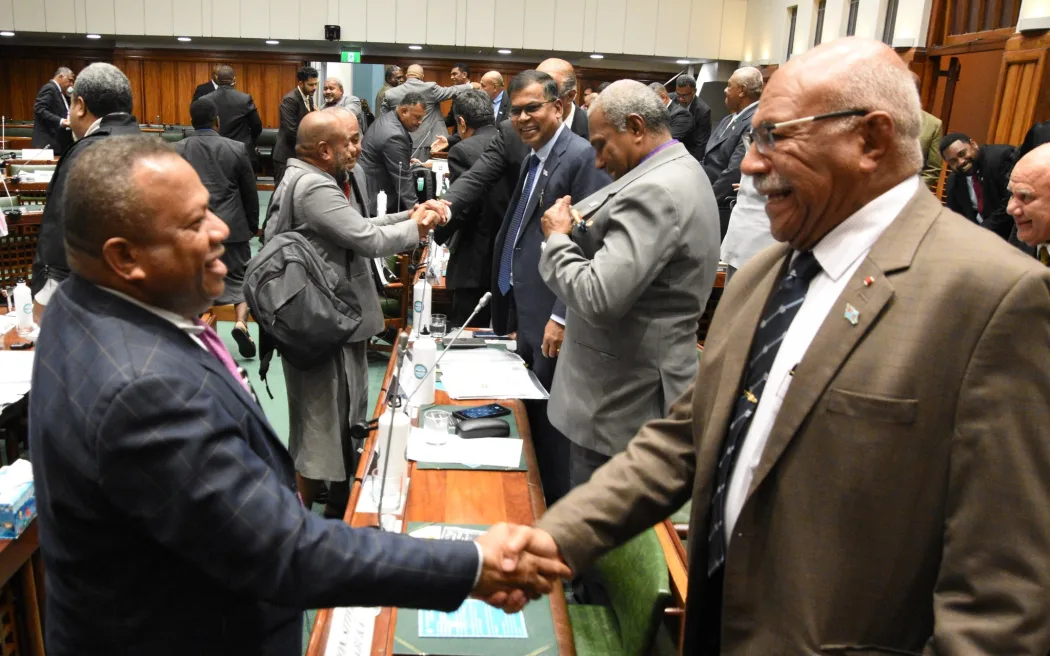
Prime Minister Sitiveni Rabuka’s People’s Alliance Party (PAP) is the ruling party alongside the Social Democratic Liberal Party (Sodelpa) and the National Federation Party (NFP).
Rabuka has also managed to coalesce the support of a dozen opposition MPs from the former FijiFirst Party to build a 40-member strong government side in the 55-member parliament.
Jope Tarai, a scholar at the Australian National University, told RNZ Pacific that the Prime Minister should watch them closely.
“They’ve (Sodelpa and NFP) been in the centre of the machinery of government, they’ve gotten full air time and they’ve gotten access. So, in that regard, the main opposition rival would probably come from those two parties, given the advantage of incumbency,” he said.
Tarai believes PAP had been “brutal” towards its coalition partners in the past, which could have built resentment.
“If PAP is not careful, parties that have been humiliated, NFP, Sodelpa, and Unity Fiji (another opposition party not in parliament) as well … this could give them a reason to unify against PAP, and that could be a different dynamic all together,” he said.
Going against the flow is Fiji’s Opposition leader, who tried to get convicted former Prime Minister Frank Bainimarama’s support to contest the election.
Inia Seruiratu told Pacific Waves that he wanted to carry on the legacy of the now deregistered FijiFirst, but Bainimarama did not play ball.
The former FijiFirst MP has since cut ties with the ex-military chief and rebranded the defunct party under the name of People First.
“We have to rebrand, not only as former FijiFirst politicians but of course the opposition as well. The opposition plays a very key role in democratic government but unfortunately there is a lot of animosity, a lot of party politics,” he said.
Bainimarama seized power in a military coup in 2006. He deposed the then democratically elected late Prime Minister Laisenia Qarase and took on the top job under an interim administration in 2007.
However, Fiji returned to democracy in 2014 and Bainimarama’s FijiFirst swept to victory in the first general election in eight years.
Seruiratu has defended FijiFirst, despite its leader’s 16-year rule being described by the current administration as a “dictatorship”.
“How do you define a dictatorship? FijiFirst won two consecutive elections. FijiFirst did a lot for Fiji in terms of raising the living standards, the state of the economy and of course our regional and international connections,” Seruiratu said.
He admits his People First party – approved as the country’s newest political part in November last year – has no manifesto and a lot of work to do. But is hopes to draw support from Fiji’s Western Division, which was previously a FijiFirst stronghold, from Indo-Fijians.
He said the party is pro multiracialism and secularism and will ensure half of its candidates are women.
“It’s about Fiji, we will one day finish [in politics] but what is it that we leave behind for our children? We need to create a better place for Fijians, not only for a few”, Seruiratu said.
Tarai insists that the coalition partners have key portfolios and strong visibility, despite the plight of the former co-Deputy Prime Minister Biman Prasad.
The former Finance Minister and current NFP leader resigned last October after facing corruption charges.
Prasad was charged with allegedly failing to declare his directorship in hotel ventures as required under the Political Parties Act.
Sodelpa’s leader Aseri Radrodro was dumped from Cabinet in January 2024 after an alleged drug and sex scandal with the then Minister for Women, Children and Social Protection, Lynda Tabuya.
Fijileaks, a blog site, known for breaking news about political corruption, had released explosive allegations of an extramarital affair between the two while they were on official business in Australia. Both Radrodro and Tabuya denied have rejected the allegations.
Radrodro was reinstated to the role of Education Minister three months later.
Tarai said Radrodro’s portfolio is key to attracting young voters, who have historically avoided the ballot box.
“While the Prime Minister is involved in high-stakes legal constitutional challenges, these parties are engaging in work where they are visible to up and coming voters and various everyday people,” he said.
Tarai feels there is growing support and sympathy for the former co-Deputy Prime Minister Manoa Kamikamica, who stepped down a week before Prasad after facing corruption charges.
Kamikamica has been charged by the Fiji Independent Commission Against Corruption (FICAC) with perjury and providing false information to a public servant.
Tarai said Rabuka’s nephew, Filimoni Vosarogo, the Minister for Lands and Mineral Resources, is definitely a candidate for the top job.
Vasarogo has stood in as acting prime minister while Rabuka was on official travel.
“He represented the PM legally in 2018 in terms of his [court] cases, he has a particular public persona that fits the conservative frame of the populous and he’s getting more and more of the roles that gain him public relations,” Tarai said.
Political commentators have questioned whether the son of Fiji’s first prime minister, High Chief Ratu Tevita Mara, aka Roko Ului, will step into politics in the future.
However, Roko Ului hails from Lau, a province in the eastern division with the lowest number of registered voters.
“What is perceived in the legacy of his late father (Ratu Sir Kamisese Mara) was under a different electoral system, so in that regard it’s going to take a lot of work,” Tarai said.
Roko Ului, a former military general, fled to Tonga in 2011 and went into exile after the then Prime Minister Bainimarama wanted him tried for treason.
The royal family sheltered him in their Nuku’alofa palace, where he worked as an advisor to King Tupou VI.
The Bainimarama administration banned him from re-entering Fiji – something that only became possible after Rabuka’s government came into power in December 2022.
Meanwhile, Tabuya, now the information, environment and climate change minister, was the fourth-highest polling MP in the 2022 general election, behind Rabuka, Bainimarama and the former Attorney-General Aiyaz Sayed-Khaiyum.
She was sacked then reinstated to Cabinet after a private video of her dancing naked was leaked online and went viral in December 2024.
Tarai said given the scandal, he doubted PAP would promote her.
“Given the internal party tensions I would be very surprised if she gets put forward, knowing full well that there are underlying hushed issues as well within the coalition,” he said.
Fiji is expected to head to the polls anytime between 07 August this year and 07 February in 2027. Eight political parties have registered to contest the general election so far.
Aside from the three coalition government parties the list includes the Fiji Labour Party, People First, All People’s Party, We Unite Fiji Party, and Unity Fiji.