

By Pita Ligaiula in Manila, Philippines
Pacific tuna stocks remain healthy and stable despite record-high catches in 2024, according to a major scientific update delivered to WCPFC22, but sharp warnings over billfish and shark declines highlighted the pressures facing the world’s largest tuna fishery.
Presenting the 2024 Stock Status and Fisheries Update to the Western and Central Pacific Fisheries Commission (WCPFC), SPC scientist Paul Hamer laid out a mixed picture with booming catches, stable stock conditions for major tuna species, and early signs of recovery for some shark populations but persistent depletion of oceanic whitetip and serious uncertainty around billfish.
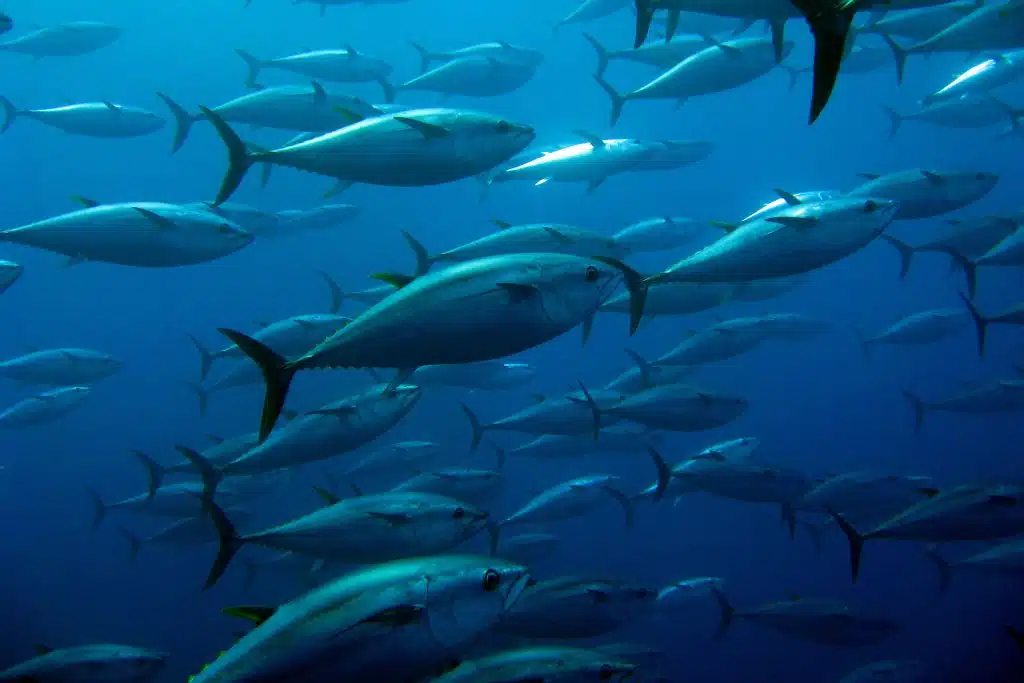
Hamer told delegates that 2024 produced the highest total tuna catch ever recorded in the WCPO — 3.059 million tonnes, a 15 percent jump from 2023. Skipjack catches alone hit 2.046 million tonnes, also a record.
“The purse seine fishery remains the dominant gear accounting for 70 percent of the total catch,” he said, noting a major spike in free-school sets that drove the increase.
He added that “2024 provisional total catch value [is] approx USD$5.6 billion.”
The core message from SPC’s 2024 assessments was clear that Skipjack, yellowfin, bigeye and South Pacific albacore are all not overfished and not undergoing overfishing.
For skipjack the backbone of the billion-dollar fishery, Hamer said: “The recent median stock depletion Spawning Biomass (SBrecent)/SBF=0 = 0.51… there is zero probability of breaching the limit reference point (LRP)… Stock is not overfished or undergoing overfishing.”
Yellowfin and bigeye, often the focus of management tension, are also stable.
For bigeye, “The recent median stock depletion SBrecent/Spawning Biomass with zero fishing (SBF)=0 = 0.35…Stock is not overfished or undergoing overfishing.” Hamer said.
South Pacific albacore — the fishery now under intense negotiation at WCPFC22 — also remains within safe biological limits.
“The recent median stock depletion… is close to the interim TRP… Stock is not overfished or undergoing overfishing.”
The strongest warnings in SPC’s presentation came for species outside the four main tuna stocks.
On oceanic whitetip already banned from retention Hamer said the stock “remains in a severely depleted state,” despite signs of slow rebuilding.
“Recent biomass… showed a subtle increase… from 4 percent of unfished biomass to 6 percent in recent years…” he reported but stressed that the species remains the most threatened among WCPFC-assessed sharks.
Billfish assessments also raised concern, particularly the politically sensitive Southwest Pacific striped marlin.
“The assessment has high uncertainty… likely overfished, unlikely to be undergoing overfishing.” Hamer noted.
SPC’s analysis showed how climate variability shaped fishing patterns.
Neutral to La Niña conditions in 2024 drove purse seine effort westward toward PNG and Solomon Islands and boosted the success of free-school sets. This resulted in a “notable increase in unassociated sets in 2024,” Hamer said.
That shift reduced bigeye catch in the purse seine fishery — a relief for managers concerned about juvenile bigeye mortality in FAD-associated sets.
Despite the positive picture for the main tuna stocks, SPC scientists stressed that sustained high catches require continued adherence to harvest strategies, climate-responsive management and vigilance across fleets.
“Tuna stock status: in the green and close to TRPs for all four target species… Oceanic whitetip shark – severely depleted, but reduced fishing mortality, some signs of recovery.” said Hamer said.
As WCPFC22 grapples with the politically charged adoption of a harvest strategy for South Pacific albacore, SPC’s scientific update delivered a strong reminder that the region’s tuna resources remain strong, but only careful, science-driven management will keep them that way.