


By Pita Ligaiula in Manila, Philippines
The Global Tuna Alliance (GTA) is urging governments heading into the Western and Central Pacific Fisheries Commission (WCPFC22) meeting in Manila to back a Pacific-driven plan to secure the future of South Pacific albacore, warning that delay will “prolong uncertainty and weaken trust” in the region’s tuna management.
In a strong call to action, the alliance of major retailers and supply-chain companies said WCPFC members have “a rare opportunity to secure a predictable future for South Pacific albacore and set a benchmark for science-based management across the Pacific.”
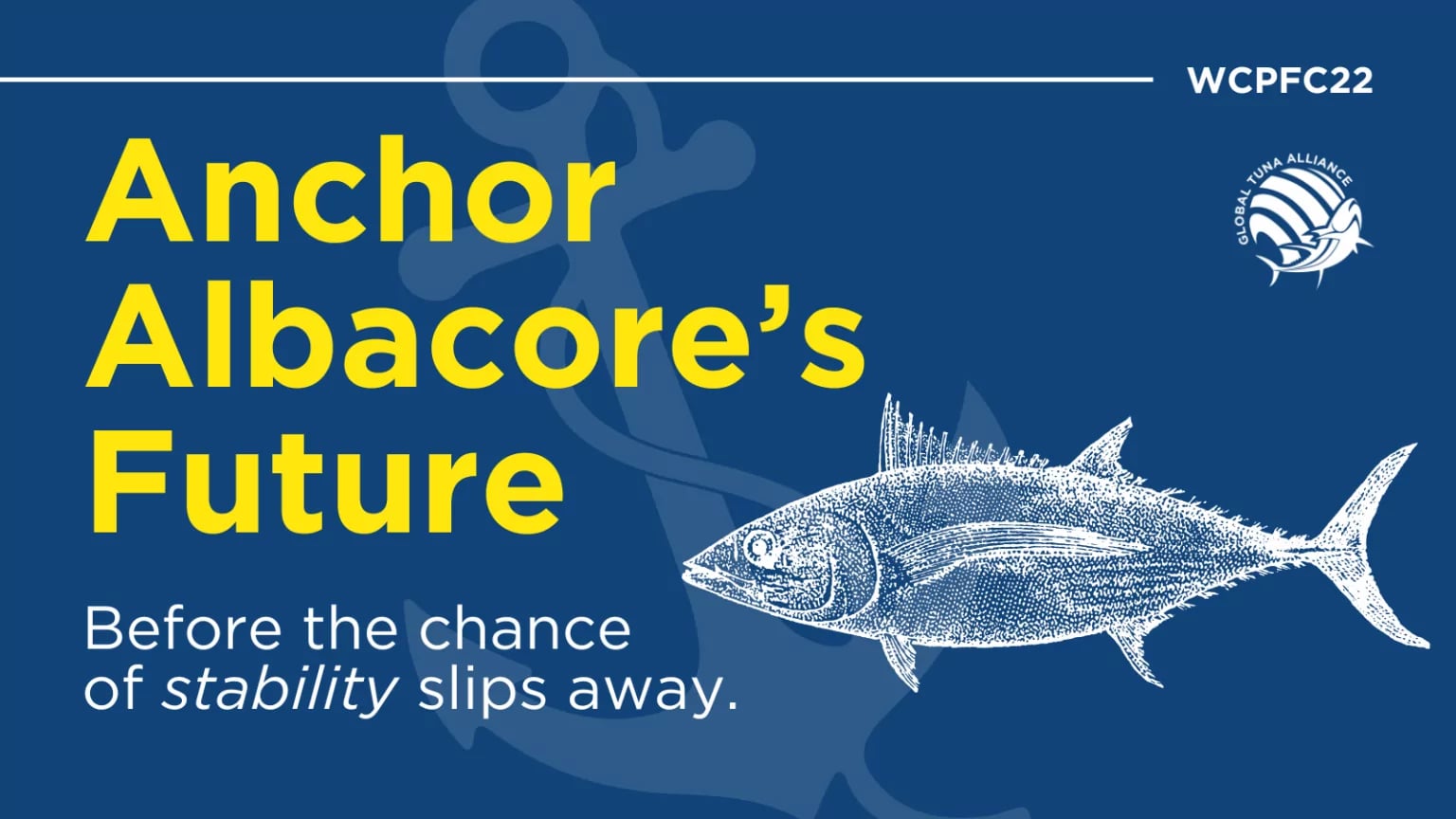
“Through ‘Anchor Albacore’s Future’, we’re highlighting why adoption matters now,” the GTA said.
“Delaying action would prolong uncertainty, weaken trust in the Commission’s harvest strategy commitments and increase risk for markets that rely on stable, well-managed fisheries.”
Governments from across the world will gather in Manila in early December for WCPFC22, where rule-setting decisions on quotas and management plans for tuna across half the planet will be made.
South Pacific albacore is expected to dominate talks this year.
Pacific Island nations, working through the Forum Fisheries Agency (FFA), have tabled a comprehensive Management Procedure (MP) and an allocation measure designed to bring long-term stability to a fishery trapped in “boom and bust” cycles.
The GTA said its partners including 41 major global retailers and suppliers — support the FFA plan.
“Their message is consistent: stability and predictability are essential for ongoing market confidence and access,” the alliance said.
According to the GTA, the FFA’s proposal would:
*Provide predictability: A stable, evidence-based long-term framework supports planning and investment.
*Protect trust: Adoption aligns with certification requirements, supporting continued market access.
*Show leadership: It demonstrates the WCPFC’s ability to deliver on its harvest strategy commitments.
*Build momentum: A successful outcome here strengthens confidence for other tuna species and fisheries to follow.
As part of its 2025 WCPFC position, the GTA is calling for members to:
*Adopt the full FFA proposed management procedure and complementary implementing CMM for South Pacific albacore (SPA) tuna.
*Adopt Target Reference Points (TRPs) for bigeye tuna (BET) and yellowfin tuna (YFT).
*Strengthen labour standards for crew.
*Mandate progress toward 100 percent observer coverage, including electronic monitoring.
*Eliminate unmonitored high-seas transshipment.
*Strengthen bycatch and FAD management measures, including seabird protection and shark-fin-attached rules.
The GTA said current longline observer coverage at a minimum of 5 percent is “inadequate” and undermines accurate reporting and bycatch estimates.
“Set a progressive target to increase observer coverage … working towards 100 percent coverage across all industrial tuna fisheries,” it said.
It also backed FFA’s proposal for the albacore zone south of 10°S, including 10 percent human observer coverage by 2027 and 30 percent monitoring coverage by 2030.
On transhipments, the GTA said unmonitored activity “must be eliminated.”
“We urge the Commission to strengthen current regulation by treating high seas transshipment as a prohibited activity unless specific and restrictive criteria for determining ‘impracticability’ are rigorously implemented.”
The alliance called for updated seabird mitigation, noting that areas between 25°S and 30°S are critical for threatened species such as the Antipodean albatross.
It also urged:
*Mandatory “fins naturally attached” rules for sharks
*Science-based limits on FAD numbers
*A timeline for 100 percent biodegradable FADs
*Better FAD tracking and recovery measures
With both Pacific nations and market players aligned, the GTA said the Commission has a clear path forward.
“With alignment from the region and the market, members have a rare opportunity to secure a predictable future for South Pacific albacore,” it said. “The time to Anchor Albacore’s Future is now.”