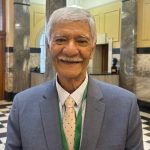
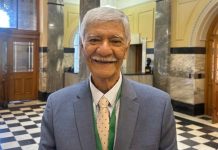
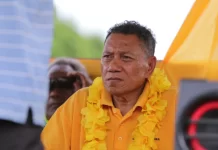
Tuvalu’s Minister for Transport, Energy, Communications and Innovation, Simon Kofe, has delivered a blunt message ahead of the Extraordinary Session of the International Maritime Organisation’s (IMO) Marine Environment Protection Committee (MEPC) — the world can no longer afford delays in protecting vulnerable nations from the climate crisis.
“At the close of MEPC 83 at the International Maritime Organisation (IMO), Tuvalu and our 6PAC+ allies abstained. That choice was not a retreat, but a message.
We could not endorse a framework that delayed justice and left vulnerable nations unprotected. Abstention was the only way to register our profound disappointment in both the process and the outcome,” Kofe said.
“But disappointment is not defeat. The Pacific adapts, but we do not give up. We return to London with six submissions that set out a clear course for this institution to follow,” he stressed.
Kofe said Tuvalu’s proposals ahead of the extraordinary session are designed to push the IMO toward a just and equitable transition that reflects the urgency of the climate crisis and the reality faced by Small Island Developing States (SIDS) and Least Developed Countries (LDCs).
Kofe said Tuvalu’s first submission (MEPC ES.2-2-13) proposes key amendments to the IMO’s adopting resolution.
“We propose essential additions to the IMO’s adopting resolution to ensure it reflects the commitments already made by Member States.
We seek consistency with international law, the Paris Agreement, and the IMO’s own 2023 Strategy — so that the resolution upholds the principle of a just and equitable transition and recognises the particular vulnerabilities of Small Island Developing States (SIDS) and Least Developed Countries (LDCS),” he said.
On Tuvalu’s second submission (MEPC ES.2-3-3), Kofe said the Net-Zero Fund a crucial mechanism to support developing countries in decarbonising maritime industries must become operational far earlier than planned.
“We call for the Net-Zero Fund to be operational by 2026 not 2029. The current timeline leaves developing countries without the readiness finance needed to prepare for the transition.
We also urge the IMO to recognise food security as a critical part of the disproportionate negative impacts faced by vulnerable economies. The Fund must be built to leave no country behind,” he said.
He warned that waiting until 2029 “is unconscionable.”
“Delaying until 2029 risks billions in lost support — billions that should already be building resilience and a just transition,” Kofe said.
On the structure of the Net-Zero Fund, Kofe said equity must be built into its foundation.
“Justice must be written into its design. We propose an equal split on the Board: seven seats each for SIDS and LDS; developing countries; and developed countries. That is how equity becomes real,” he said.
Kofe also called for the IMO to ensure that only genuinely clean fuels qualify under the Net-Zero Framework.
“Only scalable, truly clean solutions should qualify. Scarce resources must not be wasted on false options that buy more years for fossil fuels. We cannot risk locking in fuels that compromise the environmental integrity of the Net-Zero Framework, slow the energy transition, and endanger food security,” he said.
Citing the latest global temperature data, Kofe highlighted the urgency for real action.
“The evidence is clear. 2024 was the first year the planet stayed above 1.5 °C for twelve consecutive months.
The IPCC made it clear in 2018 that 1.5 °C is a dangerous threshold — not just for Pacific Islands, but for the planet as a whole. In Tuvalu, we already feel the impact: the land we call home is disappearing under our feet,” he said.
“While larger, wealthier nations debate the threat to livelihoods, Pacific Island nations are forced to consider the threat to lives and to statehood itself. That is the scale of what is at stake.”
Kofe said Tuvalu’s abstention at MEPC 83 was not an act of disengagement, but a clear signal of the Pacific’s determination to hold the world to account.
“We are here to lead high ambition, as we always have. Our abstention at MEPC 83 was a signal: Tuvalu will not rubber-stamp weak outcomes. At this Extraordinary Session, we call on every delegation to set a course toward a just and equitable transition. This is about more than shipping. It is about survival,” Kofe said.
“The IMO must find the courage to deliver this time,” said Kofe.