

Home Blog Page 980

DPP files application to restrain Russian super yacht Amadea from leaving Fiji

Fiji’s Director of Public Prosecutions, Christopher Pryde has filed an application seeking orders that the Russian superyacht Amadea be restrained from leaving Fijian waters.

This is until the finalisation of an application to register a warrant to seize the property and that a U.S warrant to seize the Amadea be registered.

The ODPP filed an ex parte Originating Summons under the Mutual Assistance in Criminal Matters Act in the High Court Tuesday.

The court is yet to give a date for hearing the DPP’s application.

Amadea is being investigated for possible breaches of Fiji’s Exclusive Economic Zone and money laundering.

Commissioner of Police Brigadier-General Sitivenu Qiliho told FBC News their U.S counterparts have made submissions to the government through Attorney General Aiyaz Sayed-Khaiyum regarding the proceedings of the investigation.

The yacht, owned by Russian billionaire Suleiman Kerimov berthed at the Lautoka Wharf last Wednesday and has been seized by police.

The crew of the Amadea remain on board and are not allowed to disembark as the investigation continues.

SOURCE: FBC NEWS/PACNEWS

Commitments announced during 7th Our Ocean Conference

Actions from Denmark, the United States, and the Marshall Islands doubled the number of signatories to the Declaration on Zero Emission Shipping by 2050.

Actions in the form of new plans to develop zero-emission shipping routes in Europe, Latin America, and Asia.

Many nations to commit new resources to the fight against IUU fishing, with nearly US$250 million pledged via policy, governance, on-the-water assets, technical assistance, and innovative forms of monitoring and traceability.

United States brings together 21 agencies with an integrated, government-wide response to IUU fishing globally under the Maritime Security and Fisheries Enforcement Act.

United Kingdom increased their target for offshore wind deployment to deliver 50 GW by 2030, with an ambition for 5 GW to be from floating offshore wind.

Actions to support the development of upgraded fisheries and aquaculture value chains, with the European Union and the United Kingdom both committing more than $130 million each to domestic improvements, while the UN Food and Agriculture Organization alone is providing $53 million to fund such work with a focus on Small Island Developing States.

Australia announced US$700 million to protect the Great Barrier Reef.

The Australian Government has committed to a $20 million investment to improve data integration and electronic vessel monitoring systems supporting near real-time, evidence-based decision-making for fisheries management.

Australia announced an additional US$10 million to support the third phase of the community-based fisheries management program from 2021 to 2025. The third phase continued support for scaling up community-based fisheries, and fisheries management in Solomon Islands cannabis and Vanuatu.

The Green Climate Fund announced an anchor commitment of up to US$125 million, implemented by Pegasus Capital Advisors to fight coral reef degradation.

The Republic of Korea announced US$100 million per year to address the scourge of plastic pollution.

The United States announced more than US$160 million to support coastal resilience through the National Coastal Resilience Fund.

United States announced more than 100 commitments worth more than US$2.6 billion, including contributions from at least 13 departments and agencies. Because protecting our ocean is an “all-hands-on-deck” effort.

‘Palau committed to join the RRAA, joining the ocean Risk and Resilience Action Alliance a first full SIDS member.

It supported the Declaration on zero-emission shipping by 2050 and pledged to work together to strengthen global efforts to achieve zero emissions for the international shipping by 2050 at the IMO.

Lastly, Palau will support the Clydebank declaration, pledging to work together to establish zero-emission maritime routes known as the Green corridors. Too often, we overlook the impact of shipping emissions, which are significant and rising, said President Surangel Whipps Jr.

A total of 410 commitments were made worth US$16.35 billion at the 7th Our Ocean Conference in Palau.

SOURCE: ISLAND TIMES/PACNEWS

U.S calls on Australia to increase 2030 emission reduction pledge to help prevent ‘greater destruction’

The U.S will urge Australia to increase its 2030 emission reduction pledge this year, with a senior official declaring it was “a long time ago” when the Abbott government set the target the Morrison government says is “fixed”.

The assistant U.S secretary of state for environmental affairs, Monica Medina, said the U.S was “determined that everyone raise ambition” in tackling the climate crisis in a bid to avoid “greater destruction”.

In an interview with Guardian Australia from Palau in the western Pacific, where she attended an oceans conference, Medina signalled that the U.S was particularly focused on countries that did not commit to deeper cuts at the climate summit in Glasgow late last year.

“We’re calling on every country that didn’t increase their target to raise it,” she said when asked whether Australia should lift its 2030 target this year.

“We have to stay within 1.5 degrees [of heating]. Every tenth of a degree above that leads to greater disruption, greater destruction, and we can’t get those back.”

Medina said Pacific island countries continually raised climate as the most important issue on their agenda because it was “an existential threat”, and she said reefs including the Great Barrier Reef were “incredibly vulnerable”.

Medina works closely with Joe Biden’s special presidential envoy for climate, John Kerry, who said last week the latest assessment of the Intergovernmental Panel on Climate Change “demands that we act sooner, quicker, faster, bigger than we are”.

Australia is one of the countries that did not increase its 2030 target at the Cop26 summit in Glasgow in November, sticking with the Abbott-era 26% to 28% cut in greenhouse gas emissions against 2005 levels.

Amid internal divisions within the Coalition, Australia submitted a document to the UN that “reaffirmed” that target, while touting projections the country was “on track” to reduce emissions by up to 35 percent.

Australia is expected to face increased diplomatic pressure to formally commit to deeper cuts this year, because the Glasgow decision urged countries to “revisit and strengthen” their 2030 targets by the end of 2022 to align them with the Paris agreement’s temperature goals.

Just hours after Australia signed up to that Glasgow decision, ministers Marise Payne and Angus Taylor issued a statement declaring Australia’s 2030 target “is fixed and we are committed to meeting and beating it”.

The Labor leader, Anthony Albanese, has pledged to set a 2030 emissions reduction target of 43% on 2005 levels if he wins the election, arguing the Coalition’s existing policies leave Australia sitting “in the naughty corner” at climate conferences, and corrode trust among Pacific countries.

The Australian Greens want to reduce Australia’s emissions by 75 percent by 2030 and phase out coal and gas.

In the interview, Medina avoided wading into Australian domestic politics or the current election campaign, and was careful to express the US position as applying to all countries that didn’t commit to deeper cuts last year.

But when pressed on the fact the Australian formal target remained at the level it was when first set in 2015, Medina said that was “a long time ago – everyone needs to raise their ambition”.

Medina, who is responsible for the state department’s bureau of oceans and international environmental and scientific affairs, reiterated the Biden administration regarded the climate crisis as “a high priority in all our diplomatic engagements”.

Medina said it was important the Our Ocean conference – co-hosted by Palau and the U.S last week – was held in a Pacific island country “on the leading edge of the climate crisis”.

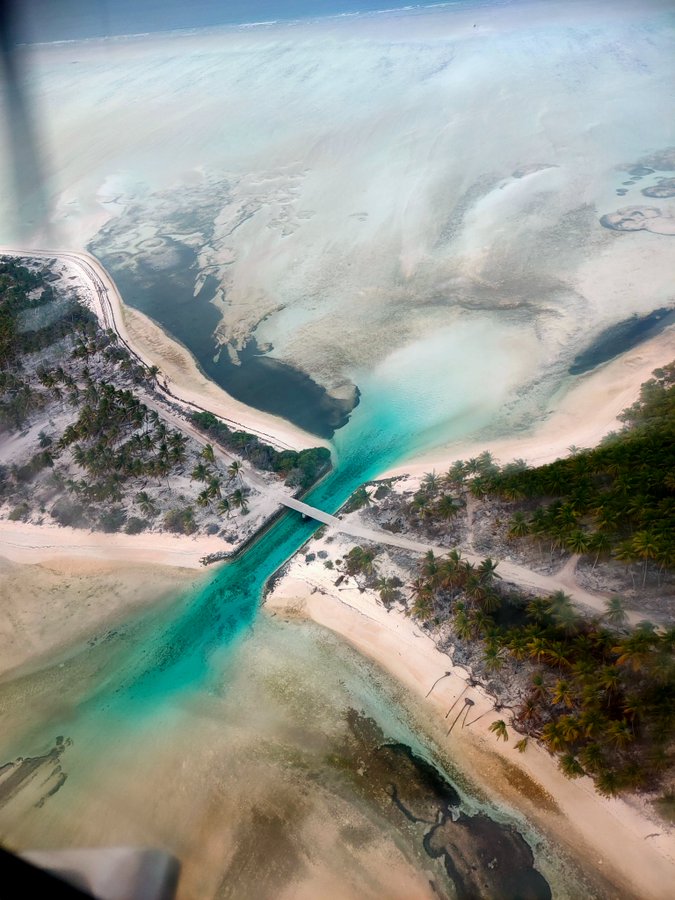
“The hospital here on Palau is on the other side of a causeway and when there’s a big storm the causeway floods and people can’t get to the hospital,” she said.

“When we talk to Pacific island nations they all talk about climate change as the most important thing that they have on their agenda to work with us on … and we can see it with our very eyes.”

Medina said Pacific island countries were not the big emitters, “but they can be both a place for solutions and for innovation”.

The Great Barrier Reef has been hit with a sixth mass coral bleaching event, the marine park’s authority confirmed last month.

“We know that coral reefs are incredibly vulnerable and that the Great Barrier Reef is a global treasure,” Medina said.

“It’s clearly so, so important to the Australian economy. And I know they’ve stepped up their efforts to combat acidification in the Great Barrier Reef but it’s something we all have to pay attention to.”

Australia sent a delegation to Palau for the two-day conference, led by the ambassador for the environment, Jamie Isbister, and accompanied by Australia’s Sherpa for the high level panel for a sustainable ocean economy, Dr Russell Reichelt.

Other issues on the agenda included curbing plastic pollution and cracking down on illegal, unreported, and unregulated fishing.

Medina said she was optimistic about the prospects of securing a legally binding, global agreement on plastic, a step she saw as “essential”.

“We find plastic particles in the deepest part of the ocean and all the way up to the highest mountain peaks in the Himalayas. We find it in the polar regions, both the Antarctic and the Arctic, it’s everywhere,” she said.

Medina also called for global transparency requirements for fishing boats, saying illegal exploitation of resources was “a huge problem”.

“It’s hurting coastal nations. They’re losing their fish. The world is losing one of its major food sources and it’s just got to stop,” she said.

Egypt is due to host the next major climate summit in November. U.S officials have previously said they don’t regard Australia’s 2030 target as being consistent with limiting heating to 1.5C above pre-industrial levels.

SOURCE: THE GUARDIAN/PACNEWS

East Timor heads to polls to pick next president

East Timor’s citizens head to the polls on Tuesday to choose either a Nobel laureate or a former guerrilla fighter – the incumbent president – as their next leader.

Polling stations in South-east Asia’s youngest country open at 7am for what is a rematch of a 2007 election won handily by former revolutionary hero and peace prize winner Jose Ramos-Horta.

Nearly 860,000 people in the country of just 1.3 million are eligible to vote, and ballot counting could take several days.

Ramos-Horta also earned a dominant win in this election’s first round on 19 March, winning 46 percent of votes versus President Francisco “Lu-Olo” Guterres’ 22 percent, but failing to secure the needed majority. Participation across the nation reached 77 percent as voters chose between 16 candidates, a record high number.

The winner will take office for five years from 20 May – the day East Timor celebrates the 20th anniversary of its independence from Indonesia, which occupied the former Portuguese colony for 24 years.

The election is seen as a chance to reset a political deadlock between the two main parties: the National Congress of the Reconstruction of Timor-Leste (CNRT) and Revolutionary Front for an Independent East Timor (Fretilin).

Guterres, 67, a former guerilla fighter, is the Fretilin party president and was elected as the country’s leader in 2017 with the support of former rebel Xanana Gusmao, the country’s first president and current CNRT leader.

But this time Gusmao and his party chose to nominate Ramos-Horta, who was awarded the Nobel Peace Prize in 1996 for his efforts towards a peaceful solution to the conflict in East Timor and was the main spokesperson of the independence movement. The 72-year-old, who came out of retirement to challenge Guterres, served as the country’s first prime minister before his presidential term from 2007 to 2012. He survived an assassination attempt in 2008.

In 2007’s presidential election, Ramos-Horta won by 69 percent while Guterres gained 31 percent of the votes.

The tiny nation of 1.3 million is still grappling with the Covid-19 pandemic’s impact on its economy. According to the World Bank, 42 percent of the population lives in poverty.

SOURCE: AFP/PACNEWS

China, Solomon Islands pact would set ‘concerning precedent’, United States warns

The United States has warned a proposed security pact between Solomon Islands and China may destabilise the Pacific Island nation and set a “concerning precedent” for the region.

State Department spokesman Ned Price made the comment as the White House confirmed reports that top U.S official Kurt Campbell would visit Solomon Islands later this week.

Campbell, the Indo-Pacific coordinator of the National Security Council, will lead a delegation along with senior State Department official Daniel Kritenbrink.

The Financial Times revealed the planned trip earlier this month. However, the details have only just been released publicly.

Price said the purpose of the visit was partly “to share perspectives, to share interests, to share concerns”.

“Despite the Solomon Islands government’s comments, the broad nature of the security agreement leaves open the door for the deployment of PRC (Peoples Republic of China) military forces to the Solomon Islands,” he said.

“We believe that signing such an agreement could increase destabilisation within the Solomon Islands and will set a concerning precedent for the wider Pacific island region.”

The U.S revealed earlier this year that it would re-establish its embassy in Honiara in an effort to counter China’s influence in the region.
American officials visiting Solomon Islands this week will also visit Fiji and Papua New Guinea.

“Part of our engagement, including in this upcoming context, is to ensure that our partners in the Indo-Pacific and around the world understand what the United States brings to the table, understands what partnership can bring,” Price said.

Solomon Islands Prime Minister Manasseh Sogavare insists he has no plans to allow China to build a military base in the country, less than 2,000 kilometres from the Queensland coast.

However, a leaked draft of the document shows Beijing could be allowed to station navy ships and defence personnel there to protect billions of dollars in Chinese infrastructure investment.

Australia has “respectfully” urged Sogavare against proceeding with the pact, arguing it could support the security needs of Solomon Islands “with full respect for its sovereignty”.

The commander of the U.S Pacific Fleet, Admiral Samuel Paparo, has also previously criticised what he has described as a “secret” arrangement.

SOURCE: ABC/PACNEWS

UBS faces 10-year ban from PNG as royal commission delivers verdict

UBS Australia could face a ten-year ban from doing business in Papua New Guinea over its role in a controversial US$1.3 billion (US$956 million) loan to the Pacific nation, which has been the subject of a royal commission.

Counsel assisting the commission has recommended the Swiss Bank’s Australian unit, law firm Norton Rose and certain individuals involved in the 2014 transaction be banned from conducting business in PNG for up to 10 years.

The report prepared by the counsel assisting claims that UBS threatened state officials as it lobbied for the lucrative mandate while failing to provide “proper and independent advice” to PNG.

“They [the PNG government] thought, with some justification, that UBS were on their side, and their financial adviser solely, but they seem to be wrong about that,” counsel assisting James Renwick, SC, told the commission in his final submissions.

Among the allegations in the report was that UBS made threatening phone calls to the state’s decision makers and told PNG advisers that if it was not selected as a financier it would consider options that “may not be of the benefit of the state”. “UBS’ threatening conduct throughout the tender process, whilst not an overriding consideration by parties acting on behalf of the state may have featured in the decision-making process,” the report said.

Dr Renwick told the commission to consider banning UBS Australia from engagement by PNG or any state-owned enterprises for 10 years and for law firm Norton Rose, which declined to co-operate with its inquiry, to face a five-year ban.

He further proposed that certain individuals be banned from activities in PNG. They include Mitchell Turner and Patrick Jilek, the two UBS key personnel on the transaction. In addition, former Norton Rose lawyers involved in the transaction were singled out for potential sanction.

Those individuals were at the heart of the February 2014 deal in which UBS provided PNG with a loan which the state used to buy US$900 million shares in ASX-listed Oil Search via a placement.

The proceeds were then used to buy a 23 percent stake in PNG’s Elk Antelope project.

But a plunge in Oil Search shares triggered an effective margin call for PNG, inflicting a $400 million (US$294 million) loss on the state.

The ill-fated outcome, circumstances and legalities of the complex transaction were seized upon by the political foes of then-prime minister Peter O’Neill, who sanctioned the deal. That culminated in the establishment of the royal commission in August 2019 to determine whether laws were broken, and who benefited.

But the commission, aided by retired Australian judge Margaret White and Dr Renwick, has battled the pandemic and the reluctance of Australian entities such as Norton Rose and individuals involved to co-operate with its inquiry.

The calls for sanctions in the counsel assisting’s submissions are likely to be included in the royal commission’s final report, which was handed to PNG Prime Minister James Marape from chief commissioner Sir Salamo Injia on 05 April.

The report is due to be tabled in the PNG parliament as soon as Tuesday and Marape has pledged to take the recommendations seriously.

UBS, Dr Renwick said, had produced certain documents but did not make current or former employees available to give evidence.

A report commissioned by U.S analysts Brattle presented to the royal commission determined that UBS had overcharged PNG an aggregate amount of $180 million (US$132 million) in providing the loan.

Brattle’s calculations were described by the commission as “unchallenged” at the time the final submissions were made.

UBS submitted a second response to the counsel assisting the commission on 09 March regarding the conclusions of Brattle Group, a source close to the matter said.

“The complex UBS loan was not well understood by the state and its in-house officials and advisers, but it turns out to have involved over-charging by UBS,” the counsel assisting’s final submission said.

“The state should in our submission ask for this money back and the Australian authorities should be asked to investigate and, if appropriate, take action.”

Dr Renwick told the commission in his final submission that the ASIC had the powers to call on UBS Australia officers to give evidence and procure documents, so that it “could consider whether action should be taken against current or former UBS officers and/or the corporation itself”.

The submission said it had heard evidence that at least six months before the loan, UBS was considered to be the favoured financier to repay a loan from the United Arab Emirates sovereign fund IPIC that was due to mature.

There was no tender process involving the eventual loan and UBS engaged in threatening conduct throughout the IPIC refinancing tender process, which the commission said may have featured in the decision-making process of PNG to appoint UBS.

This included making threatening phone calls to the state’s decision makers and threats to parties acting on behalf of the state that if UBS was not selected to refinance the IPIC bond, it would have to look at other options that “may not benefit the state”.

A UBS spokeswoman declined to comment on the initial findings.

The terms of reference asked the commission to examine which entities benefited from the proceeds of the loan, which was used to allow PNG to buy 149.39 million shares in Oil Search, or about 10 percent of the company, through a placement, in February 2014.

Oil Search, in turn, used the proceeds to buy a 22.8 percent stake in a petroleum retention licence, known as PRL-15, in the Elk-Antelope gas field. The vendors were Canadian company InterOil and a locally registered company PAC LNG.

Since PNG had borrowed money to buy shares in Oil Search that were then used to invest in the stake, questions were raised as to why the state bought Oil Search shares rather than simply buying the stake in the gas field directly.

Dr Renwick’s final submission described O’Neill’s attempts to distance himself from PRL-15 as “extraordinary and so unconvincing that they give rise to the question of whether he might be wishing to conceal something and if so, what”.

Swiss businessman Carlo Civelli had control over the shares of InterOil and the PAC LNG companies, leading the commission to conclude that “much of the proceeds of the sale … would have been received by entities under Civelli’s control”.

But the commission found that O’Neill and [former Treasury secretary] Dairi Vele “wished to distance themselves from any dealings with Civelli”, to the extent that they provided contradictory evidence.

For instance, O’Neill claimed never to have met or spoken to Civelli in 2012 and 2013, despite other accounts that he had and the commission’s own findings to the contrary.

“If O’Neill’s denials were false, as we submit they were, the question is why O’Neill went to such lengths to deny it: at the very least it raises suspicions that such conversations may not have involved legitimate business dealings,” the commission said.

The US$900 million consideration paid for the 22.8 percent stake was also described as “odd given French oil giant Total paid U$S613 million for a 61.3 percent stake in the same field, just three months earlier in 2014”.

But the commission said research conducted by Brattle “concluded that they had not seen any evidence to suggest that the price paid by Oil Search was not justified and that the prices paid by Oil Search and Total were similar.”

Furthermore, the commission also did not find that the size of the gas resource had been misrepresented as had been implied by a report written by research firm Sarkal.

SOURCE: AFR/PACNEWS

John Kerry says the Ocean is finally getting the attention it deserves in the Climate Change fight

By Amy Gunia

John Kerry is a lifelong ocean lover and a long-time advocate for their protection. It’s this passion which led the U.S. Special Presidential Envoy for Climate to start the Our Ocean conference in 2014 during his time as Secretary of State in the Obama Administration. The annual meeting brings together countries, civil society, and businesses to cooperate on and make commitments to further ocean protection. In the years since, Kerry believes, the conference has effectively raised the profile of the oceans in the climate discussion.

“We have succeeded, I think, in getting everyone to understand that you can’t solve the climate crisis without the ocean,” Kerry told TIME in an interview on 13 April on the sidelines of this year’s Our Ocean conference in the Pacific island nation Palau. “And you can’t solve the ocean crisis without reducing emissions.” This year alone, 410 commitments were made and US$16.35 billion committed to ocean protection.

Although the conference focused on ocean-related topics, Kerry’s keynote address also touched on Russia’s invasion of Ukraine and how the events unfolding there highlight the urgency to accelerate the transition to an independent and clean energy future. Speaking with TIME, he expanded on those issues.

This is the first time an Our Ocean conference is being held in a small island developing state, which are particularly at risk from climate change. How does being here in Palau drive home your commitment to protecting the oceans and the need to do that?

It’s not something too novel, because I’ve been in island states before, but it is very stark in the way that it clarifies the reality of their problems. You see the poverty and you see the reduced numbers of options and you can tune in much more easily to the reason that the impact of a marine protected area has more of a kick here than it does in places that are wealthier, whether it’s the state of Washington or Oregon or Massachusetts or California. Obviously, managing it here is a much tougher or people-disruptive process. So I think it just emphasises it.

Palau is blessed in the sense that it’s got elevation and therefore sea level rise might not be the same thing as if you’re an atoll nation. If you’re an atoll nation, it’s a more immediate crisis. But nevertheless, the lack of resources, when you hear what the budget size is or what the needs are, it just puts an exclamation point on it.

What do you want to see from COP27 in terms of ocean protection?

I think it’s going to begin to be time to have greater transparency and accountability of what people are doing and making certain that their mitigation efforts are taking place because if you don’t mitigate you cannot cure the ocean. So I think mitigation taking enough of a central position in COP27 is the big key.

Do you think the oceans, and their role in climate change, are now getting the focus that they deserve?

Beginning to. I think the last few years have been a building process. I think what we succeeded in doing at Glasgow—when oceans got included for the first time in the body of text of COP—that was a huge step forward that signaled success with what started with the Our Ocean conference in 2014.

We have succeeded, I think, in getting everyone to understand that you can’t solve the climate crisis without the ocean. And you can’t solve the ocean crisis without reducing emissions. The warming of the earth and the acidic particulates that fall from the burning of fossil fuels are what’s changing the chemistry of the ocean. So that’s now fully baked into what’s happening at COPs.

You touched on events in Ukraine in your keynote address at the conference. How do you keep people thinking about climate change and keep leaders making progress on climate change when there are so many competing priorities?

Look at what Europe is doing. Europe has doubled down, tripled down on the deployment of renewables. Europe is breaking away from dependency on Putin for gas. I think it regrets enormously the policy of the last years where they sort of played into this complacency and convenience, that it wouldn’t be weaponised, or Putin would never do something. So now people are forewarned and clearly responding.

The sooner everybody stops fueling the war, the better. The downsides of the dependency of the region on fossil fuel have been highlighted and brought home in dramatic and horrible ways.

U.S officials have warned China about sanctions should they support Russia’s war in Ukraine. Do you think that China and the U.S can continue to partner on climate change?

We’re putting that to the test right now. We’ve exchanged several calls in the last month and a half or two months. We’ve had a couple of Zoom meetings and we’re really trying to find out just how connected the issues will be.

Does the situation in Ukraine put the U.S climate agenda at risk?

There’s a potential to affect it. Could it be negative or very negative? Yeah. Is it today? We don’t know yet.

There are a lot of Americans struggling to pay for gas right now. What would your message be to them on climate action?

Rising gas prices have a big impact on people’s lives and I’m very mindful of that. But the fastest thing we can do is to get away from being so dependent on fossil fuel, like gas and oil, and make the transition to a clean energy economy. And the sooner we do that, the sooner we’re not victims of these kinds of price swings.

What action do you want to see taken in the next decade to address climate change?

Everything. We are way behind. We’ve known that, it’s no surprise. I’ve been saying that in speech after speech for a couple of years now. We remain way behind, notwithstanding Glasgow.

Obviously COVID-19 has had some impact on that and of course Ukraine has had some impact on that. But it’s much more the entrenchment of certain interests to protect themselves and to adopt strategies that will result in greater production of fossil fuel and an overt strategy to try to pretend it’s all due to Ukraine, which it’s not.

The IPCC report makes it crystal clear that if we want to avoid trillions of dollars being spent to clean up the worst consequences of the climate crisis, we have to hugely pick up the pace at which we are currently combating greenhouse gas emissions. That means much faster in our deployment of renewables. That means much faster in our transition to electric vehicles, much faster in our efforts to contain methane. Every step of the way, we have to speed up. We have to treat this like the existential issue that it is. Not speak the words, but do the things, and take the actions that are necessary for the transition.

We just have to keep punching with the technology that we have today, so that we can still reduce enough by 2050 to get to net-zero. It’s all linked. If anybody is putting forward a net-zero 2050 [plan], my first question to them is, ‘what are you doing between 2020 and 2030?’ If you don’t do enough then, you don’t make it.

TIME is a media partner for Our Oceans Conference.

SOURCE: TIME.COM/PACNEWS

U.S top officials to visit Solomons, Fiji, PNG on China pact concern

White House Indo-Pacific coordinator Kurt Campbell and the U.S State Department’s top official for Asia will travel this week to the Solomon Islands amid concerns that the Pacific country is making a security pact with China.

Campbell and Assistant Secretary of State for East Asian and Pacific Affairs, Daniel Kritenbrink, will lead a delegation to the Solomon Islands, Fiji and Papua New Guinea.

The delegation includes Department of Defence and U.S Agency for International Development officials, the White House National Security Council said in a statement on Monday.

“The delegation will meet with senior government officials to ensure our partnerships deliver prosperity, security, and peace across the Pacific Islands and the Indo-Pacific,” it said without giving dates for the trip.

The team will also stop in Hawaii to “consult with senior military officials and regional partners at United States Indo-Pacific Command,” it said.

In February, the United States announced it would open an embassy in the Solomon Islands, part of an effort by the Biden administration to commit more diplomatic and security resources to the Indo-Pacific to counter China’s drive for greater influence.

The Solomon Islands said in March that it was creating a partnership with China to tackle security threats and ensure a safe environment for investment in what would be a major inroad for Beijing in a region that U.S allies Australia and New Zealand have for decades seen as their “backyard”.

But after a regional backlash, the Solomon Islands said it would not allow a Chinese military base there.

Australia’s Defence Minister Peter Dutton has said that China hopes to gain a military foothold in the Pacific Islands, including a “military port” in Papua New Guinea.

China offered to redevelop a naval base in Papua New Guinea in 2018 but Australia’s closest northern neighbour decided to have Australia develop the base instead….

SOURCE: AAP/PACNEWS

Solomon Islands official warns country’s leader ‘trying to cement power’ through China security pact

A policy advisor for the Opposition in the Pacific nation has spoken out against a deal with China which would allow the Communist power to build a military base on the Solomon Islands.

The Solomon Islands Prime Minister agreed to a controversial security pact with China to cement his political power, a policy advisor for the Opposition in the Pacific nation has claimed.

Australia’s Pacific Minister travelled to the island nation last week to urge the country’s leader Manasseh Sogavare not to sign the pact with the Communist power.

The Morrison government fears the deal will allow China to establish a military base in the South Pacific nation.

Solomon Islands Opposition Policy Advisor Joel Fangalasuu said it was not in his country’s interests to be drawn into a geopolitical struggle.

“The Opposition’s stance to this is clear,” he told Sky News Australia on Monday.

“We do not believe China should be allowed to build a military base here in the Solomons.

“The Solomon Islands does not have any external enemies. This alone should be reason enough for China not to be allowed to build a military base here.”

He said he believed the Solomon Islands Prime Minister was trying to strengthen his hold on power by making ties with China.

“We think this deal will really cement his grip on the political power, especially in light of the internal drivers of security the Solomons Islands faces,” the advisor said.

Fangalasuu said the deal would attract “geopolitical interest and competition we do not want to be a part of”

“We would not support this deal. We would kick China out. That would be our position,” he said.

Pacific Minister Zed Seselja last week said there had been “direct engagement” between Australia and the South Pacific country over the proposed security pact.

“We look forward to ongoing engagement with Solomon Islands, and with our Pacific family members, on these very important issues. Our view remains that the Pacific family will continue to meet the security needs of our region,” he said.

Prime Minister Scott Morrison has said he will “continue to press” the Solomon Islands over its deal with China.

Australia’s Minister for the Pacific Senator Zed Seselja claims he used a visit to the Solomon Islands to “respectfully” ask Prime Minister Manasseh Sogavare to reconsider signing a security partnership with China.

Morrison was asked last Tuesday what his government would do to ensure China did not establish a military base in the Pacific.

“Well, you heard from the Prime Minister of the Solomon Islands, that is not something that they would allow to occur. He made that very clear,” he said.

“We’re continuing to press on the issue of rotation, possible rotation of vessels or others that might seek to go to Solomon Islands.

“It’s a very serious issue we’ll continue to press,” he said.

SOURCE: SKY NEWS/PACNEWS

Fiji Police await AG’s advice on Russian yacht Amadea investigation

Fiji’s Police Commissioner Brigadier General Sitiveni Qiliho says they are waiting on the advice of the Attorney General for the next direction in relation to the investigation into the Russian yacht – Amadea.

The Amadea is being investigated for possible breaches of Fiji’s Exclusive Economic Zone and money laundering.

Qiliho told FBC News their U.S counterparts have made submissions to the government through Attorney General Aiyaz Sayed-Khaiyum regarding the proceedings of the investigation.

He said these steps of investigation are outlined in the Fiji Mutual Assistance in Criminal Matters Act of 1997, which is guiding their investigations.

“In that regard, the U.S government will make its request and submission to the Fiji government through the office of the Attorney General. That dictates what we do, so what we investigated and pass on to our U.S counterparts and those of them that we are working here together with will push us through to the next course of action, which is meeting that direction from the Attorney General.”

The yacht, owned by Russian billionaire Suleiman Kerimov berthed at the Lautoka Wharf last Tuesday and was been seized by police.

The crew of the Amadea remain on board and are not allowed to disembark as the investigation continues.

SOURCE: FBC NEWS/PACNEWS

Stay connected

529FansLike
172FollowersFollow
156SubscribersSubscribe
- Advertisement -