
Home Blog Page 8

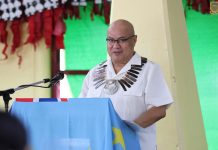
Solomon Islands Governor General suspends Police Commissioner Vaevaso

0

Solomon Islands Governor-General Sir David Tiva Kapu has suspended Police Commissioner Ian Vaevaso from his duties with immediate effect following advice from the Prime Minister and in accordance with Section 129(6) of the Constitution.

In a letter dated 17 June 2026, a copy of which was sighted by SBMOnline, Sir David informed Commissioner Vaevaso that the suspension stems from allegations of misconduct and/or misbehaviour that were allegedly not considered, addressed, disclosed, or reviewed during his appointment process by the previous Prime Minister and the Police and Correctional Service Commission.

To investigate the allegations, the Governor-General has established a tribunal under Section 129(5) of the Constitution to conduct a thorough inquiry into the matter.

Sir David said the suspension is intended to ensure that the investigation is carried out fairly and without interference.

Commissioner Vaevaso will remain suspended until the tribunal completes its work and submits its report and recommendations to the Governor-General.

The letter further states that formal charges will be presented by a lead prosecutor appointed to the tribunal, while Commissioner Vaevaso will be entitled to engage legal counsel to represent him throughout the inquiry process.

Despite the suspension, the Governor-General acknowledged Commissioner Vaevaso’s service to the nation and wished him well during the proceedings.

Speaking exclusively to SBMOnline Wednesday, Vaevaso confirmed receiving the letter from the Governor-General and said he welcomed the process.

“That’s true. I have nothing to hide. I will allow the process to take its course. I would also like to see the allegations. Since I was appointed, people have continued to raise allegations. I appreciate the process, as it will also bring this issue to a close,” Vaevaso told SBMOnline.

No details of the allegations have been made public.

Palau prepares for Pacific summit as climate and security pressures build

0

Palau is gearing up to welcome leaders from across the Pacific for this year’s 55th Pacific Islands Forum (PIF) Leaders Meeting in Koror from August 30 to September.

Officials say the meeting will be shaped by some of the region’s most pressing challenges, including climate change, transnational crime and economic stability.

Speaking ahead of the summit, Palau Minister of Justice Jennifer Olegeriil said the host government wanted more than a smooth event. Olegeriil said the forum should produce serious political momentum.

“Palau is excited to host the upcoming PIFS leaders’ meeting in Palau,” Olegeriil said, adding that the government is focused on creating “a setting, an environment where the discussions between leaders there are robust.”

She said Palau has already been working through the agenda with the Pacific Islands Forum Secretariat to make sure the talks reflect the region’s most urgent concerns.

“Those include the climate crisis, cross-border crime, regional support and wider economic pressures.

“We would have done the legwork to be able to ensure an agenda that will sufficiently address the many different challenges the Pacific, as individual nations as well as the region, are facing,” she said.

Olegeriil said the goal was to foster what she described as “strong Talanoa-type conversations” that allow leaders, development partners and others in the room to confront problems openly and develop common responses.
“That opportunity to have strong Talanoa-type conversations,” she said, would help ensure transnational as well as regional responses are placed on the table.

The minister said Palau’s preparations went beyond logistics. The bigger task, she said, was making sure the summit delivers substantive discussion on shared Pacific priorities.

The forum comes as Pacific governments continue to grapple with a fuel crisis, including invoking the Biketawa Declaration, and as regional preparations intensify for COP31, which is set to be hosted by Australia and Turkey.

For Palau, the meeting is both a diplomatic test and an opportunity to shape regional discussions at a moment when Pacific leaders are under growing pressure to turn unity into action.

Solomon Islands minister says security and development must move together

0

The Solomon Islands’ new government sees security and development as closely linked, while pushing for stronger national ownership of security policy and continued regional cooperation.

Minister for National Planning and Development Coordination, Peter Kenilorea Jr, said the country’s approach was shaped by its own experience of unrest and external support, including the Regional Assistance Mission to the Solomon Islands.

“For us, in the Solomons, it’s an issue to do with development,” he said.

“We see security and development as two sides of the same coin.”

He said the government wants to draw a clearer line between domestic control and regional partnership.

“We have actually gone through security issues ourselves,” Kenilorea said.

“It comes from a practical place whereby we have learned that it’s so important for us to ensure that our security is one that ensures our own sovereign understanding of it.”

At the same time, he said Solomon Islands recognises that instability at home can quickly become a wider regional concern.

“What happened in Solomon Islands ended up being a regional issue for many other countries to come in and join us,” he said.

“We’re really looking to have that conversation deeper even within ourselves in the country, have ownership of our own security space.”

Kenilorea said the government also wants to strengthen collective security across the Pacific.

“We’re looking to see how we can take it to an even higher level where all of us can benefit from a safer Pacific, including through the oceans, the blue continent kind of outlook towards that,” he said.

Kiribati minister warns online misinformation distorts Pacific youth’s reality

0

Kiribati’s top minister for women, youth, sport and social affairs has warned that the Pacific’s digital transformation is reshaping community life at speed.

Ruth Cross-Kwansing said the change brought opportunities and serious risks for young people, elders and public safety.

Speaking at the Pacific Peace and Security Dialogue on the human security dimensions of the Boe Declaration on Regional Security and the 2050 Strategy for the Blue Pacific, Cross-Kwansing said the region must confront the darker side of social media, misinformation and online manipulation if it wants to turn its peace-and-security vision into reality.

For Kwansing, the challenge is immediate and local. Kiribati, she said, was spread across 21 inhabited islands and 3.5 million square kilometres of ocean, making digital networks both essential and destabilising.

“What connects us, apart from our culture and the long, wonderful history that we have, is the social connections that we are able to form. But those same connections now move through platforms that can spread information faster than governments can respond,” she said.

“The information that can spread across social media is faster than any government vehicle or any government official that can work to respond.

“The threat and the solution are sitting in pretty much the same device.”

The minister argued that this paradox is hitting young people hardest. In her telling, social media algorithms are shaping how Pacific youth see themselves and the world, often amplifying harmful narratives and normalising damaging behaviour.

“Our young people are at a time of great influence in their lives,” she said, and what they consume online can shape their “thoughts and their narratives and their worldview.”

When those messages are toxic, she warned, the effects are not abstract.

“It is contributing to the mental health challenges and to harmful narratives about what they’re positioned and what their opportunities in the world are.”

The result, in her view, is a distorted sense of reality that can take a generation “down a real dark hole of perception.”

Cross-Kwansing also drew a direct line between online behaviour and the region’s struggle with gender-based violence.

The difference between a harmful exchange in a village and one amplified online, she said, is that digital spaces can validate and multiply abusive ideas.

“There’s a difference between having a conversation in your house or in your village, as opposed to a conversation that’s taking place online.

The risks, she added, are not limited to the young. Older people and professionals are also vulnerable to scams and misinformation.

“Our elders are also quite vulnerable,” she said, pointing to fake investment schemes and other online deceptions that can drain savings and undermine trust.

Her remarks pushed the session away from generic celebration of technology and toward a harder assessment of what digital life is doing to Pacific societies.

She acknowledged that online tools can help communities respond to crises and share information quickly. But she said the region is now facing “so many dangers” alongside those benefits, and leaders have a duty to respond.

“That’s our job as leaders. To be able to identify and then develop solutions for those problems.”
The region, she suggested, can no longer afford to treat social media, misinformation and online abuse as side issues.

“They are now central to the safety of young people, the dignity of communities and the resilience of the Pacific itself,” she said.

Fuel crisis exposes Pacific economic vulnerability, leaders say

Pacific leaders have warned that the region’s fuel crisis is no longer just a supply problem, but a threat to economic security, as rising prices, inflation and the cost of living ripple through island economies.

At the 2026 Pacific Peace and Security Dialogue hosted in Suva, Fiji, ministers from the Cook Islands, Papua New Guinea, Nauru and Tuvalu said the shock has underscored the need for regional cooperation, stronger supply chains and a faster shift toward more resilient economies.

Papua New Guinea Finance Minister Thomas Opa said remote islands are feeling the pressure most acutely, with higher fuel costs hitting transport, business and jobs.

“The increase in fuel prices has really affected not only the people on the mainland that will now buy more fuel at the bowser, it also affects business, and if the business is not growing, they cannot make profit, they cannot employ people – so it has broader implications on the wellbeing of people. This is a concern that affects Papua New Guinea.”

Opa said PNG has introduced a fuel subsidy but called it unsustainable in the long term.

“The government is exploring smaller refineries to strengthen domestic supply and support other Pacific states.”

Tuvalu’s Minister for Transport, Energy, Communication and Innovation, Simon Kofe, said the crisis is a warning that energy transition is now a security issue.

“We do a lot of advocacy on the international stage, but what are we doing on the local level to achieve that transition? It’s no longer just an environmental issue; it’s now become a security issue for us.”

Cook Islands Foreign Affairs Minister Tingika Elikana said resilience in the Pacific depends on economic stability rather than military power.

Nauru Minister for Women and Social Development Affairs, Charmaine Scotty, said regional cooperation can cut costs and create opportunities.

She argued that “the Pacific’s greatest resource is not beneath our oceans or on our lands. It is our people.”

Queensland force State of Origin decider after 44 24 rampant win

0

Selwyn Cobbo bagged a hat-trick as Queensland forced a decider in the best-of-three State of Origin rugby league series on Wednesday after a comprehensive 44-24 victory over New South Wales.

Playing on neutral territory at the Melbourne Cricket Ground in front of a record Origin crowd of 91,671, the Maroons ran in seven tries to four in slippery conditions to keep their title defence.

Trailing 12-8 at the break, Queensland ran riot in the second-half to exact revenge after the Blues produced the biggest comeback win in Origin history in the opener in Sydney.

The series-decider will be played on 08 July in Brisbane.

“They started better than us, but I liked the way we dug deep and played our best in the back end of the game,” Queensland captain Cameron Munster said.

Stars Mitch Moses and Payne Haas returned from injury, but could not spark the Blues who faded badly.

“We wanted to get it done tonight, finish the series in Melbourne,” Blues fullback James Tedesco said.

“We will have our backs to the wall, but it will feel even sweeter getting the win up at Suncorp.”

After such a sluggish start in the opener, the Blues came out firing with Kotoni Staggs crossing over in the sixth minute following Tom Flegler’s drop from the kick-off.

The calamitous mistake rattled a Maroons team who had coach Billy Slater’s pre-game message to play without fear still ringing in their ears.

The pumped-up Blues pounced with Mark Nawaqanitawase flying over the line in the right corner after a great pass from star Nathan Cleary, who then nailed the conversion.

Queensland finally shook from their stupor when Munster produced a spectacular one-handed pass before Trent Loiero finished off a brilliant team try.

But Munster hit his head on the ground during the play and missed the last 15 minutes of the first-half due to a head injury assessment.

NSW held on to a slim lead at the interval before Munster returned to start the second-half in a huge boost for the Maroons.

Munster made an immediate impact when he set up Cobbo as Queensland hit the front.

Cobbo added another shortly later and Queensland’s momentum could not be stopped with Jojo Fifita’s try and Sam Walker’s conversion stretching their lead to 26-12.

After their comeback heroics in Sydney, the never-say-die Blues attempted another fightback when Nawaqanitawase scored his second try in the 59th minute.

But the Maroons finished full of run, as Cobbo completed his hat-trick to seal just their second win from seven matches at the MCG.

UN Decolonisation Committee pressed to act on New Caledonia, French Polynesia, Guam and Tokelau

The United Nations Special Committee on Decolonisation heard renewed calls for action on New Caledonia, French Polynesia, Guam and Tokelau as it opened the main part of its 2026 session, with Pacific representatives, petitioners and administering Powers debating the pace of self-determination and decolonisation in the territories.

The discussions came as the committee approved three draft resolutions aimed at strengthening UN support for the world’s remaining Non-Self-Governing Territories, including measures promoting information-sharing, reporting obligations and visiting missions.

New Caledonia dominated much of the debate, with petitioners urging the United Nations to take a more active role in addressing the territory’s political crisis and advancing its self-determination process.

Petitioner Reverend James Bhagwan questioned whether the Special Committee’s annual consideration of New Caledonia was producing meaningful progress.

He asked whether the Special Committee’s annual consideration of New Caledonia without a visiting mission, measurable benchmarks or a decolonisation timetable is advancing freedom, “or merely managing delay”.

Bhagwan also urged the United Nations to assess the electoral environment ahead of provincial elections scheduled for 28 June and “ensure that the poll is not used to normalize an unresolved colonial situation”.

Petitioner Billy Wetewea said the unrest that erupted in 2024 reflected deeper problems within the territory.

“The 2024 uprising was not an isolated event, but rather the consequence of a failed colonisation process,” said Wetewea.

He also cited a widespread “collapse of confidence” in France as the administering power.

Other petitioners called on the United Nations to help resolve the territory’s political crisis, defend Indigenous Kanak rights and revive what they described as a stalled self-determination process.

Speaking on behalf of France, the administering Power, its representative said New Caledonia remains a sui generis collectivity established under the 1998 Nouméa Accord and retains the right to self-determination under the French Constitution.

The representative said France would continue supporting New Caledonia through the upcoming elections and assist efforts to rebuild following the violence of 2024.

Fiji and Papua New Guinea both called for all parties to engage in good faith in the self-determination process and urged the United Nations to deploy a visiting mission to New Caledonia as soon as possible.

The committee also heard renewed criticism of France’s role in French Polynesia.

Petitioner Mareva Kitalong told delegates that “Decolonisation is not an issue of the past.”

She called on France to “finally open dialogue on decolonisation” as requested by the United Nations, arguing that despite its autonomous status, French Polynesia remains without political autonomy and legislative sovereignty.

Kitalong also highlighted to what she described as France’s “nuclear debt” to French Polynesia, citing the environmental and health impacts of decades of nuclear testing in the territory.

France rejected suggestions that French Polynesia lacked autonomy, saying the territory exercises broad powers over its economy, education, health and tourism sectors.

The French representative said the relationship between France and French Polynesia is based on longstanding dialogue and noted that France contributes approximately €2 billion (US$2.32 billion) annually to the territory, equivalent to about 30 percent of its gross domestic product.

In Guam, petitioner Pim Limtiaco said the Pacific territory continues to face challenges linked to its strategic location in the Asia-Pacific region.

She argued that Guam remains affected by the legacy of the Second World War and warned that current geopolitical competition is creating new pressures.

“The United States continues to ignore our input,” she said.

Limtiaco claimed the United States is now “eyeing our oceans” for deep-sea mining as it seeks to compete with Beijing and invited the Special Committee to visit Guam to observe what she described as active colonialism.

The discussion on Tokelau highlighted a more gradual approach to self-determination.

Andre Van Der Walt, Interim Administrator of Tokelau, said New Zealand remains committed to supporting the territory and noted that Tokelau has effectively exercised self-government for decades.

“It remains essential that the people of Tokelau are able to consider questions [of decolonization] at their own pace and in their own way,” he stressed.

Fiji’s representative welcomed New Zealand’s long-term investment in Tokelau despite the territory’s unique challenges and encouraged continued support until a mutually agreed governance arrangement is reached.

The debates highlighted the differing paths being taken by Pacific territories still listed as Non-Self-Governing Territories, with New Caledonia facing renewed scrutiny over its political future, French Polynesia continuing to push for a formal decolonisation dialogue, Guam raising concerns over strategic and resource interests, and Tokelau maintaining a gradual, locally driven approach to determining its future status.

The Special Committee’s discussions will continue as delegates examine the remaining Non-Self-Governing Territories and consider further recommendations for submission to the UN General Assembly.

Bougainville President Toroama says PNG Parliament breached Melanesian Agreement, calls for international intervention

Bougainville President Ishmael Toroama has accused Papua New Guinea’s National Parliament of breaching the Melanesian Agreement (MA) and undermining the Bougainville peace process after lawmakers adopted a draft sessional order on the Bougainville Referendum results without the consent of the Speaker of the Bougainville House of Representatives.

Toroama said the decision taken by the National Parliament on 09 June 2026 contravened commitments made under the Melanesian Agreement and threatened the principles that have guided the Bougainville peace process since the signing of the Bougainville Peace Agreement.

“The decision by the National Parliament on Tuesday 9 June 2026 to adopt a draft sessional order on the results of the Bougainville Referendum, without the required consent of the Speaker of the Bougainville House of Representatives, amounts to a breach of the Melanesian Agreement and runs contrary to the principles of respect, good faith and partnership that underpin the Bougainville Peace Agreement,” he said in a statement.

Toroama also expressed dissatisfaction with aspects of Prime Minister James Marape’s statements, the manner in which the parliamentary debate was conducted and the position taken on the negotiated majority threshold.

“I am disappointed in certain parts of the Prime Ministers statements, the order of the debate and the unilateral position on the negotiated majority threshold.”

The Bougainville President said he had previously warned that parliamentary developments in Port Moresby could test the resolve of Bougainvilleans and again urged the people of Bougainville to remain calm and united despite the latest developments.

“I echo that entreaty now. I repeat that our strength remains our unity of purpose and our faith in the justice of our cause,” he emphasised.

Toroama said the Autonomous Bougainville Government would continue engaging with the National Government despite what he described as attempts to weaken agreements reached between the two sides.

“As the Vice President stated, the Bougainville Government will continue to engage with the National Government in good faith, despite recent attempts to subvert the Melanesian Agreement and undermine the ratification process,” he said.

The President also called for international involvement, saying commitments made under the Melanesian Agreement regarding international monitoring should now be activated.

According to Toroama, the agreement provided for international monitoring with support from the United Nations, and he urged the facilitator responsible for developing the Melanesian Framework to convene international stakeholders to address the situation.

“The Melanesian Agreement called for international monitoring with UN support.

“I now call on the facilitator appointed to support development of the Melanesian Framework to activate that commitment to international monitoring and convene a meeting of international partners, representatives of the international community and the international witnesses to the signing of the Bougainville Peace Agreement, to address the breach by the National Government of its commitments under the Melanesian Agreement and to ensure that the process and principles agreed at Burnham are honoured,” he said.

The call represents the strongest response yet from the Bougainville leadership following the parliamentary decision, which has intensified tensions surrounding the ratification process for the 2019 Bougainville Referendum result.

Despite the dispute, Toroama said Bougainville remained committed to pursuing its political aspirations through peaceful means and continued dialogue.

“We continue to place our trust in God to protect us, and to guide all parties in good faith in the delivery of Bougainville’s legitimate political destiny,” he said.

The statement signals that the Autonomous Bougainville Government will continue pressing for adherence to the commitments and processes established under the Bougainville Peace Agreement and the subsequent Melanesian Agreement, while seeking greater international scrutiny of the developments following the National Parliament’s decision.

Polling cutback sparks anger as New Caledonia heads into tense vote

0

A major cut in the number of polling stations in New Caledonia’s capital has sparked a heated debate about access to the vote, less than two weeks out from a key provincial election.

French authorities have reduced the number of polling booths in Nouméa from 57 to just nine.

Concerns are growing among voters and observers about what the changes could mean for turnout.

Speaking from Nouméa, Nic Maclellan, Islands Business correspondent, says the decision could create real barriers for some communities especially in working-class areas with limited public transport on Sundays.

“Normally around Noumēa, the capital, there are 57 polling booths, town hall, held at schools, other public offices. This year they’ve been reduced to just nine,” Maclellan told Pacific Mornings.

“In poorer working-class suburbs in the north of the capital, Noumēa, without good bus services on Sundays, it may be difficult for some people to get to a polling booth.”

He says the combination of fewer voting sites, limited transport, and a strong security presence is fuelling concern that some voters could be effectively shut out of the process.

Local debate is growing over whether the changes restrict access to the vote and raise concerns about democratic rights particularly for Indigenous Kanaks as well as Wallisian and Tahitian communities who are less likely to have private transport.

For the pro-independence movement, the changes to the electoral system are not just about logistics. They go to the heart of how decolonisation is meant to be delivered.

“The FLNKS [Kanak and Socialist National Liberation Front] is clear: we are not opposed to changes to the electoral rolls but only within the framework of a comprehensive agreement that confirms the path to decolonisation,” Emmanuel Tjibaou, President of the pro-independence Union Calédonienne (the largest party within the FLNKS coalition), said in a statement.

That position is also being echoed more broadly across the wider independence coalition, which says the rules governing who can vote are central to the political settlement with France.

“Electoral conditions are at the heart of the Nouméa Accord and not negotiable… [These issues are] at the heart of the decolonisation process,” a FLNKS communiquē read.

The voting changes come as New Caledonia prepares for its first provincial elections in more than seven years, after repeated delays following the unrest in 2024.

The upcoming vote will be New Caledonia’s first provincial election in seven years.

The last election was held in 2019, with subsequent polls delayed following political tensions and unrest.

Voters will head to the polls on 28 June to elect members of the Congress of New Caledonia, which plays a key role in shaping the territory’s political future.

Beyond voting access, the election is also being shaped by the economic fallout from last year’s unrest.

That period of instability is still being felt across the economy and public services.

Maclellan says the territory’s economy suffered a sharp downturn, with gross domestic product falling by around 13.5 percent in a single year.

“Public transport has been badly disrupted and the economy suffered a terrible hit in 2024. It’s still only slowly rebounding from that,” he said.

Beyond the politics, everyday pressures are shaping how people are thinking about the election.

Health services remain under strain, youth unemployment is high, and the nickel industry – once a key economic driver – has been heavily disrupted.

But on the other side of the political divide, loyalist leaders argue the current adjustments fall short of ensuring fair access and representation for all communities.

Sonia Backès, leader of the anti-independence Loyalist Bloc, has criticised the changes as unacceptable in their current form. The changes are “insufficient” and “democratically unacceptable”, she told media.

Despite those challenges, the political contest remains deeply divided.

In the Southern Province, anti-independence parties have formed a rare, united front in an effort to consolidate support.

At the same time, the pro-independence bloc is facing internal splits, with divisions emerging beyond the traditional FLNKS structure.

Maclellan says the wider political uncertainty is being shaped by developments far beyond the territory, including France’s own political future ahead of its 2027 presidential election.

“Can there be a new agreement crafted over the next year before the French presidential elections which are due in May 2027, less than a year away.

“I think a lot of people feel that there won’t be an agreement until New Caledonia’s work out who’s the next French president,” Maclellan told PMN.

With President Emmanuel Macron unable to stand again, he says longer-term decisions on New Caledonia’s status are unlikely to move forward in the short term.

“The vast majority of Indigenous Kanak support independence,” Maclellan said. “A significant proportion of the non-Kanak population, particularly Europeans, want to stay with France.

“That’s an unresolved debate that underlies everything that is on the table in these elections.”

Maclellan says a final agreement on sovereignty may remain out of reach until there is greater clarity on leadership in Paris and unity on the ground in New Caledonia itself.

Acting locally in the Pacific: How discovering new sea star species in the Clarion-Clipperton Zone is reshaping what we know about life on the seafloor

0

This year, the International Day for Biological Diversity calls us to “act locally for global impact,” a principle that resonates deeply with the scientists working to document life in the most remote reaches of our oceans.

In the deep seabed, where darkness, cold and crushing pressure define the environment, most species remain unknown to science. Identifying, naming and describing them, the work of taxonomists, is one of the most locally grounded acts in biology research which requires hands-on study of individual specimens from sparse sites. And yet its impact is unmistakably global.

Named species can be tracked, protected and incorporated into the international frameworks that govern our shared ocean, including the Kunming-Montreal Global Biodiversity Framework (KMGBF), which sets ambitious targets to halt and reverse biodiversity loss by 2030. The work of the International Seabed Authority (ISA) also depends on this knowledge to fulfill its responsibilities under the United Nations Convention on the Law of the Sea – to regulate and control mineral-related activities in the international seabed Area while protecting the marine environment – and to ensure the sustainable development of deep-sea activities.

As part of the observance of International Day for Biological Diversity, ISA is spotlighting five taxonomists whose work carried out locally, in laboratories and at sea, is contributing to a growing global understanding of the biodiversity of the deep seabed. Their discoveries, supported by ISA’s Sustainable Seabed Knowledge Initiative (SSKI), directly advance the One Thousand Reasons campaign, which aims to formally describe at least one thousand new deep-sea species by 2030 in collaboration with the World Register of Marine Species (WoRMS). Together, these efforts are shaping how the international community understands, monitors, and protects the deep seabed and how it can effectively implement the Agreement on Marine Biological Diversity of Areas Beyond National Jurisdiction (BBNJ Agreement).

Dr Magdalini Christodoulou is a marine taxonomist at the Biology Centre of the Upper Austria Landes-Kultur GmbH, working in close collaboration with the German Centre for Marine Biodiversity Research.

Her work focuses on the taxonomy of deep-sea echinoderms, a group that includes sea stars, brittle stars and sea urchins. Much of her research focuses on the Clarion-Clipperton Fracture Zone (CCZ), a region that spans approximately six million square kilometres between Hawaiʻi and Mexico in the central Pacific Ocean. Despite growing scientific interest in the CCZ, largely driven in part by the prospect of deep-sea mining, it remains one of the least explored regions on Earth.

Dr Christodoulou’s taxonomy work is helping to change that.

Her recent research has contributed to the formal description of new species including Caymanostella hades, C. persephone and Ophiotholia saskia, and in a separate study focused on brittle stars from the CCZ. The known biodiversity of the brittle start group increased fourfold while entirely new evolutionary lineages were discovered.

Among her most striking recent findings was the discovery of two new Caymanostella sea star species collected from the same piece of sunken wood, a so-called “wood fall,” at a depth of around 4,500 metres. This research discovery was supported by the ISA’s One Thousand Reasons campaign. The co-occurrence of two distinct new species on a single, rarely encountered habitat raises profound questions about how deep-sea life disperses, specializes and survives in one of the most resource-limited environments on the planet.

Photo via ISA

This year’s International Day for Biodiversity theme calls us to “act locally for global impact.” How does your taxonomy work connect to this idea?

This theme really captures the essence of taxonomy. My work focuses on identifying and describing species from the deep sea, and although these discoveries are made at a local scale, often within very specific regions, they contribute to building a much clearer and broader picture of global ocean biodiversity. Every time a species is identified or described, we gain important knowledge about how these ecosystems function and how they could potentially respond to environmental change or human impact.

Although the work may seem highly local, based on material collected from specific expeditions or areas of the seafloor, the impact is global because the oceans are deeply interconnected. My research has contributed to expanding known species distributions, describing new species, and improving our understanding of deep-sea biodiversity patterns by comparing the fauna of subregions. Accurate taxonomy supports governments, scientists and policymakers in making informed decisions on issues such as Areas of Particular Environmental Interest (APEIS) and Regional Environmental Management Plans (REMPs), biodiversity monitoring and emerging activities like deep-sea mining. Ultimately, taxonomy provides the baseline knowledge needed to protect biodiversity. I firmly believe, like many other deep seabed taxonomists, we cannot conserve what we do not yet know exists.

Can you walk us through a recent discovery and what was most exciting or unexpected about it?

A recent and particularly exciting discovery was the identification of two new species of the genus Caymanostella collected from the same piece of wood, a “wood fall,” in the CCZ at depths of around 4,500 metres. These species belong to a relatively rare group of sea stars associated with wood-fall habitats.

Wood falls, pieces of wood that sink from the ocean surface to the deep seafloor, create small, temporary islands of life in an otherwise food-limited environment. Because they are so rarely encountered, they represent highly specialised and ephemeral habitats. Finding new species associated with them highlights just how much deep-sea biodiversity remains undocumented, even in regions that are increasingly being explored in the context of potential deep-sea mining activities.

What was particularly unexpected was the co-occurrence of two distinct new species on a single wood fall, suggesting a high degree of specialization and potentially complex ecological interactions within this type of habitat. It also raises fascinating questions about how these organisms disperse across vast deep-sea distances and locate such rare and short-lived resources.

Photo via ISA

How do new tools like environmental DNA, AI-assisted image recognition and high-resolution video complement classical taxonomy?

While these new technologies have the potential to significantly reinforce deep-sea biodiversity research, they cannot fully replace classical taxonomy. They, however, can be complementary. Environmental DNA, AI-assisted image recognition and high-resolution imaging can greatly increase the speed and scale at which we detect biodiversity. In the deep sea, where sampling is logistically challenging and many species are rare or occur at low abundance, these tools help capture signals of biodiversity that might otherwise be missed.

Classical taxonomy remains essential because these methods often stop at detection. eDNA can tell us that a species is present, but it does not always allow confirmation down to species level, nor does it provide information on life stage or morphology. AI-based identifications are only as good as the reference datasets they are trained on, which in the deep sea are still incomplete. The most robust approach is an integrative one, combining morphology, molecular data, ecological context and, where available, imagery or in situ observations. In my own recent work, I have applied high-resolution imaging and molecular sequencing alongside classical morphological taxonomy, helping to strengthen species delimitation and provide a more complete understanding of deep-sea biodiversity.

Photo via ISA

Why does ISA’s One Thousand Reasons campaign matter for advancing this kind of research?

Initiatives such as the One Thousand Reasons campaign are important because they bring greater visibility to taxonomy and help accelerate both the discovery and documentation of deep-sea biodiversity at a time when this knowledge is urgently needed. They provide the means to optimise taxonomic research by enabling the full utilisation of logistically difficult and costly collected samples, facilitating exchange between expert teams and supporting shared use of infrastructure and expertise across institutions.

By highlighting concrete discoveries and linking them to broader biodiversity and conservation goals, these initiatives demonstrate the real-world value of taxonomy and baseline science. They reinforce the idea that documenting biodiversity is not an ephemeral task, but an ongoing scientific foundation. Such initiatives also ensure that taxonomy remains supported as a core discipline directly connected to global biodiversity policy and conservation priorities.

Why does data sharing and collaboration across institutions matter for understanding the deep seabed?

Data sharing and collaboration are essential for understanding and managing the deep seabed because no single institution or country can fully study such a vast, remote and complex environment alone. As different institutions share expertise, reference collections, molecular facilities, imaging capabilities and historical material species can be accurately identified and described.

The new Caymanostella species, for example, were collected during the JPI Oceans Mining Impact project, a joint European campaign in the CCZ that brings together over 30 partner institutions across Europe, led by the GEOMAR Helmholtz Centre for Ocean Research Kiel. The project provides an independent, transdisciplinary environmental assessment of the potential impacts of deep-sea polymetallic nodule mining, and the specimens collected through it were later described through collaboration between scientists from multiple institutions. Collaborating with other taxonomists has given me the opportunity to learn different methodologies and improve the reliability of species identification through cross-validation and shared knowledge. A new species discovered locally forms the basis of a much larger global effort to understand and protect marine biodiversity, strongly reflecting the idea of “act locally, for global impact.”

What would success look like in the next decade in terms of reducing the taxonomic data gap and improving how biodiversity knowledge feeds into deep-sea governance?

For me, success over the next decade would mean seeing taxonomy placed more centrally within deep-sea science and better supported and integrated into both research and policymaking. One of the main priorities is building the next generation of deep-sea taxonomists, as a shortage of expertise persists globally, particularly for many understudied deep-sea groups. Success would include creating more dedicated positions within relevant institutions, alongside opportunities for training, mentorship and international collaboration.

I would also like to see biodiversity knowledge more directly embedded into deep-sea governance and decision-making. Taxonomy is often viewed as a purely descriptive science, but it underpins everything from biodiversity assessments to conservation planning and environmental impact assessment. Success would mean ensuring that robust taxonomic data are recognised as essential evidence for policymaking and for achieving broader international commitments, including the goals of the KMGBF. Documenting biodiversity must be treated as a fundamental requirement for understanding and sustainably managing the deep seabed.

Photo via ISA

About ISA

ISA is an autonomous intergovernmental organisation mandated by the UNCLOS to manage the mineral resources of the seabed beyond national jurisdiction for the shared benefit of humankind. ISA is committed to ensuring that all economic activities in the deep seabed, including mining, are regulated and responsibly managed using the best available scientific evidence for the benefit of all humankind.

About the “One Thousand Reasons” Campaign

Launched by the ISA under SSKI, it is a global effort to describe at least 1,000 new deep-sea species by 2030. The campaign promotes international collaboration, particularly engaging scientists from developing States, and integrates species descriptions into open-access databases to support sustainable management of the international seabed area.

SSKI is a multi-donor, flagship initiative under the ISA’s Marine Scientific Research Action Plan for the implementation of the UN Decade of Ocean Science. The Initiative has received significant financial support from the European Union, the Republic of Korea, France, Ireland, China, the United Kingdom of Great Britain and Northern Ireland (UK), Portugal and India

For media inquiries, please contact: ISA Communications Unit, news@isa.org.jm

Stay connected

529FansLike
172FollowersFollow
156SubscribersSubscribe
- Advertisement -