Home Blog Page 69

Forum Chair Wale protests China’s missile test in the Pacific

Forum Chair and Solomon Islands Prime Minister Matthew Wale has lodged a strong protest over China’s ballistic missile test in the Pacific, saying it was “not something a friend does” and warning that no country should conduct intercontinental ballistic missile (ICBM) tests in the region.

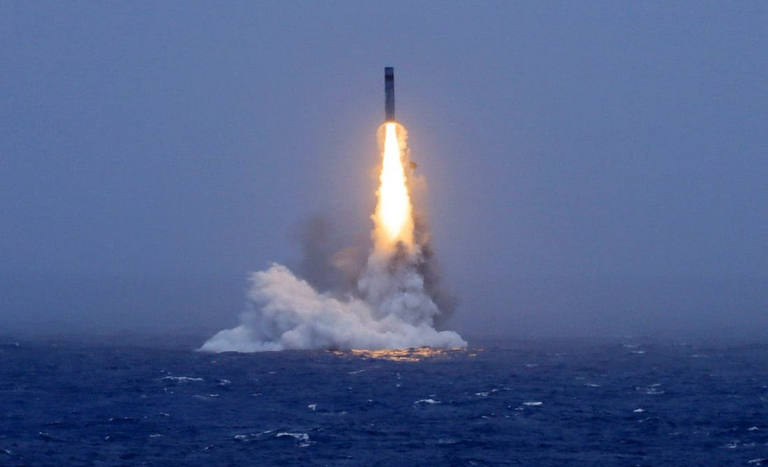
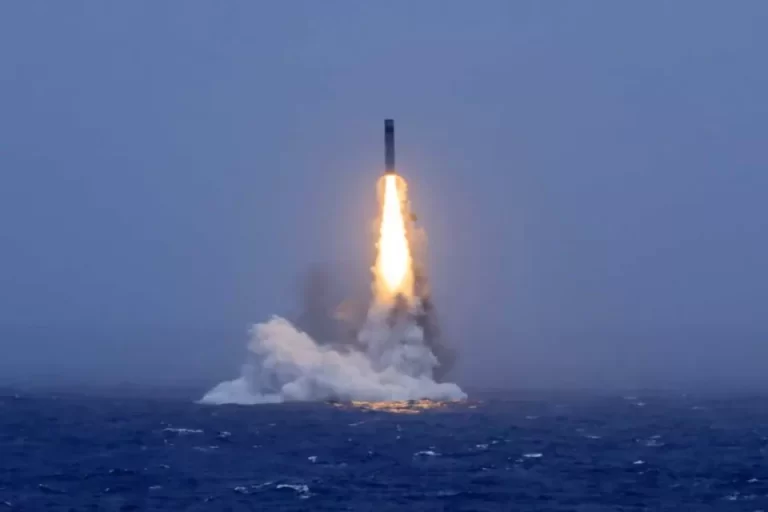
The nuclear-capable missile that China test-fired from a submarine Monday flew over multiple Pacific nations and appears to have hit waters close to Tuvalu’s Exclusive Economic Zone (EEZ).

Responding to questions from reporters in Honiara, PM Wale said he had formally raised Solomon Islands’ concerns with China.

“China’s a good friend of Solomon Islands, but this is not something a friend does.

“This is not good in our region and as Chair of Pacific Islands Forum I’ve expressed my strong, registered my strong protest with the Ambassador.

“Solomon Islands also lodged a protest note. But we don’t want to see any more countries, China, America, anybody, we don’t want anybody testing the ICBMs in the Pacific Islands region.

“That’s the bottom line. Be our friend, but don’t threaten us,” he told reporters in Honiara.

Asked whether the missile test had acted as a deterrent, Wale said it highlighted the need for a stronger regional platform.

“Well, in many ways the missile test is further evidence for the need for regional platform so that the region can speak as one.

“It will allow some countries, not all the countries in the Pacific are not all on the same level of strength and may not want to speak up when things like this happen.
“But a regional platform will allow cover and allow for much greater sharing of intelligence and information so we can be advocating better for Pacific wide issues,” he stressed.

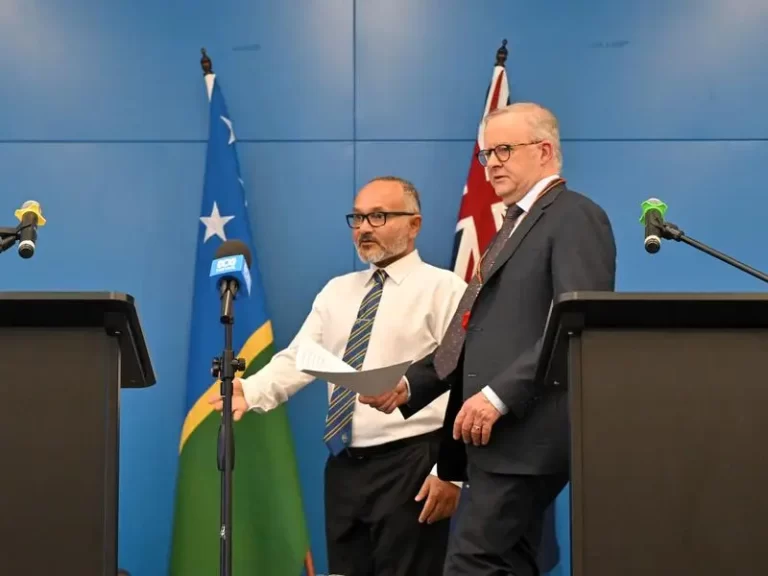
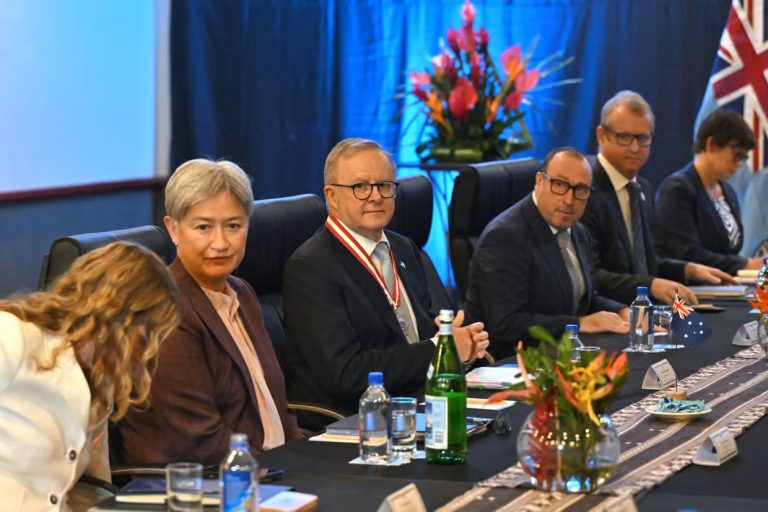
Speaking in Honiara alongside Wale, Australian Prime Minister Anthony Albanese also criticised the missile test, describing it as a provocative and destabilising act.

He confirmed Australia had raised its concerns directly with China.

“We have made clear our concerns to China in both Beijing and in Canberra and I’m making our concerns clear here as well in Honiara.

“We don’t want to see any action that is destabilising or which undermines the peace, security and stability of the Pacific and the region. And there is no doubt that this is a provocative act by China which does destabilise the region. And therefore, we will put forward our strong view.

“We have said consistently that we want to cooperate with China where we can, we’ll disagree where we must and we’ll engage in our national interests.

“This is one of those occasions where we must disagree with this action. And in particular we point out that it is standard procedure for tests such as this for there to be given 48 hours notice. This was not done on this occasion,” PM Albanese said.

Albanese said Australia’s concerns extended beyond the lack of advance notice to the type of weapon that was tested.

“Part of our concern here isn’t just the lack of notice that occurred. It is the fact that this was a test of a nuclear capable intercontinental ballistic missile fired from a nuclear-powered submarine.

“That is of real concern because what we need is less nuclear weapons, certainly not more. And the fact that this test took place with very little notice is of real concern. And so we join that as part of the concerns that we will express is the nature of the weapon that was tested that has a capacity clearly to reach at long range and to cause considerable, considerable damage were it to be weaponised.

“So, we’ll continue to advocate strongly but advocate as well, consistent with our view when it comes to the use of nuclear weapons is very clear and has been consistent and has indeed been a bipartisan approach for Australia for a long period of time,” PM Albanese said.
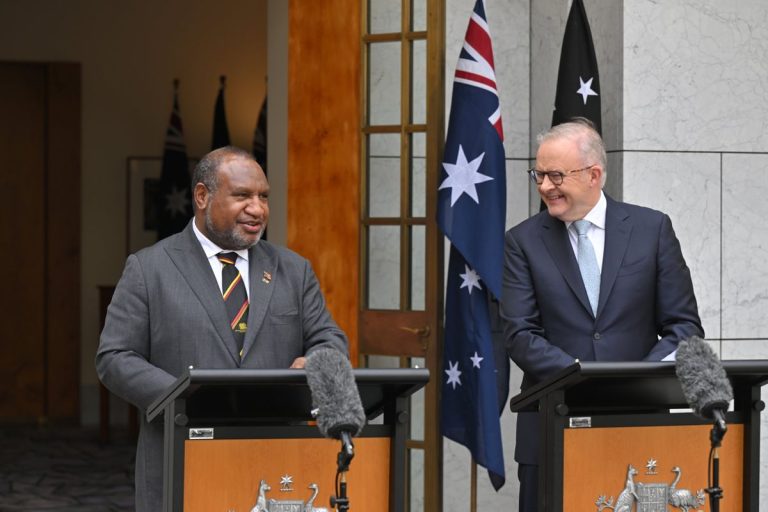
PNG PM Marape calls on global superpowers to halt missile tests after Chinese launch

0

Papua New Guinea Prime Minister James Marape has called on all global military powers to respect the Pacific as an ‘Ocean of Peace’ following China’s test launch of a strategic ballistic missile into international waters in the South Pacific.

The missile, deployed from a nuclear-powered submarine, prompted a firm response from the Prime Minister, who said that the region must never again become a theatre for military competition, weapons testing, or activities that threaten regional stability and the environment.

Marape said that Papua New Guinea respects the sovereignty of all nations and recognises their right to operate in accordance with international law, but he countered that the Pacific should be dedicated to sustaining life rather than preparing for conflict.

“Our Pacific is an Ocean of Peace,” Marape said, stating that this aligns with the consistent aspiration of Pacific Islands Forum leaders and their shared ‘Blue Pacific Continent’ vision.

Marape, who has served continuously as Prime Minister since 2019, said Pacific nations continue to carry the heavy legacy of historical conflicts that were never of their own making.
“Our region has lived through war, nuclear testing and military activities imposed upon us by larger powers. We do not want history repeated,” he said.

He called for regional waters to remain entirely free from the testing of harmful weapons and military arsenals, whether launched from the air, sea, or land.

The Prime Minister also highlighted the critical ecological role of the Pacific Ocean as a major global carbon sink and home to extraordinary marine biodiversity that sustains fisheries feeding millions of people worldwide.

The public appeal comes as Port Moresby navigates a delicate diplomatic balancing act.

This year marks 50 years of formal diplomatic relations between Papua New Guinea and the People’s Republic of China since ties were first established in 1976.

Marape reaffirmed PNG’s longstanding commitment to the One China Policy, describing the relationship as genuine and founded on mutual respect. However, he drew a clear line regarding military escalation in regional waters.

“It is in that same spirit of friendship that I respectfully appeal to our Chinese friends that this be the last such missile test conducted in Pacific waters,” Marape said.

The Prime Minister emphasised that his message is not directed solely at Beijing, stating that the appeal applies equally to every nation possessing advanced military capability.

“It applies equally to the United States, France, Japan, the United Kingdom and every nation with military capability,” Marape said.

“If you respect the Pacific and its people, then please respect our ocean.

“We ask all major powers to refrain from using Pacific waters for missile testing, military weapons trials or any activity that contributes to conflict or militarisation,” said PM Marape.

Marape confirmed that the Government will convey its concerns directly to the Chinese leadership through established diplomatic channels, while continuing to advocate the “Ocean of Peace” position to all of PNG’s international partners.

Australia to host Pacific leaders as China threat looms

0

Australian Prime Minister Anthony Albanese will host a trio of Pacific prime ministers as he tries to bolster Australia’s regional influence amid the creeping threat of China.

The bilateral meetings with Papua New Guinea’s James Marape, Tonga’s Lord Fakafanua and Samoa’s La’auli Leuatea Schmidt will be followed by a Pacific rugby league event in Brisbane with all four leaders.

Albanese will also host the prime ministers at the State of Origin decider at Suncorp Stadium.

The prime minister has returned from a successful trip to Fiji and the Solomon Islands, during which he signed a significant defence pact with Fiji.

The Ocean of Peace Alliance, which could be expanded to other Pacific nations, makes Fiji Australia’s fourth official ally.

Since 2023, Australia has signed treaties with Tuvalu and Nauru and an alliance with Papua New Guinea, as well as the Nakamal Agreement with Vanuatu.

Solomon Islands Prime Minister Matthew Wale has requested a bilateral treaty with Australia, expanding on work done in 2017.

Wale hopes to act quickly to sustain the favour of his government in what would be a decisive turn away from favouring Chinese security deals.

Henry Ivarature of the Australian Pacific Security College said Australia had done “exceptionally well” to cement itself as the regional hub for Pacific countries.

He expected continued talks to expand Australia’s presence in neighbouring islands, signalling a new era of strength for the region.

“I think Australia has learnt to listen and it has learnt to accept the way Pacific governments work. It has been patient,” he said.

But Dr Ivarature said attention would now turn to sustaining trust across a long period, something that shared interests such as rugby league were likely to help facilitate.

“You have to keep your house warm,” he said.

“These kind of agreements have to be maintained. When I travel to little islands like Tuvalu and I see Australian posts there, that is a really positive sign.”

The Brisbane talks will likely focus on expanding military and aid work in the Pacific, as China looms as a geopolitical threat.

Beijing tested a long-range missile in the South Pacific just as Australia and Fiji inked their alliance.

“It’s a very, very poor picture of relations,” Dr Ivarature said.

“The Pacific just wants to keep a region of peace.

“Australia needs the engagement with the Pacific to keep China’s influence, while not completely out, at bay,” Dr Ivarature said.

Thousands without power In U.S Pacific Islands after Super Typhoon

0

Tens of thousands of people were without power Tuesday on Guam and the Northern Marianas after a super typhoon tore through the U.S Pacific territories, with no deaths reported.

The small island of Rota was the worst affected after a direct hit from Super Typhoon Bavi with winds up to 180 miles (290 kilometers) per hour on Monday, bringing down trees and power lines and knocking out water supplies.

Rota’s Mayor Aubry Hocog said she had been told that two people sustained non-fatal injuries but that “there were no deaths confirmed.”

Hocog said that over “50 percent of our island has undergone damages, and it could be more,” adding that it could take “two to three months” to fully restore power supply.

“There is still a very long line of our people lining up to get water. (Utilities company) CUC is rationing the water up to 25 gallons (95 litres) per household just so we can be sure to have enough for everybody,” she added.

Rota resident Masum Dhali, 24, said that “many homes have suffered severe damage, with countless roofs completely torn off.”

“Across the island, there is no electricity, no running water, and no mobile network service,” Dhali told AFP via Facebook, adding that “numerous water pipelines have been broken, and many power poles have fallen, leaving the entire island without essential services.”

Local media showed a long line of cars on Rota — home to some 1,500 people — queueing to get drinking water as temperatures hit a hot and humid 85F (29C).

Saipan and Tinian, the two main islands of the Northern Marianas home to around 40,000 people, also lost power as did parts of nearby Guam, a separate US territory home to major military bases.

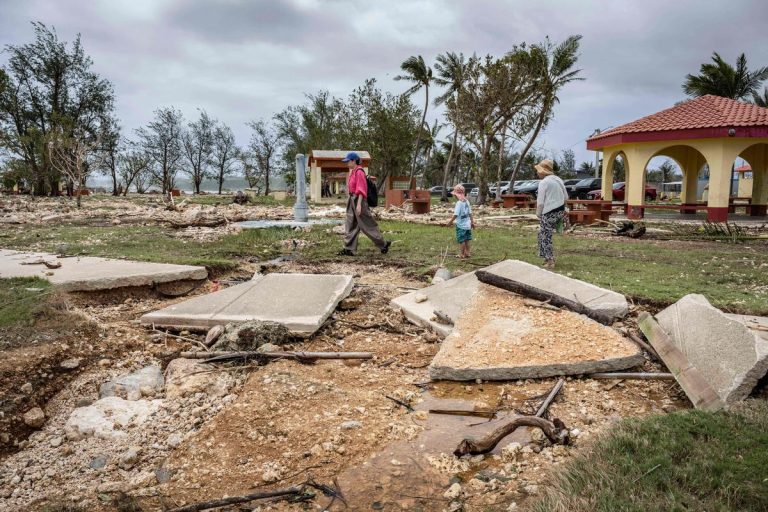
On Guam, less than 50 miles (80 kilometers) from Rota, fallen trees, bits of streetlamps and rocks were strewn over the roads late Monday and AFP saw at least one car flipped on its side.

With the exception of Rota, the damage in the region of around 210,000 people was less severe than after Sinkalu, a super typhoon that hit in April.

Guam resident Marie and her partner, who were clearing up the debris with an excavator, had to move out of their house after Sinlaku and were living in a van when Bavi struck.

“All of our stuff (in the van) got wet from this typhoon now, so we ended up coming here to our car because we have nowhere else to go,”” 37-year-old Marie told AFP.

Handyman Bob Benavente said at a seaside park where rocks had been washed ashore by the storm surge that some rainwater leaked into his house but that he and his neighbors had not suffered major damage.

“Everybody goes out and gets gas, water, all the supplies (before storms arrive)… Everyone’s used to it here. It’s part of the island lifestyle,” the 61-year-old told AFP.

Oceans experienced their hottest June on record and could set fresh highs in the months ahead, the European Union’s Copernicus Marine Service said last week.

Warmer oceans help tropical storms to intensify and add more moisture, which can fall as heavy rain.

Adding to the mix is the return this year of El Nino, a natural climate phenomenon that warms Pacific surface temperatures and typically occurs every two to seven years.

Its effects can include drought across parts of the Amazon, Indonesia and Australia, disrupted monsoons in India, and more tropical storms and typhoons in the Pacific.

Charles “Chip” Guard, 80, a meteorologist who for years worked for the National Weather Service in Guam, remembers 11 super typhoons in the Pacific in 1997.

“That was very strong El Nino year. This is a strong El Nino year, but you know the season’s only just started and we already had a couple,” Guard told AFP.

How a single nuclear-capable missile could undo China’s long-running Pacific charm offensive

0

Analysis by Jonathan Milne

China has read the black-and-white letters of the Treaty of Rarotonga carefully, before firing a ballistic missile into the South Pacific Nuclear-Free Zone. As a signatory to protocols II and III of the 1985 Treaty, the People’s Republic has pledged to never use or threaten nuclear explosives against any treaty signatory. And it’s committed to not test any nuclear explosive anywhere in the zone’s designated boundaries.

The missile fired Monday – most likely a new generation JL-3 missile designed to carry a nuclear warhead – is thought to have been launched from a nuclear-powered submarine outside the nuclear-free zone.

It soared past American missile-tracking facilities on Guam and in the Marshall Islands, and over the exclusive economic zones of Micronesia, Nauru and Kiribati, before splashing down north of Tuvalu.

China can credibly say it was not a threat, and it was not a nuclear explosive, so it was not a treaty breach. “This test launch complies with international law and international practice and is not directed at any specific country or target,” said Senior Captain Wang Xuemeng.

But China has not read the mood of Pacific peoples so well as it has read the letter of the law.

After years of diplomatic work, infrastructure investment and trust-building across the South Pacific, it risks losing many of its hard-fought gains in one fell swoop of a ballistic missile.

This was a rare strategic miscalculation by a nation whose foreign policy has usually been marked more by its calm foresight, as others act impulsively.

Some analysts have linked the test to the timing of the Fiji-Australia security deal, and say China is sending a message to Australia. It was the same day that Australian prime minister Anthony Albanese and his Fiji counterpart, Sitiveni Rabuka, signed a new bilateral defence agreement.

(International correspondent Anna Fifield, writing at Between Giants, rejects this explanation, noting that missile launches are dependent on weather and other factors.)

Other analysts have linked the timing to the start of joint naval exercises with Russia, and say China is sending a signal to the US. Lyle Morris at the Asia Society Policy Institute argues that the fact Japan, Australia and New Zealand were given an hour or two’s notice, but America was given none, shows it was primarily a signal to the United States.

“It means the People’s Liberation Army Navy is capable of targeting the continental U.S from bastions close to Chinese waters,” he tells Fifield. “The launch appears intended to demonstrate an operational sea-based nuclear deterrent.”

To be clear, China is not alone in such missile testing. The US routinely carries out test launches of ballistic missiles from land or sea, including one fired from California at a target in the Marshall Islands in March. But the Marshall Islands are not (yet) part of the Pacific Nuclear-Free Zone.

And this is a more serious provocation by China than the test-firing of a missile from Hainan Island in 2024; this shows that China could use its submarines to hit the US mainland with nuclear-armed missiles.

Yet whether Chairman Xi Jinping wants to send an airborne communiqué to friends like Russia, or to adversaries like the USA and Australia, this can be seen only as a fleeting exchange.

The more enduring message he is sending is to Pacific island nations like the Solomons, Fiji, Vanuatu, Cook Islands and Kiribati, which had been slowly strengthening their relations with China over the past eight years, since signing up to China’s Belt and Road Initiative.

These are populations that, like New Zealand, have watched with mounting alarm the mercurial behaviour of US President Donald Trump, and concluded that China is a calmer and more predictable friend. The Asia NZ Foundation’s annual Perceptions of Asia survey, last month, showed for the first time that New Zealanders were more likely to see China as a friend than the USA.

But now, this.

Consider beneath the flight path, Kiribati (formerly known as the Gilbert Islands) whose people were severely affected by 33 atmospheric nuclear tests conducted by the UK and US between 1957 and 1962. Local populations were exposed to radioactive fallout; there was lasting environmental contamination and intergenerational health complications like elevated cancer rates.

Kiribati had, controversially, slid closer to China than other Pacific nations. In 2019 it officially severed ties with Taiwan to recognise Beijing, and China has since funded large-scale infrastructure projects, supplied ships and planes, and provided Chinese officers for community policing. The China-Kiribati security relations created a rift with New Zealand, which temporarily suspended development aid.

Just two weeks ago, China’s chargé d’affaires Zhao Jian led a delegation of the ‘Chinese Assisting Police Team’ to parade at the Kiribati Police National Day celebrations. They were inspected by President Taneti Maamau.

It was a similar story in the Cooks, whose prime minister, Mark Brown, had signed a strategic partnership and agreements with China around infrastructure development and deep-sea mineral research. Again, it undermined relations with New Zealand, and Foreign Minister Winston Peters temporarily suspended aid.

But New Zealand and Australia have been quietly rebuilding relations with Kiribati, the Cooks and other island nations. Australia’s Anthony Albanese visited Fiji on Monday this week, and is in the Solomon Islands on Tuesday to advance bilateral security negotiations with the nation’s new prime minister, Matthew Wale.

Indeed, in his capacity as the current chair of the Pacific Islands Forum, Wale has been the first Pacific leader to speak out about this week’s missile test.

“China is a good friend of the Solomon Islands, but this is not something a friend does,” he said. “This is not good in our region. And as chair of the Pacific Islands Forum I have registered my strong protest yesterday with the ambassador. Solomon Islands also lodged a protest note.

“We don’t want to see any more countries — China, America, anybody — testing in the Pacific Islands region, that’s the bottom line. Be our friend, but don’t threaten us.”

China has undermined much of its own diplomatic work with this missile test.

Over the years, 13 Pacific nations have ratified the Treaty of Rarotonga, linking their lands and waters into one vast nuclear-free zone, and ratification is pending for a 14th, the Marshall Islands.

Foreign Affairs Minister Winston Peters says he’ll be talking with Pacific counterparts about China’s action.

“Pacific leaders have been clear we do not want to see the region become a theatre for outside military competition. This launch is not consistent with regional stability, and peace in the South Pacific,” he says.

“We, like our neighbours in other Pacific countries, have no interest in China using the South Pacific as a testing site for missile capability.”

Kiribati has consistently urged all nations to cease weapons testing in the “Blue Pacific Continent”. And like the I-Kiribati, the Cook Islands peoples are passionate about their opposition to nuclear weapons and testing – they’ve given the name to the Treaty of Rarotonga, the nuclear-free treaty signed on their biggest island on the 40th anniversary of the Hiroshima bomb.

Asked that day in 1985 whether the treaty was truly significant, in its incremental progress, New Zealand prime minister David Lange responded: “You can’t climb a ladder by starting at the top.”

Building relationships in the Pacific can only be achieved one step at a time. China has tried to start at the top of the ladder.

Rugby League World Cup 2026: 100 Days to Go

0

The best and most competitive Rugby League World Cup is just 100 days from kick-off as players from 26 teams representing 14 nations in Men’s, Women’s and Wheelchair tournaments ramp up preparations to win the game’s ultimate prize.

Rugby League World Cup 2026 gets underway on October 15 with the Kangaroos, the 2025 Ashes Series winners, taking on Pacific Cup champions New Zealand at Sydney’s Allianz Stadium.

It will conclude with the Men’s and Women’s finals on November 15 at Brisbane’s Suncorp Stadium, where the 100 Days To Go countdown was launched by Australian Rugby League Commissioner, The Hon Kate Jones.

Kangaroos coach Kevin Walter and Jillaroos coach Jess Skinner were also in attendance at the event, which was MC’d by Channel 7 sports presenter Mel McLaughlin.

Staged in nine cities in Australia, New Zealand and Papua New Guinea, Rugby League World Cup 2026 will feature 51 matches across the three tournaments in Sydney, Brisbane, Perth, Port Moresby, Christchurch, Newcastle, Wollongong, Gold Coast and Townsville.

Rugby League World Cup 2026 is proudly supported by the Australian Government.

Minister for Sport, the Hon Anika Wells MP, said: “The Albanese Government’s investment will help deliver a world-class tournament that inspires participation in rugby league at the junior level, including for Australians with disability.

“RLWC26 will strengthen Australia’s reputation as a global leader in hosting major sporting events as we build towards the Brisbane 2032 Games.”

Rugby League World Cup 2026 is also supported by the NSW Government through their tourism and major events agency Destination NSW, Queensland Government, through Tourism Events Queensland, Experience Gold Coast and Townsville City Council with Townsville Enterprise Limited, and Western Australian Government through Tourism WA. The Rugby League World Cup 2026 New Zealand match day is supported by ChristchurchNZ.

More than 100,000 tickets have been sold so far for RLWC2026, and fans are encouraged to take advantage of the accessible ticket pricing as matches are expected to sell out.

To coincide with the 100 Days To Go countdown to the Rugby League World Cup, RLWC2026 has announced the tournament’s inaugural commercial partners:

*Youi – Official General Insurance Partner of RLWC2026
* Bank South Pacific – Official Banking Partner of RLWC2026
*Rebel – Official Sports Retail Partner of RLWC2026
*Steeden – Official Match Ball of RLWC2026
*Ticketmaster – Official Ticketing Partner of RLWC2026
*New Balance – Official Apparel Partner of RLWC2026

The involvement of such a prestigious suite of commercial partners highlights the strong belief that RLWC2026 will be the most anticipated Rugby League World Cup ever staged. RLWC2026 would like to thank our partners for their commitment to showcasing rugby league’s ultimate event.

Established in 1954, the Rugby League World Cup is the second oldest sporting World Cup, and the 17th iteration is set to be the most competitive yet as Australia, New Zealand, England, Samoa, Tonga, Papua New Guinea, Fiji, France, Cook Islands and Lebanon battle it out for the Paul Barrière Trophy.

Tonga started a Pacific revolution at the 2017 World Cup and Samoa went a step further at RLWC2021 by creating history as the first Pacific nation to qualify for a World Cup final.

Since then, New Zealand have twice won the Pacific Cup, including a record 30-0 defeat of Australia in 2023, while Tonga qualified for the 2024 final and Samoa played in last year’s final against the Kiwis.

The format of the pool stages for RLWC2026 ensures a cut-throat element to the Men’s tournament, with crossover games and head-to-head results potentially determining semi-final spots and ensuring every match is must win.

Men

The 10-team Men’s tournament will include one pool of four and two pools of three nations.

*Group A: Australia, New Zealand, Fiji, Cook Islands
*Group B: England, Samoa, Lebanon
*Group C: Tonga, Papua New Guinea, France

Group A teams will each play three matches against the other teams in Group A. Group B and C teams will each play three matches against the teams in the adjacent group (ie Group B teams will play Group C teams only).

The Men’s tournament will kick off at Allianz Stadium on Thursday, October 15, with the heavyweight clash between the top two world-ranked teams, the Kangaroos and the Kiwis.

The opening weekend will also feature a clash between England and Tonga at Perth’s HBF Park, on Saturday, 17 October.

The Group stage culminates with a match between Pacific giants Tonga and Samoa, at CommBank Stadium, on Sunday, November 1, that is likely to decide which nation progresses to the play-off stages of the tournament and which nation is eliminated.

The top two teams from Group A will progress to the Semi-Finals, while the top two teams from a combined table of Group B and Pool C will progress to the Semi-Finals.

Men’s matches will be played across Sydney, Port Moresby, Perth, Newcastle, Christchurch, Brisbane, Wollongong, Gold Coast and Townsville.

Women

In the Women’s World Cup, eight nations are set to take to rugby league’s ultimate stage and the all-conquering Jillaroos will not have everything their own way as the growth of the NRLW and eligibility rule changes strengthen other nations.

After dominating Women’s Rugby League until their first defeat by Australia in the 2013 World Cup final, the Kiwi Ferns are again building and will be bolstered by big name stars switching from the Jillaroos and the addition of cross-code athletes.

*Group A: Australia, England, Samoa, Wales
*Group B: New Zealand, Papua New Guinea, France, Fiji

The Women’s tournament will kick off on Friday, October 16 with a clash between the Jillaroos and Samoa that will headline a double-header at CommBank Stadium with the Samoa v France Men’s match.

Each team will play three matches against the other teams in their Group. The top two teams from each Group will progress to the Semi-Finals.

Wheelchair

Just as the 2017 World Cup took Women’s rugby league to new heights, the Wheelchair World Cup is set to expose new fans to a form of the code that underlines why rugby league is known as the greatest game for all.

England will be aiming for back-to-back Wheelchair World Cups, while France will be out to avenge their defeat in the RLWC2021 final an Australia’s Wheelaroos will be aiming to win on home soil.

The eight-team Wheelchair tournament will be played in its entirety at Wollongong’s WIN Entertainment Centre.

*Group A: England, Ireland, Wales, USA
*Group B: France, Australia, Scotland, New Zealand

England’s opening match against Wales on October 30 will coincide with the England Men’s and Women’s teams playing afterwards in a double-header at the adjacent WIN Stadium, with Papua New Guinea and Fetu Samoa their respective opponents.

Pacific Elders warn against external influence in regional security

Pacific Elders have warned that growing geopolitical competition is reshaping the region and have called for Pacific security to remain firmly under the control of Pacific leaders, saying regional institutions must protect sovereignty, transparency and equal decision-making.

The Pacific Elders said peace in the region is broader than the absence of conflict.

“Pacific peace has never meant simply the absence of conflict. It is the presence of justice, dignity, respect and balance. It is the protection of our people, our ocean, our cultures and the inheritance we leave to future generations.

For Pacific peoples, peace is inseparable from sovereignty, stewardship, climate justice and our collective responsibility to one another,” the Elders said in a statement.

The Elders said Pacific regionalism has always been based on cooperation between sovereign nations.

“As Pacific Elders, we have witnessed the evolution of Pacific regionalism over many decades. We have seen our institutions at their strongest when they have upheld the equal sovereignty and self-determination of every Pacific nation, strengthened consensus, and placed the collective interests of our Blue Pacific above the competing interests of external powers. Pacific regionalism has never been about surrendering sovereignty. It has been about sovereign nations choosing to act together in pursuit of common purpose.”

The statement said the Pacific now faces an important turning point.

“Today we believe the region stands at an important crossroads.”

The Elders said they were concerned that the region’s vulnerabilities were increasingly being viewed as opportunities for external influence.

“Increasing geopolitical competition is reshaping the Pacific in ways that demand careful reflection. We are concerned that the vulnerabilities of our peoples, our exposure to climate change, economic dependence, geographic isolation and security challenges, are increasingly being treated as entry points for external influence, reframed as strategic opportunities rather than injustices requiring collective action. Rather than addressing their structural causes, these vulnerabilities are too often used to justify new forms of intervention and security cooperation.”

They warned that such an approach weakens Pacific sovereignty.

“When vulnerability becomes a pathway for external influence, sovereignty itself is diminished. This is not the vision upon which Pacific regionalism was founded. Our regional institutions were created to strengthen the equal sovereignty and self-determination of every Pacific nation through cooperation and shared purpose, not to create new pathways through which power is concentrated, or influence is exercised over the most vulnerable.”

The Elders reaffirmed the Pacific Islands Forum as the region’s principal decision-making body but said it must continue to evolve.

“The Pacific Islands Forum remains the proper home for collective regional decision-making, but its legitimacy must continually be renewed. Like all institutions, the Forum should continue to evolve to ensure that power is shared more equitably across the region, decision-making is transparent, and all members, regardless of size or geopolitical influence, participate as equal partners. The future of Pacific regionalism cannot be determined by Australia, New Zealand or the larger Pacific states alone. Every member of our Pacific family must have an equal voice in shaping our shared future.”

They said regional security governance must remain under the authority of Pacific political leaders.

“Security governance must remain firmly under the authority of Pacific Leaders and Ministers. Technical officials provide essential expertise, but they cannot replace political leadership or pre-empt the decisions of sovereign governments.”

The statement raised concerns over the role of the Joint Heads of Pacific Security.

“We are therefore concerned that bodies such as the Joint Heads of Pacific Security, comprising unelected officials and operating outside the formal Forum governance structure, risk becoming a parallel centre of regional security decision-making. Pacific security must remain genuinely Pacific-led, accountable to Pacific governments and people through institutions established by Pacific Leaders. This principle should guide the development of new regional security initiatives.”

The Elders said any future regional security architecture should operate through the Pacific Islands Forum.

“If regional security architecture is to be strengthened, it should do so through the Pacific Islands Forum itself. Just as the Forum’s economic governance is anchored through Leaders, Ministers, Officials and formal sub-committees, regional security should follow the same constitutional principle.

Any regional security mechanism should be formally located within Forum-agreed processes, supported by the Pacific Islands Forum Secretariat, and accountable to Leaders and Ministers. It should not develop as a stand-alone security structure whose authority is unclear or whose direction is shaped outside collective Pacific political oversight. Bodies such as the Joint Heads of Pacific Security should remain technical advisory mechanisms, not permanent pillars of Forum governance.”

The statement also questioned proposals for a Regional Operations Deployment Framework.

“We are concerned by proposals for a Regional Operations Deployment Framework, advanced under the banner of humanitarian assistance and disaster relief but extending to stability operations, election support and event security.

While any regional framework must ultimately be agreed by Pacific governments through Forum processes, we are concerned that key elements and drafting instructions are being developed before Leaders have determined the framework’s purpose, governance and accountability. The Boe Declaration calls for flexible and responsive regional architecture. It should not be interpreted as a mandate for a single standing deployment mechanism or for technical processes to run ahead of collective political oversight.”

The Elders also expressed concern about proposals for more centralised approaches to maritime security.

“We are equally concerned by proposals for increasingly centralised, intelligence-led and militarised approaches to regional maritime security, including Waqa Moana.

“Pacific cooperation against transnational crime is essential, but new initiatives must complement—not duplicate or displace—the decades of civilian-led regional cooperation established through the Niue Treaty Subsidiary Agreement, the Forum Fisheries Agency, the Regional Fisheries Surveillance Centre and the region’s world-leading work on maritime domain awareness and combating illegal, unreported and unregulated fishing.

“These achievements should be strengthened, not overshadowed by approaches that centralise authority, duplicate existing systems, blur the distinction between civilian and military cooperation, or shift control away from Pacific-owned institution,” the statement said.

They also urged caution over proposals for a regional security treaty.

“Finally, we encourage careful reflection on proposals to further institutionalise or codify the region’s emerging security architecture, including through a regional security treaty. Such proposals must be understood in the context of the wider security agenda now developing across the region and alongside our existing legal framework.”

The Elders said the Treaty of Rarotonga should remain a cornerstone of Pacific peace.

“The Treaty of Rarotonga was hard won. It stands not simply as a legal instrument, nor as a foundation upon which new security arrangements can automatically be built, but as an enduring expression of Pacific values and our collective commitment to peace.

It should be strengthened, not repurposed or weakened through processes that inadvertently constrain Pacific sovereignty or embed security arrangements before their broader implications have been fully considered.”

The statement said regional peace must address the broader causes of insecurity.

“An Ocean of Peace cannot be built on a narrow security agenda.

Peace cannot be separated from climate justice or from the forces that produce insecurity in Pacific lives: climate change, fossil fuel dependence, extractive industries, militarisation, nuclear legacies, gendered violence and the denial of self-determination. These are the challenges that any genuine Pacific peace agenda must confront,” the statement said.

Australia chases next Pacific treaty after Fiji win

0

Australian Prime Minister Anthony Albanese is seeking to finalise a security deal with the Solomon Islands within months, off the back of a major diplomatic win elsewhere in the Pacific.

The prime minister arrived in Honiara on Tuesday morning, receiving a red-carpet welcome as he was greeted by his Solomon Islands counterpart Matthew Wale.

The leaders held a brief bilateral meeting at the airport moments after Albanese touched down.

The prime minister told Wale there was “much more that we need to do together”, including the development of a comprehensive treaty.

“We will task our ministers to continue to do work on that and hopefully to conclude that by the end of the year,” he said.

Wale said he was extremely pleased to see Albanese so soon after his own visit to Canberra in early June.

“We have much to transact, so we look forward to great conversations,” he said.

Albanese will become the first foreign leader to address the Solomon Islands’ Independence Day celebrations.

He entered the national stadium alongside Wale and both were given floral garlands to wear.

The visit to the Solomons followed Australia signing a mutual defence alliance, known as the Ocean of Peace treaty, in Suva on Monday.

The alliance, which views an attack on one nation as an attack on the other, marks Fiji’s first mutual defence pact.

The Pacific island nation has become Australia’s fourth formal ally, joining the U.S, New Zealand and Papua New Guinea.

The treaty allows other Pacific nations to join the alliance.

Wale has previously called for a Pacific-wide pact.

The agreement was signed alongside the Vuvale Union, which includes $1 billion (US$690 million) in investment over the coming decade into key areas including climate and economic initiatives.

During a joint press conference with Albanese, Fijian Prime Minister Sitiveni Rabuka said he did not anticipate any “severe pushback” from China.

“I believe that they will welcome the understanding that it is within Australia and Fiji,” he told reporters.

“It does not threaten Fiji’s relationship with China nor Australia’s relationship with China.

“And as we have made it very clear in the past, your enemies are not necessarily my enemies.”

But China’s foreign ministry spokeswoman Mao Ning issued a frosty response on Monday evening.

“We do not engage in geopolitical rivalry or seek selfish political games.

“It is hoped that the country of concern will truly respect the independence of Pacific Island nations, focus on their sustainability, such as economic development, and avoid targeting any third party or harming the interest of any third party,’ she said.

PM Rabuka says Fiji’s sovereignty secure under historic Australia alliance

Prime Minister Sitiveni Rabuka says Fiji’s sovereignty remains secure under the newly signed Vuvale Union and Ocean of Peace Alliance with Australia, stressing that the partnership is built on dialogue, regional solidarity and respect for international law.

Speaking at a joint press conference with Australian Prime Minister Anthony Albanese in Suva on Monday, Rabuka was asked how Fiji would ensure the long-term protection of its sovereignty under the alliance.

“We are protected by the articles of the United Nations. We are a member of the United Nations. If anything threatens that sovereignty, we have the Vuvale partnership. We have our own regional solidarity to rely on as well as the world’s understanding of the word sovereignty.

“I believe our sovereignty is secure. Our relationship is based on understanding, on dialogue rather than disputes. We will not take our differences to weapons. We will come to the conference table and work through that way to ensure that our sovereignty is respected,” Rabuka told Journalists in Suva.

Responding to questions about criticism that Australia was advancing its own agenda in response to China’s growing influence in the Pacific, Prime Minister Albanese said the alliance builds on a long history of cooperation between the two countries.

“This alliance is about elevating what is a long history of defence cooperation.

“And indeed, when we sat in our bilateral meeting, not just the Prime Minister but three of his colleagues as well, had all undertaken experience in Victoria or indeed at Duntroon. And so, this is, as well, builds on the work that we’ve done over a long period of time standing side by side in peacekeeping missions.”

“This is about our relationship but elevating it to the highest possible level of an alliance,” said Albanese.
Asked what practical defence and security benefits the agreement would bring for Fiji, Albanese said the treaty strengthens Australia’s commitment to Fiji’s security.

“Firstly, the alliance provisions are very clear, which is that an attack on Fiji from an outside force would trigger Australia’s full support for Fiji and for its sovereignty,” Albanese said.

He said the agreement would also expand defence cooperation.

“When it comes to defence cooperation, what this will do is to further allow for discussions about specifics. We have provided some infrastructure in the past.

“It’s not about troops in each other’s nations or that at all, but it will allow for a clearer area of cooperation and requests to be made over the full suite of challenges that confront national security in 2026.

“That comes not just from traditional ways that it’s seen, but areas like cyber security and other areas as well. And it will mean an upgrade in areas including increased cooperation in training and exercises as well,” said Albanese.

The two leaders were also asked whether other Pacific Island countries could join the alliance in the future.

Rabuka said the agreement demonstrates what Pacific neighbours can achieve together.

“It’s not a matter of wanting. We have just signed the treaty as an example of what Pacific neighbours can do for each other and together as we move forward to ensure that the Pacific remains an ocean of peace, that we are prepared to come to everybody else at and anybody else in the Pacific region assistance when they are threatened.”

“And that is the real nature of this. We can specifically ask for one, as I had tried to develop, and Australia said, yes, we’ll go with you. And I’m sure right now there are other Pacific leaders who are waiting to come in. The more, the stronger, the better,” Rabuka stressed.

Albanese said Australia wants Pacific countries to take responsibility for the region’s own security while distinguishing the new agreement from broader regional arrangements.

“We have said very clearly that when it comes to security issues, the Pacific family need to look after our own security. We’ve made that clear across the board.

“And the Vuvale Agreement is certainly a part of that. But we have said that we want to be as well the security partner of choice within our family. So, that has a range of aspects, including the Pacific Policing Initiative that has been very successful.

“An alliance, though, is something at a very different level. It’s something that was proposed by Prime Minister Rabuka and we were happy to agree because of the history and the relationship that we have with Fiji, which is very, very special.”

“It’s a bilateral alliance. That is a different level from the discussions that normally take place about regional security and those elements as well,” said PM Albanese.

China tests long-range missile in South Pacific in move Australia condemns as ‘destabilising to region’

0

China has conducted a long-range missile test in the South Pacific just hours after Australia signed a defence agreement with Fiji, sparking condemnation from Canberra and regional leaders.

The Australian foreign minister, Penny Wong, said the missile test was “destabilising” to the region, while her New Zealand counterpart, Winston Peters, described it as “deeply concerning”.

A Chinese navy statement said a nuclear submarine launched a “strategic missile carrying a training simulation warhead” on Monday, adding it had “accurately land(ed) in the designated sea area”.

“This missile test launch is a routine arrangement of China’s annual military training, and relevant countries were informed in advance,” spokesperson Wang Xuemeng said in the WeChat statement.

China’s defence ministry did not confirm whether an intercontinental ballistic missile (ICBM) was used in Monday’s test.

The exact location of the test was unknown. The New Zealand government said it was informed of the planned launch hours beforehand and noted that it was fired into the South Pacific Nuclear Free Zone.

The ⁠test came just hours after Australia and Fiji signed a major defence alliance, committing each country to come ⁠to the other’s aid in the event of an attack.

The so-called Ocean of Peace alliance, which is open to other countries to join in the future, is part of Australia’s efforts to deepen ties in the Pacific and push back at Beijing’s attempts to expand its influence in the region.

Malcolm Davis, a senior defence analyst at the Australian Strategic Policy Institute, was certain the timing of the test was not a coincidence.

“[The test] is clearly an indication that China will use military force, or the threat of military force, to try to intimidate and coerce small Pacific states into not seeking closer relations with Australia,” he said.

Australia’s assistant foreign minister, Matt Thistlethwaite, told the ABC the government did not believe there was a link between the alliance announcement and the test.

But another federal government source told the Guardian they believed the events were linked.

China’s ministry of foreign affairs said the launch was “not directed at any specific country or target”.

“Related launch operations were conducted safely, in a standardised manner and professionally. It is hoped that relevant countries will not over-interpret this,” spokesperson Mao Ning told reporters.

The Chinese embassy in Australia did not respond to a request for comment.

Australia’s acting prime minister, Richard Marles, said China had only informed his country on Monday of its plans to conduct a long-range missile test in the Pacific region, with reports that it was a nuclear-capable device with a dummy warhead.

“We were informed by China of its intention to do this test,” Marles told a press conference on Monday afternoon.

“This is a long-range missile test, and we are very concerned about any actions which undermine the stability, the peace, and security of the Pacific,” he said.

Thistlethwaite said Australia was “deeply concerned” and had already “conveyed those concerns to the Chinese government, both in Beijing and in Canberra as well”.

“The motivations behind it, I think, are a question for the Chinese government. I think the Australian people, and indeed the people of the Pacific, would like to know the motivation behind it,” Thistlethwaite said.

A statement from the Japanese government said it had tried to convince China not to fire the test missile and had “expressed serious concerns over China’s increasing military activity”.

Wong said she would “leave it to China to speak to its intent” but that Australia had been aware of a Chinese task group in the region “for some time”.

“Australia has been clear with China that we regard this as destabilising to the region,” Wong said from Fiji, where she was travelling with the prime minister, Anthony Albanese.

“Australia has been clear that this proposal, this proposed test, is in the context of a rapid military buildup by China, which is lacking in the transparency and reassurance as to intent, that the region expects.

“The Pacific Islands Forum leaders have made clear that they want the Pacific to be an Ocean of Peace. We believe this test is inconsistent with that objective.”

Wong would not confirm whether Australia had been informed about the missile’s potential nuclear capability. On Monday afternoon she said Australia had been informed the test would be “within the next 24 hours”.

The test reportedly occurred at about the same time.

Speaking to the ABC on Monday evening, Wong said Australian defence attachés in Beijing and officials in Canberra had been briefed by their Chinese counterparts earlier in the day. Australian officials communicated the government’s view, she said.

Wong said she expected to discuss the test in her next official engagements with Chinese representatives.

“In an era where we see contest and competition, the destabilising acts can lead to miscalculation, can lead where we do not want these actions to lead,” she said.

China last tested an intercontinental ballistic missile in 2024, a rare event that highlighted the country’s increasing military capabilities.

Data from Starboard Maritime Intelligence, a New Zealand ship-tracking company, showed three Chinese satellite-tracking vessels positioned throughout the Pacific.

Two vessels departed China on about 25 June and now sit near the Federated States of Micronesia. The third departed China in early May and is now at harbour in Fiji’s capital, Suva.

“These vessels carry large satellite dishes used to track missile launches and other space activity and are likely in the Pacific to collect data from the ⁠missile test China has reportedly notified regional governments to expect within 24 hours,” said Mark Douglas, an analyst for Starboard.

Noting the departure times of the Chinese vessels, he added: “This test has been planned well in advance. That said, the notification landing the day after Australia and Fiji signed the Ocean of Peace Alliance is interesting, to say the least.