Home Blog Page 39

PNG Chief Justice will not face Leadership Tribunal, Sir Gibbs cleared

0

Papua New Guinea Chief Justice Sir Gibbs Salika has been cleared of any wrongdoing as evidence provided by the Ombudsman Commission to refer him to a Leadership Tribunal is “insufficient”, says acting public prosecutor Helen Roalakona.

“We have declined to refer the leader to the National Executive Council for the appointment of a Leadership Tribunal,” she said.

“We have declined to refer the leader to the National Executive Council for the appointment of a Leadership Tribunal,” she said.

“The decision was done through careful and close assessment of the material given to us by the Ombudsman Commission.

“We have considered all the evidence in its entirety and have arrived at the decision that there is insufficient evidence, and therefore we have declined to refer the matter.”

Sir Gibbs was referred to the Office of the Public Prosecutor by the commission on 09 March, over the 50 allegations of failure to declare incomes from unknown sources, contrary to Section 27 (1) of the Constitution, and Section 4 of the Organic Law on the Duties and Responsibilities of Leadership.

He was alleged to have failed to declare in his annual statements the source of additional income he received between 2018 and 2024, amounting to K1.6 million (US$368,000), and his wife’s income between 2019 and 2023, amounting to K460,000 (US$105,000).

It was determined in the assessment of evidence that most transactions consisted of a pattern of cash withdrawals from Sir Gibbs’ primary salary account which were deposited on the same date into his savings account.

The amounts were additional income and were declared by Sir Gibbs as his net income in his annual statements for those years.

Upon assessment, Roalakona discovered that the additional allowances that were received in Sir Gibbs’
accounts were payments done by the National Judicial Staff Services through internet banking, and were registered under transactions numbers, and was declared as his additional income.

It was also determined that the income received by his spouse during the alleged periods were traced to be monies deposited from Sir Gibbs’ primary salary account and were declared by him in the annual statements.

“The determination on the evidence is that there is insufficient evidence that is not credible or cogent to warrant the referral of the Leader to the appointing authority for a Leadership Tribunal,” Roalakona said.

So pursuant to Section 177 (b) of the Constitution, Roalakona declined to bring a proceeding under the Leadership Code against Sir Gibbs over misconduct in office.

NZ Hosts 142nd Forum Fisheries Committee Annual Officials Meeting

The 142nd Annual Officials Meeting of the Forum Fisheries Committee (FFC) opened in Aotearoa New Zealand, this morning, bringing together senior fisheries officials and delegates from across the Pacific region for a week of high-level regional discussions on the future of Pacific fisheries.

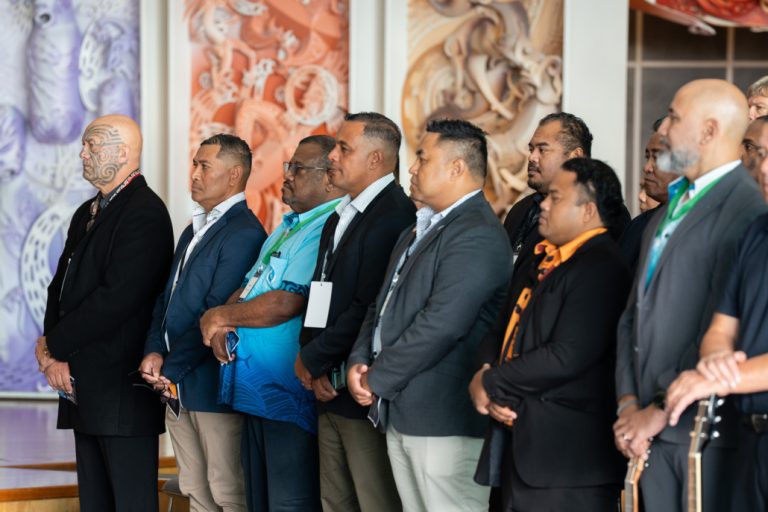
Hosted by the Government of New Zealand, the meeting began with a traditional Māori pōwhiri at Te Papa Tongarewa, New Zealand’s national museum. The formal welcoming ceremony brought together Members, delegates and participants in a powerful expression of partnership, respect and shared purpose.

The pōwhiri ceremony marked the start of the weeklong Annual Forum Fisheries Committee (FFC) Officials 142nd Meeting in Wellington, New Zealand. Photo: New Zealand Ministry for Primary Industries

The pōwhiri, which included traditional speeches and waiata from both hosts and visitors, welcomed delegates onto the marae and into the meeting space. The ceremony reflected the deep cultural connections between Pacific peoples and the ocean, and the shared responsibility of stewarding the region’s fisheries resources for future generations.

Associate Deputy Director-General for Trade and International Relations at the NZ Ministry of Primary Industries (MPI), Diana Reaich, welcomed delegates on behalf of the New Zealand Government and acknowledged the outgoing Chair, Niue’s Poi Okesene, for his leadership over the past year.

“I am sure you will all agree that his leadership has been instrumental in fostering unity, constructive dialogue, and a clear focus on outcomes that serve the long-term interests of Pacific fisheries and Pacific communities,” Reaich said.

She noted that the successful adoption of the South Pacific albacore management procedure and seabird conservation measure at last year’s Western and Central Pacific Fisheries Commission (WCPFC) meeting demonstrated what could be achieved through regional cooperation and collective commitment.

“As you all know, fisheries are central to the economic security, food security and livelihoods of our region,” she said.

“They underpin national revenues, support local communities, and are integral to the broader resilience and sustainable development of Pacific Island countries and communities.”

Pacific Islands Forum Fisheries Agency (FFA) Director-General Noan David Pakop thanked the Government of New Zealand for hosting the meeting and acknowledged the significance of the traditional welcome.

“We are particularly honoured by the traditional pōwhiri welcome this morning, which reflects the spirit of partnership, respect and shared stewardship that underpins our regional fisheries cooperation,” Pakop said.

He said the meeting comes at an important time for the region as Pacific countries continue navigating increasing geopolitical interest, climate change impacts, growing pressure on ocean resources and evolving regional priorities.

“Today, tuna continues to be the common currency of the Blue Pacific,” Pakop said.

“The Pacific region collectively manages one of the largest and most valuable tuna fisheries in the world, and the strength of our cooperation over many decades remains globally recognised as one of the great success stories of regionalism.”

Pakop said Members would spend the week discussing issues central to the future of regional fisheries cooperation, including the FFA Strategic Plan review, implementation of the KPMG Review recommendations, regional fisheries management priorities and preparations for upcoming WCPFC negotiations.

Outgoing Chair Poi Okesene of Niue reflected on the significance of gathering at Te Papa Tongarewa.

“It is especially fitting that we gather here at Te Papa Tongarewa, where the stories of land and ocean are connected and preserved with care,” Okesene said.

“Te Papa honours and celebrates Pacific and Māori heritage and reminds us that the moana is not simply a resource, but a relationship that connects us all.”

Okesene also highlighted key achievements during his term as Chair, including the adoption of the South Pacific albacore management procedure, progress on conservation and management measures, strengthened regional monitoring and surveillance cooperation, and advancements in treaty negotiations.

“These achievements are the result of countless months of hard work, long days, late-night conversations, and the willingness of members to compromise for the greater good,” he said.

Outgoing FFC Officials Chair, Poi Okesene of Niue Fisheries, hands over a paddle to Heather Ward of the New Zealand Ministry for Primary Industries, symbolising the handover of the FFC Chair from Niue to New Zealand for the next 12 months. Photo: New Zealand Ministry for Primary Industries

Incoming FFC Officials Chair, Heather Ward, Manager of International Fisheries at the New Zealand Ministry for Primary Industries, paid tribute to Niue’s leadership and acknowledged the challenges ahead for the region.

“We must also confront the complexities of mixed fisheries management as we continue work on developing a management procedure for bigeye tuna,” Ward said.

“This week, members will also consider other priorities ahead of the annual WCPFC meeting, including strengthening the management of transshipment and progressing toward a practical electronic monitoring programme within the WCPFC framework.”

Ward also acknowledged the wider global environment affecting Pacific fisheries, including rising fuel prices and broader economic pressures impacting fisheries operations across the region.

“At the same time, we continue to grapple with ways to increase the value derived from our tuna fisheries,” she said.

The new Chair officially declared the 142nd Annual Officials Meeting of the Forum Fisheries Committee open.

Over the coming days, Members will deliberate on a broad range of regional priorities, including strategic planning, climate change implementation, monitoring, control and surveillance cooperation, market access, the East New Britain Initiative, and strengthening the collective coastal State position on key fisheries issues.

The Forum Fisheries Committee remains the region’s premier technical and policy forum for fisheries cooperation, bringing together Members of the Pacific Islands Forum Fisheries Agency to collectively manage and protect one of the world’s largest tuna fisheries for the benefit of Pacific peoples.

When the ocean is sacred: Pacific theology and the governance of deep-sea mining

0

By Jaap Timmer, Emilka Skrzypek and Nicholas Bainton

Regulatory frameworks for deep-sea mining (DSM) treat the ocean as a space to be measured, governed and economically valued. DSM proponents claim that this form of mining avoids many of the negative impacts associated with terrestrial extraction (such as displacement or land use changes), working from an assumption that deep seas are largely inert or empty spaces.

What such frameworks, and proponents’ views, fail to accommodate is an ocean that is already inhabited. Not merely by ecosystems, but in many Indigenous contexts by ancestors, by spirits and by God, and thus by moral obligations that predate any regulatory regime. This is not a problem of cultural inclusion. It is an ontological conflict. It is a profound disagreement over what kind of being the ocean is before it is rendered legible in regulatory systems.

The distinction matters. DSM governance frameworks can include cultural representatives, require community consultation or mandate Indigenous participation — and yet still operate with a fundamentally different account of what the ocean is. Across a range of Pacific religious and ethical traditions, articulated in diverse and sometimes contested ways, responsibility to the sea is not just responsibility for the ocean, as a resource to be managed. It is responsibility to the ocean, as a morally inhabited world that humans enter already indebted.

In October 2025, this tension became visible at a climate talanoa in Sydney. Uniting Church leaders welcomed Climate Minister Chris Bowen and Pacific counterparts with a clear message: harm to the ocean is not merely a policy failure, but a moral and spiritual violation. Drawing on Pasifika theology, church leaders called for climate leadership grounded in care and justice. There are other examples.

Also in 2025, Methodist leader Reverend James Bhagwan condemned proposed seabed mining leases in American Samoa, framing DSM as a moral and spiritual violation rather than a neutral technological option, invoking a sacred responsibility understood by many Pacific people and churches for and to the ocean.

This framing was sharpened at a recent workshop at Macquarie University on DSM and Enchanted Ecologies. Prominent Pacific theologian Reverend Dr Cliff Bird and regional scholars, including the authors of this blog, reflected on the ways the unknowability of the seabed mirrors the mystery at the heart of encounters with God, ancestors and spirits. What emerged from this workshop is a concept we term spiritual responsibility: the obligation that arises from living within a world populated by humans, ancestors, spirits, non-human beings and God, bound together in enduring relation.

Different Pacific theological traditions develop this notion through several overlapping concepts. Reweaving the Ecological Mat (REM) advances a relational theology that decentres human dominance and situates responsibility within an ecological Aiga (household) in which land, sea and air are not resources, but storied, sacred spaces shaped by ancestral presence and obligation. Practices such as tabu and rahui, which set aside areas for regeneration, exemplify spiritual responsibility as restraint rather than mastery.

Concepts such as vanua or fonua name the inseparability of people, place and spiritual power, though they are interpreted and articulated differently across communities, denominations and islands.

Within such cosmologies, responsibility is prior to choice. People do not decide whether to be accountable to land or sea in the way one might adopt a policy position; accountability is a condition of their being. Ancestors are not merely remembered; they remain morally present. Spirits are not symbolic; they are attached to lands and waters, such that environmental harm becomes a form of relational violation. God too, within many Pacific Christian theologies, is not a distant arbiter but an active participant in sustaining the moral coherence of the world.

This is not an argument that Christian theology should be embedded in environmental governance everywhere, nor that other belief systems are less deserving of recognition. Rather, it reflects the specific historical and institutional context of DSM governance in the Pacific, where Christian churches remain among the most influential moral, social and political institutions. In many Pacific states, churches operate as key interlocutors between communities and governments, shape public ethics and articulate moral limits to development in ways that carry political weight. Elsewhere, different religious or ethical traditions may warrant similar attention. The claim here is context-specific rather than universal: in Pacific DSM governance, Christian theologies are already operative in shaping public reasoning about the ocean, whether or not governance regimes acknowledge their role.

We are also not trying to imply that Pacific states, communities and church positions on DSM are uniform or politically innocent. Rather, we draw attention to the strong and growing theological current across the region that treats DSM as categorically different from the regulatory calculus that governs it.

Considering all this, DSM governance bodies should move beyond technical regulation and risk management as the sole basis for decision-making. This does not mean substituting spiritual considerations for scientific expertise. It means recognising that these are not competing ways of thinking about the same thing — they are different accounts of what the ocean is, and what obligations follow from that. Again, we emphasise the importance of the distinction.

Following through on this would require institutional changes, with procedural consequences. These could include establishing advisory mechanisms that integrate Pacific theological and cosmological traditions as legitimate sources of ethical authority, rather than merely as “cultural context”, requiring ethical and spiritual assessments to run alongside environmental impact assessments, and explicitly identifying where regulatory categories fail to capture spiritual responsibilities. Findings of ethical indeterminacy, where a regulatory or governance mechanism cannot satisfactorily adjudicate moral claims, should be considered a basis for delaying, reshaping or stopping licensing processes, rather than, as at present, merely generating “social licence” risks to be managed.

Such arrangements would have analogues in existing mechanisms — for example, regimes that allow resource projects to be constrained or prohibited on the grounds of Indigenous spiritual significance — while recognising that Pacific theological claims often extend beyond site-specific heritage to oceanic relational worlds. These changes would require sustained, targeted investment in Pacific-led theological and ethical capacity building within governance institutions.

This points to forms of support that are both feasible and, depending on the specifics, appropriate for governments, regional organisations, universities or churches. Such investment could include:

•support for interdisciplinary training programs linking Pacific theologians, ethicists, scientists and policymakers

•resourcing for Pacific universities and theological colleges to develop applied expertise in environmental and governance ethics

•funding for governance institutions to employ or consult specialists capable of translating theological and cosmological claims into decision-relevant ethical analysis without instrumentalising them

•additional support for the existing role of Pacific churches in functioning as intermediaries between communities and states.

International churches need to contribute, but secular and donor agencies should also consider doing so insofar as the focus is on environmental governance reform rather than religious advocacy.

In the end, Pacific theologies are not local barriers to global governance. They are sources of insight with global relevance, especially as new technologies and environmental crises force urgent questions about how humans can live responsibly within an interconnected and morally consequential Earth.

If the ocean is sacred, then governing deep-sea mining is not simply a technical task. It is a moral reckoning with how we choose to live in a world already shaped by spiritual responsibility.

Jaap Timmer is an Associate Professor in the Macquarie University School of Communication, Society and Culture. His expertise draws on decades of ethnographic research in the Southwest Pacific and Southeast Asia.

Emilka Skrzypek is the Deputy Director of the Centre for Energy Ethics at the University of St Andrews. With a regional focus on Oceania, her work explores broadly conceived resource relations and interdependencies.

Nick Bainton is a Professor in the ANU School of Regulation and Global Governance (RegNet), where he leads the Extractive Systems Laboratory which examines the planetary pressures and future trajectories of resource extraction in an overheated world.

Kanaloa Consortium considers bypassing Moana Pasifika owners to deal directly with NZR

0

Kanaloa Consortium, who are bidding to buy Moana Pasifika’s licence in the Super Rugby Pacific competition, are hoping their case can be given its fair hearing, as uncertainty continues to hover over the club’s future.

Kanaloa’s CEO Tracy Atiga confirmed on Monday there is an opening to get some discussions on the issue with current Moana Pasifika owners Pasifika Medical Association (PMA), which has not shown any interest in supporting Kanaloa’s proposal.

“We have had contact from the Pacific Rugby Players (PRP) association, who have been supportive and I hope that we can start discussion with the stakeholders involved,” she told RNZ Pacific.

“We are happy to hear that PRP have had a look at our proposal and are happy with it.”

Atiga said the PRP has “initiated discussions to get everybody in a room and talk about it”.

She said they are working around a tight dealine, with 15 May being the date given to them by New Zealand Rugby (NZR) to send in their proposal to the NZR Board.

Last week, she told RNZ Pacific that PMA chief executive Debbie Sorensen and New Zealand Rugby Players Association’s Rob Nichol were blocking support for the buy-out proposal.

Since then, Sorensen and Nichol have both stated that Kanaloa should send their proposal to NZR.

But Atiga insists they need to get both the organisations’ support as per letter sent to them by NZR, adding they need to look at the books, the financial records of Moana Pasifika, as per any legal business dealings.

In an interview with ABC’s Pacific Beat, Atiga claimed PMA is reluctant to show Kanaloa their books.

“No one’s going to come along and buy a franchise if they don’t have an opportunity to go through the books,” she said.

“I think that’s really what it is. We cannot think of any other reason why they have refused to talk to us.

“We need access to their due diligence process so that we can have a look at these books, have a look at how they have operated for the last five years, so that we can actually say, ‘oh, yeah, okay, your model hasn’t worked this way’.

“We feel we can introduce these different things so we can take this forward, because New Zealand Rugby really want someone to come in and buy the franchise as is now on ‘as is level’, the franchise is not sustainable.

“So we need to be able to see exactly what’s been going wrong before anyone even talks about signing over an agreement.”

Atiga said if PMA and NZRPA still do not want to engage, then Kanaloa will just work directly with NZR and let them decide whether the licence will be given to them or not.

“If the licence is gone, it goes back to New Zealand Rugby, so, let’s just have a direct conversation with New Zealand Rugby,” she said.

“They have given us to the 15th of this month to get as far down the track with PMA and NZRPA as possible, to get their support and to get their agreement to sign the licence over.”

She said that is the path Kanaloa is taking right now.

“And as soon as we have that we will put something in. We will present all the evidence where we have shown – that we have tried very hard to engage with these two parties, and then we will leave it in the hands of New Zealand Rugby to make a decision.

“Now, if New Zealand Rugby make a decision and it does not go our way, we would be demanding a written outline as to why, because we know we have already met the criteria in all other areas.”

Moana Pasifika halfback Augustine Pulu told the reporters in North Harbour last week that if no deal can be made, livelihoods will be be lost.

“That is what really breaks my heart, seeing the young guys breaking down into tears because these are the opportunities that we are not going to get anywhere else,” Pulu said.

“We have got to provide for our families. God willing, that there is another opportunity to carry on.”

Head coach Fa’alogo Tana Umaga said he is frustrated at a lack of transparency coming from the top of the organisation.

“We don’t know the facts, until we get the real facts and see what happens, we’re just trying to worry about what we can control,” he said.

“There must be a reason why those things aren’t going through. Everyone is waiting to hear from someone, we’re at the bottom of it, there’s probably reasons for that.”

If no new funder is found Moana Pasifika will be probably playing their last home game at the North Harbour Stadium on 23 May and their last Super Rugby game on 30 May against the Brumbies in Canberra.

U.S, PNG deepen security and economic ties in strategic dialogue

The United States and Papua New Guinea have pledged to deepen cooperation on security, law enforcement, digital connectivity and economic development following high-level talks in Port Moresby, with Washington also announcing plans to provide US$30 million for satellite internet connectivity across PNG.

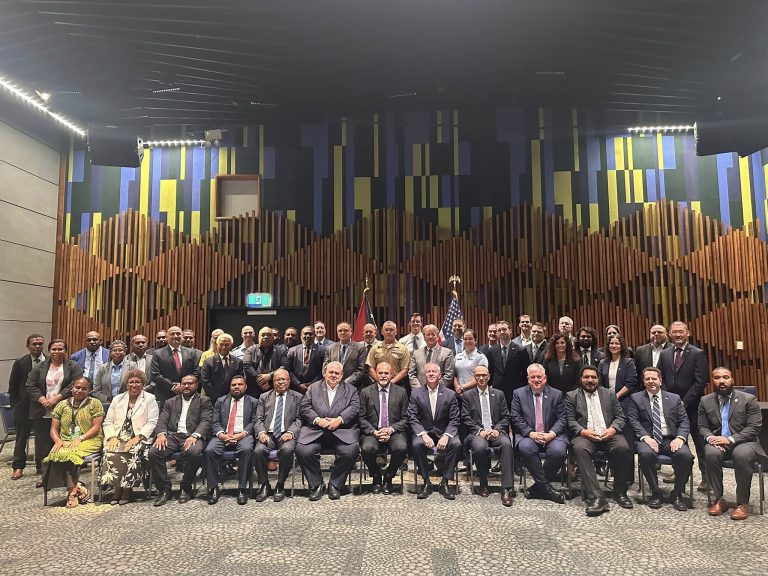
The second United States–Papua New Guinea Strategic Partnership Dialogue was held on 07 May in Port Moresby between Michael George DeSombre, United States Assistant Secretary for East Asian and Pacific Affairs, and Papua New Guinea Deputy Prime Minister John Rosso.

According to the joint statement, “The dialogue reflects the commitment of both countries to continually strengthen the bilateral relationship.”

“This iteration of the dialogue focused on improving security cooperation and finding new areas of mutual interest for economic opportunities in pursuit of a more secure and prosperous future for both countries.”

The discussions built on the Framework for Strategic Cooperation signed in September 2025 by Papua New Guinea Prime Minister James Marape and former United States Deputy Secretary of State Christopher Landau during PNG’s 50th independence anniversary celebrations.

The framework identified four major pillars for cooperation: “Defence, Maritime Security, and Law Enforcement Cooperation; Critical Mineral and Infrastructure Cooperation; Economic and Commercial Cooperation; and Digital Economy Cooperation.”

Delegations from both countries discussed each pillar during working group sessions in Port Moresby.

A major announcement from the talks was Washington’s plan to support digital expansion in Papua New Guinea through satellite technology.

“During the dialogue, the Assistant Secretary announced the United States, working with Congress, intends to provide US$30 million for satellite internet connectivity in Papua New Guinea.”

The statement said the support would expand access to essential services in remote communities.

“This American technology will connect hundreds of remote health facilities, schools and disaster centres, linking Papua New Guineans to educational resources, healthcare services, economic opportunities, and global markets in a way previously unimaginable.”

The dialogue also highlighted recent developments in the relationship, including the signing of a Global Health Memorandum of Understanding and the approval for SpaceX to operate its Starlink service in Papua New Guinea.

Security cooperation featured heavily during the talks, with the United States sending what was described as the “largest-ever U.S law enforcement contingent to visit Papua New Guinea.”

The delegation included officials from the Federal Bureau of Investigation, Drug Enforcement Administration, Department of Homeland Security, United States Coast Guard, the Federal Law Enforcement Training Centre and the State Department’s Bureau of International Narcotics and Law Enforcement.

Papua New Guinea’s delegation included representatives from Foreign Affairs, Defence, Trade and Investment, ICT and the Mineral Resource Authority.

The two countries also signed a new law enforcement agreement aimed at tackling organised crime and improving justice sector cooperation.

“The newly signed Letter of Agreement on law enforcement cooperation will enable the United States to provide comprehensive support to Papua New Guinea partners to combat money laundering, drug trafficking, transnational organized crime, cybercrime, strengthen criminal justice institutions and bilateral coordination.”

Both sides also pledged to strengthen maritime security cooperation, particularly in combating illegal fishing.

“Maritime security cooperation efforts will fight illegal, unreported, and unregulated fishing in Papua New Guinea’s exclusive economic zone — a crime that affects the entire the Pacific.”

The statement also stressed the importance of educational and professional exchanges between the two countries.

“The United States hosts educational and professional exchange programs to build relationships and share best practices between the citizens of our countries, sending students and young professionals to the United States to learn and grow in their fields.”

Assistant Secretary DeSombre and Deputy Prime Minister Rosso agreed to continue strengthening ties and confirmed the next Strategic Partnership Dialogue will be held in Washington after Papua New Guinea’s 2027 national elections.

“They expressed eagerness to build on the momentum generated this week to strengthen a relationship forged through sacrifice during World War II and guided by our shared values for generations to come.”

Yap’s coral resilience project blends science with traditional knowledge

0

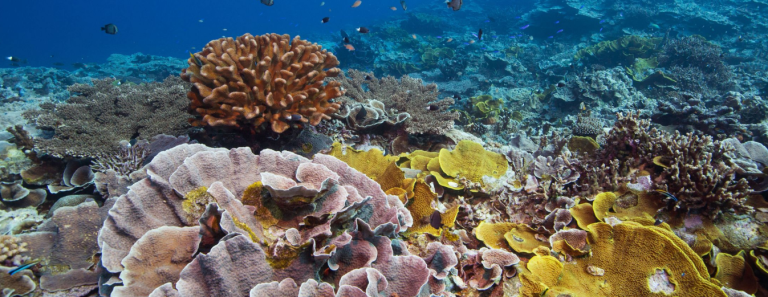
The Nature Conservancy has launched a three-year initiative to strengthen the resilience of Yap’s coral reefs amid growing pressures on the region’s marine ecosystems.

The Yap Resilience Hub project, initiated in partnership with the Great Barrier Reef Foundation (GBRF) and unveiled this week at the Yap Small Business Development Centre, involves a locally led collaborative action that fuses traditional knowledge and science to tackle threats from ridge to reef.

“The Yap Resilience Hub is not just a project; it is a promise to safeguard the coral reefs that are the lifeblood of Yap,” said Dr Yimnang Golbuu, TNC’s conservation director in Micronesia and Polynesia.

“Protecting our reefs is not only a conservation endeavor, but a moral responsibility to our communities and to generations yet to come.”

The Yap Resilience Hub is part of the GBRF-funded Resilient Reefs Pasifika initiative to assist island states in implementing a collective strategy to restore and protect the region’s coral reef systems from significant threats posed by climate change.

For Pacific islands, coral reefs are not only a source of sustenance, but also a foundation of its traditions and identity.

Experts warn that reefs in the Pacific are expected to experience severe coral bleaching conditions at least twice per decade by the 2030s, with severe bleaching expected annually by the 2040s.

Pacific island countries and territories, however, remain the most underfunded and least equipped to respond and adapt to climate impacts.

“We know the challenges before us. Yet, we also know the enduring strength of the people of Yap, their traditions and the power of partnership,” Golbuu said.

The Yap Resilience Hub will combine scientific knowledge, traditional practices and community leadership to chart a course to a more sustainable, resilient and biodiverse future, TNC said in a statement.

Golbuu said the Yap hub “demonstrates how innovation and heritage can walk hand in hand to protect what we cherish most.”

TNC said the Yap Resilience Hub emphasises community ownership and culturally appropriate approaches, ensuring that local knowledge and priorities guide project design and implementation.

The project, which will continue through 2028, focuses on capacity building for communities and delivery partners will be central to achieving long-term, sustainable outcomes, TNC said.

With approximately AUD$1.5 million (US$1.08 million) in implementation funding per hub, each will coordinate and fund local reef resilience projects, support regional capacity building, and foster collaboration across sectors.

FFA Members discuss next steps on Article 30 implementation

0

Forum Fisheries Agency (FFA) Members meeting in Wellington last week convened a dedicated session on Article 30 of the WCPFC Convention, as part of pre-meetings ahead of the 142nd Forum Fisheries Committee (FFC) Officials Meeting from 11 – 15 May 2026.

Article 30 recognises the special requirements of developing States, particularly Small Island Developing States and Territories (SIDS), reflecting the structural realities of the Western and Central Pacific Ocean (WCPO). It requires the Commission to take these circumstances into account and ensure that conservation and management measures do not transfer disproportionate burden to SIDS.

The session was joined virtually by the Western and Central Pacific Fisheries Commission (WCPFC) Secretariat, including WCPFC Executive Director Ms Rhea Moss-Christian, and built on progress made at WCPFC22 in Manila in 2025, where the Commission agreed to undertake an independent review of Article 30 under an agreed Terms of Reference.

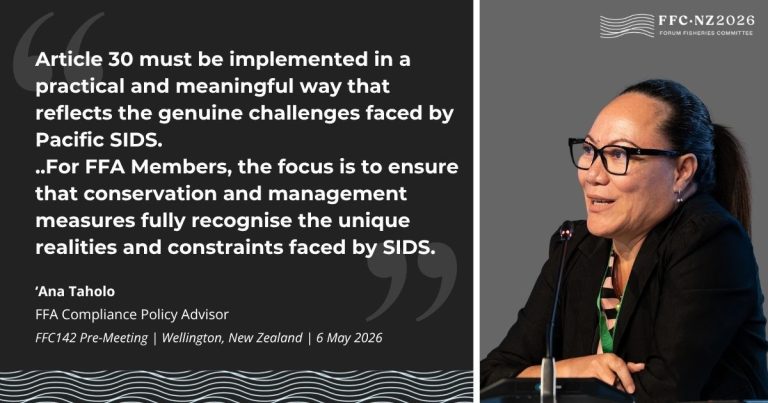
“Article 30 must be implemented in a practical and meaningful way that reflects the genuine challenges faced by Pacific SIDS,” said FFA Compliance Policy Advisor ‘Ana Taholo, who supported Members’ discussion on the issue.

“For FFA Members, the focus is to ensure that conservation and management measures fully recognise the unique realities and constraints faced by SIDS, and that these considerations are embedded from the outset in the design of measures through practical and effective implementation mechanisms.”

FFA Members noted that the review of the Commission’s implementation of Article 30 comes at a critical time and presents an important opportunity to strengthen how the provision is applied in practice. Discussions emphasised the need to ensure that disproportionate burden is addressed during the development and design of measures, rather than after measures have already been adopted and implementation obligations imposed on Members.

Members also highlighted the importance of linking Article 30 more directly with practical and sustainable funding support, as well as ensuring stronger and more consistent consideration of Article 30 throughout the development of WCPFC conservation and management measures.

As a next step, FFA Members and the Secretariat will continue to actively engage in the independent review process, both individually as Members and collectively through the FFA framework.

Article 30 mandates that the Commission recognises the special requirements of developing States, particularly Small Island Developing States and territories. In considering the special requirements of SIDS, the Commission must take into account the vulnerabilities of SIDS and that SIDS shall not be disproportionately burdened by conservation and management measures, and support their capacity to develop, manage and benefit from their tuna fisheries.

Manubada call – Pacific leaders shift from promises to pressure as region eyes energy independence

0

By Sera Tikotikovatu – Sefeti

The era of endless planning is over.

Pacific ministers ended five days of negotiations, technical sessions and ministerial talks here, adopting the Manubada Call to Action, a political declaration designed to move the region from ambition to implementation on energy and transport.

At the centre of it there is a stronger regional push toward renewable energy, maritime reform, and better access to financing.

Papua New Guinea’s Minister for National Planning and Chair of the Sixth Pacific Regional Energy and Transport Ministers’ Meeting (PRETMM6), Ano Pala said, “Pacific ministers have agreed to accelerate the transition toward renewable energy across the region”.

“Ministers called for stronger coordination and financing arrangements to unlock investment in energy and maritime transport,” Pala said.

“Pacific ministers have made it clear that access to funding at scale has taken too long and continues to be fragmented.”

“We must move from talking, to impactful solutions at scale.”

That frustration has been building.

Pacific countries remain heavily dependent on imported fossil fuels, leaving economies vulnerable to international conflicts, supply chain disruptions and sudden fuel price shocks, something many Pacific households are already feeling.

For Ralph Regenvanu, that urgency is no longer theoretical.

“Enough of setting goals and ambitions. We know what we want, we need to see implementation happen,” Regenvanu said.

He said fuel costs across the region are already having a direct effect on household survival.

“We are seeing the price of fuel double, more than double, and this is affecting the price of food and all other costs.”

That pressure shaped much of the conversation inside APEC Haus last week.

Ministers acknowledged that energy and maritime transport can no longer be treated as separate sectors.

A major part of this week’s outcome was the formal strengthening of the Pacific One Maritime Framework a Pacific-led regional roadmap first mandated in 2023 and now positioned as the region’s long-term maritime coordination blueprint through 2050.

The framework is expected to improve shipping coordination, maritime safety, cleaner fuel pathways and infrastructure investment.

But ministers were equally blunt about another challenge: donor financing.

The outcome discussions reflected growing frustration over fragmented funding, duplicated programmes and unclear investment pathways.

One of the most practical outcomes from PRETMM6 now tasks the Pacific Community to map who is funding what, where the gaps remain, and where duplication exists.

That visibility matters, because visibility creates accountability.

Regenvanu said implementation has been the Pacific’s biggest weakness.

“We recognise that implementation was a problem, which was one of the main issues, being able to implement and deliver on what we say,” he adds.

He said the Pacific process remains under SPC’s leadership.

“This Pacific Regional Ministers of Energy and Transport process is under the Pacific Community. The Pacific Community is our secretariat, we have actions in our resolutions that direct SPC to do certain things, and actions that direct partners to do other things.”

For countries like Fiji, where fuel costs remain a live public issue, what was agreed in Port Moresby is far from abstract.

It could shape fuel security, transport costs, shipping reliability and electricity prices for years to come.

The Pacific knows where it wants to go.

The challenge now is whether delivery can move faster than the next global fuel shock.

PRETMM6 warnings sharpen as Pacific Forum invokes Biketawa over growing fuel crisis

0

By Sera Tikotikovatu – Sefeti

Just hours after the Pacific Energy and Transport Ministers endorsed the outcome of PRETMM6 and warned that the region remained dangerously exposed to imported fuel shocks, Pacific Islands Forum leaders moved to strengthen regional preparedness.
In a significant step, leaders have invoked the Pacific Islands Forum Biketawa Declaration to support a coordinated regional response to the emerging energy crisis, as ongoing conflict in the Middle East continues to disrupt global fuel supply chains.

PIFS Director of Governance and Engagement, Salome Taufa, sat in as an observer at PRETMM6 and spoke to Islands Business about the intention behind this.

“This is our regions framework that provides coordinated support in times of crisis, and so this has been triggered before, the recent one was to provide support to members during the COVID19 pandemic,” she said.

“This has now been triggered by members to put in place a coordinated mechanism, so that we are more coordinated in our approach and then we will look at developing some of the responses to the countries, it is not a one-size-fit-all solution but in the coming weeks our senior officials, our foreign leaders will discuss what that response will look like.”

At PRETMM6, ministers acknowledged that Pacific countries remain highly vulnerable because of continued dependence on imported fossil fuels, warning that fuel price volatility, supply chain disruptions and rising fiscal pressures pose serious risks to island economies.

Those concerns are now playing out against a rapidly shifting global energy landscape.

Ministers reaffirmed the Pacific’s ambition to move toward 100 percent renewable energy and a fossil-fuel-free future, recognising that energy independence is no longer just about climate goals, but resilience and security.

At the same time, ministers also emphasised that energy and maritime transport are deeply interconnected and must be planned together, a recognition reflected in the formal strengthening of the Pacific One Maritime Framework.

Forum Leaders’ latest decision under Biketawa adds a separate but complementary layer of regional coordination.

A dedicated CROP Taskforce on the Middle East crisis has now been established to monitor developments, align technical advice and provide timely analysis for leaders.

It is a short-term crisis coordination mechanism.

PRETMM6, by contrast, remains the long-term regional policy platform for energy and transport transition.

Together, they reflect two sides of the same Pacific challenge, immediate fuel risks while accelerating long-term energy transition.

Pacific Energy and Transport Ministers conclude with strong Manubada call to action scaling connectivity for a Prosperous Blue Pacific

0

Pacific Energy and Transport Ministers have concluded the Sixth Pacific Regional Energy and Transport Ministers’ Meeting (PRETMM6), issuing the Manubada Call to Action to accelerate access to energy and scale maritime transport for Pacific people.

Hosted by the Government of Papua New Guinea under the theme “Scaling Connectivity for a Prosperous Blue Pacific,” the meeting brought together Ministers and senior officials from across the Pacific, alongside regional organisations, development partners, academia, industry, private sector representatives, and civil society.

From Commitments to Implementation

Ministers emphasised the region has robust policy frameworks and commitments in place, and the priority must shift decisively toward implementation and delivery of tangible results for energy security and maritime connectivity.

Advancing an Integrated and Just Transition

Ministers reaffirmed their collective ambition to achieve a 100% renewable energy future for the Blue Pacific, alongside a just and equitable transition toward a fossil fuel-free region, ensuring no country is left behind.

They also welcomed progress toward establishing a Regional Energy Commissioner for a Just Transition, to be taken to the 55th Pacific Island Forum Leaders Meeting later this year.

Strengthening Partnerships and Coordination

A key outcome of the meeting was a strong call for enhanced coordination and transparency across development partners, with Ministers highlighting persistent fragmentation and limited visibility of financing flows.

Ministers tasked the Pacific Community (SPC) to lead the coordination and development of a comprehensive regional mapping of partner initiatives, financing and support mechanisms to improve alignment, reduce duplication, and better support targeted priority gaps.

They also emphasised that all partnerships must remain anchored in Pacific leadership and aligned with regional frameworks and national priorities.

Unlocking Finance for Scaled Impact

Ministers called for predictable and accessible financing to scale access to energy and maritime transport.

Ministers called for:

• Increased grant-based and concessional financing

• A shift toward programmatic, long-term investment approaches.

• Stronger support for grid readiness, data systems and regulatory frames

• Investment in productive energy use and sustainable operations.
Endorsement of Key Regional Frameworks

Ministers endorsed regional initiatives, including:

• The Pacific One-Maritime Framework (POMF) 2026–2050, as the guiding blueprint for a safe, secure,
resilient and sustainable maritime transport sector.

• The Regional Strategy for Pacific Women in Maritime 2026–2031, promoting gender inclusion and workforce development.

• The transition to FESRIP 2.0 – The Framework for Energy Security and Resilience in the Pacific with a focus
on implementation, system readiness, and measurable delivery of renewable energy targets

Ministers also reaffirmed the importance of protecting seafarer welfare, maritime safety, and regional connectivity, recognising maritime transport as a lifeline for Pacific communities.

Delivering for Pacific Peoples

Ministers concluded the meeting by reaffirming their collective commitment to ensure that the outcomes of PRETMM6 translate into real, measurable benefits for Pacific peoples, including improved energy access, strengthened connectivity, and increased resilience to economic and climate shocks.

Looking Ahead

Ministers noted that outcomes from PRETMM6 will feed into upcoming regional and global engagements, including the 55th Pacific Islands Forum Leaders Meeting in Palau, to sustain momentum and mobilise greater international support for Pacific-led priorities.

Ministers endorsed and welcomed Solomon Islands as incoming Chair and host of the 7th Pacific Energy and Transport Ministers Meeting in 2029.

Sir Ano Pala, Papua New Guinea Minister for National Planning – Chair of the 6th Pacific Regional Transport and Energy Meeting said: “The Pacific Ministers have called for an accelerated push for 100% renewable energy across the region and we have called for stronger coordination for financing arrangements to unlock investment in energy and maritime transport.

Ministers have also officially endorsed the Pacific One Maritime Framework to bring cohesion and coordination to the efforts of maritime and transport for safety and access issues.

The final point is around stronger coordination and financing arrangements called for by the Pacific Energy and Transport Ministers Meeting.

This outcome has been called the Manubada Call to Action because of the location and the recognition of Manubada as an important site in this vicinity”

Ralph Regenvanu is Vanuatu’s Minister for Climate Change Adaptation, Energy, Environment, Meteorology, Geo-Hazards and Disaster Management said: “It’s really timely that the Ministers of Energy and the Ministers of Transport from Pacific Island countries can come here and talk about these issues and emphasise how important it is that we are energy independent. We no longer depend on fossil fuels coming from Iran or the Middle East, but we have our own energy sources. This is one of the key things of this meeting: the transition to not only energy security, but energy sovereignty. Also considering the pacific is on the frontlines of climate change, we really need to transition to a fossil fuel free future,” he said.

Dr Paula Vivili Director General of the Pacific Community said: “This joint ministerial reflects something our members have understood for many years: energy and transport matter because they touch every part of people’s lives. For a family in a remote village, or a fisherman waiting on weather and fuel prices, or a health worker trying to reach a patient by boat, these are not policy questions. They are daily realities. And that is exactly why they matter so much to us. PRETMM exists because our members chose to look at these sectors together and to focus on connectivity as a driver of prosperity for the Blue Pacific.”

Stay connected

529FansLike
172FollowersFollow
156SubscribersSubscribe
- Advertisement -