Home Blog Page 35

Ombudsman Commission’s Chief Justice referral seen as dangerous precedent: PNG Opposition

0

The Papua New Guinea Ombudsman Commission’s referral of Chief Justice Sir Gibbs Salika to the National Executive Council (NEC) for alleged misconduct in office has set a “dangerous precedent”, according to Deputy Opposition Leader Keith Iduhu.

Democracy in the country could be at risk with the interference in the separation of powers which provide for the independence of constitutional offices, he said.

“By forcing the Chief Justice to a leadership tribunal through the NEC or the appointing authority, even after the public prosecutor has acted lawfully, raises questions about the legality of the matter,” Iduhu said.

He described it as an interference in the separation of powers as Sir Gibbs, being the head of the judiciary, would be subject to the decision of the executive government.

“It is new territory and uncharted waters, so we need to tread with great caution and care as this issue goes to the heart of the constitutional principles of separation of powers,” he said.

“The Office of the Chief Justice is a constitutional office and must be independent.

“This is now dangerous territory in our constitutional democracy, whereby the executive arm of the government is now invited to meddle into the issues concerning the Chief Justice.

“By this nature, we are already asking the executive arm to interfere with the judiciary, two different arms of the government which are fundamental and embedded in our Constitution.”

Opposition Leader James Nomane said the matter should be taken seriously as the independence of the country’s judiciary was under threat.

He urged the Ombudsman Commission to exercise restraint and follow due process so as to protect one of the important pillars of the Constitution.

“Papua New Guinea’s constitutional order was built on three pillars: an executive that governs, a legislature that makes law, and a judiciary that protects rights,” Nomane said.

“Each must function without interference from the others.

“An independent Judiciary underscores our democracy by guaranteeing every citizen’s rights before the law.

“We do not defend the Chief Justice as a person; we defend the office and the principle it represents.”

Nomane added that acting Public Prosecutor Helen Roalakona should request the Supreme Court to interpret and provide clarity on such an important constitutional matter.

Pact signed, Melanesian committed to protect & sustainably manage the Pacific Ocean

0

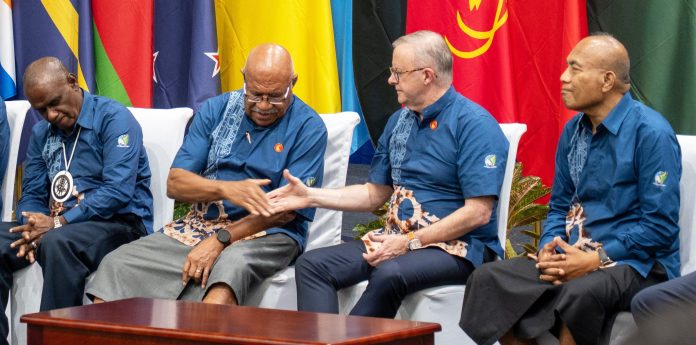
Papua New Guinea’s Prime Minister James Marape, alongside Fiji Prime Minister Sitiveni Rabuka and Vanuatu Prime Minister Jotham Napat, have officially signed the historic Melanesian Ocean Corridor of Reserves (MOROR) Declaration at APEC Haus during the Pacific Ocean Summit.

The MOCOR is a landmark subregional network of connected Marine Protected Areas (MPAs). It unites five Pacific territories, PNG, Solomon Islands, Vanuatu, Fiji, and New Caledonia to establish joint border governance, enforcement, and marine science frameworks.

The landmark declaration reflects a strong united Melanesian commitment to protect and sustainably manage the Pacific Ocean for future generations by strengthening regional cooperation on, Climate Action, marine conservation, ocean governance Pacific Regional Solidarity

The initiative aims to align national and regional priorities, enhancing maritime conservation and climate resilience across their shared marine corridors.

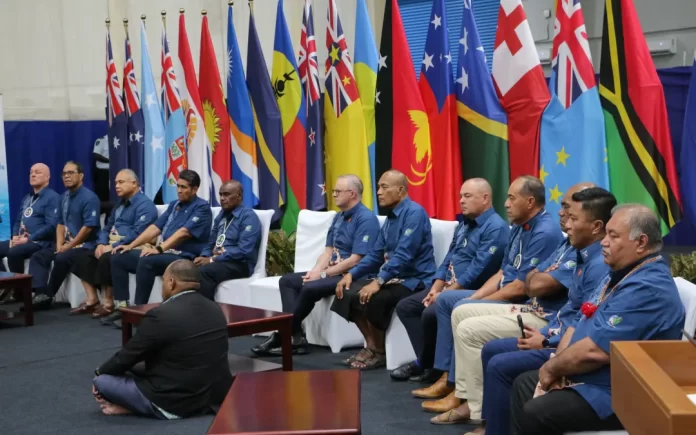
The 2026 Inaugural Melanesian Ocean Summit, Pacific leaders stand united with Papua New Guinea’s Prime Minister Marape in advancing regional collaboration and sustainable ocean governance.

The signing ceremony was witnessed by UN Special Envoy for the Ocean, Peter Thomson.

Although Solomon Islands was unable to participate due to its ongoing Prime Ministerial election process, leaders expressed confidence that Solomon Islands will soon join this important regional vision.

Prime Minister Marape said, “Together, we stand as custodians of the Pacific Ocean — united for our people, our environment, and our future.

“Together, we champion the protection of our Blue Pacific and the prosperity of Melanesia through shared leadership and action, PM Marape said.

France backs Pacific Ocean push at Melanesian Summit

France has thrown its support behind Melanesian efforts to protect the Pacific Ocean, with French Ambassador to Papua New Guinea Pierre Fournier telling leaders at the the Melanesian Ocean Summit that the Pacific will play a decisive role in implementing global ocean commitments.

Speaking at the summit in Port Moresby, Fournier said France remains committed to the preservation of the ocean and backed stronger regional cooperation on marine protection, fisheries management and maritime security.

“Our joint action to reverse the dreadful degradation of the health of the ocean with our joint commitment to protect at least 30 percent of the ocean by 2030, and the adoption of the High Seas treaty, or BBNJ agreement, are a true testimony of our contribution to the protection of more than half of the planet,” he said.

Fournier linked the summit’s discussions to outcomes from the 3rd UN Ocean Conference held in Nice in June 2025, where France co-hosted the gathering alongside Costa Rica.

He said the conference produced the Nice Ocean Action Plan, which included political commitments and voluntary actions that would have significant impact in the Pacific region.

“And the Pacific, with the biggest Ocean, has the biggest impact on the implementation of this outcome,” he said.

The French envoy also highlighted the importance of ratifying the Biodiversity Beyond National Jurisdiction (BBNJ) Agreement, saying it would strengthen efforts to protect high seas biodiversity and support regional marine corridor initiatives being promoted by Pacific countries.

Fournier said France was investing heavily in the Pacific through its territories of New Caledonia, French Polynesia and Wallis and Futuna, which together manage an Exclusive Economic Zone of 6.5 million square kilometres.

“France is a major contributor to the sustainability, prosperity and security of the Region,” he said.

He outlined France’s regional support through fisheries surveillance, maritime monitoring and humanitarian operations, including support to the Pacific Islands Forum Fisheries Agency (FFA) through naval deployments and patrol aircraft operations.

“France’s continuous support to FFA by deploying navy vessels and patrol aircrafts in FFA operations represent an average of 130 days at sea and 50 hours of flight time each year, with a cost of 2 million euros per year,” he said.

Fournier said France’s Pacific territories were also expanding marine protected areas, pointing to French Polynesia’s declaration of its entire 5 million square kilometre EEZ as a marine protected area and New Caledonia’s 50-year moratorium on seabed mineral exploration and exploitation.

“With such proactive local public policies, the monitoring and oversight measures implemented by the government in this context, and France’s four-pronged regional strategy, the Pacific can count on us,” he said.

The Ambassador also reaffirmed France’s commitment to regional security cooperation, climate action and multilateralism.

“France, a permanent member of the Security Council, is both your friend and your neighbour,” Fournier said.

“We share the same vision; we share the same values. You can count on us,” he said.

MSG visionary defends Udaune declaration as shield against global greenwashing

0

Leonard Louma, former Director General of the Melanesian Spearhead Group (MSG) Secretariat, Wednesday issued a defence of the Udaune Declaration, as a radical and necessary pushback against international climate apathy and greenwashing.

Speaking on the third day of the 2026 Melanesian Ocean Summit, Louma detailed the strategic motivations behind the agreement, framing it as a critical tool to keep the torchlight on climate change and environmental degradation.

Louma noted that the declaration was born out of profound frustration with the global status quo.

He said the “disappointingly low” outcomes of COP27 in Egypt and the persistent failure of wealthy nations to meet the promised US$100 billion annual climate finance goal.

“We noticed that greenwashing mechanisms were being contrived by major emitters to absolve themselves of responsibility,” Louma told the summit.

“We didn’t want people to forget our concerns.” he said.

The Udaune Declaration was an opportunity to tell the international community that we are not just bystanders, we have been proactive leaders in this space long before the UN Sustainable Development Goals were even crafted.”

The Udaune Declaration is not merely a statement of intent but a roadmap for radical and ambitious regional action.

Louma highlighted several key pillars:

*Fossil Fuel Non-Proliferation: The MSG is pushing for a transition away from fossil fuels to spur investment in cleaner, alternative energies.

*Deep Seabed Mining Ban: To protect marine ecosystems, the declaration commits MSG members to a moratorium on deep seabed mining within their jurisdictions until science-based research can fully determine the environmental impacts.

*Nuclear Caution: Louma reaffirmed the region’s stance against the discharge of treated nuclear material into the Pacific, urging the Japanese government to exercise extreme caution following the 2011 Fukushima disaster.

*Single-Use Plastics: A commitment to a total ban aimed at precipitating a shift toward natural, biodegradable products.

Louma linked the declaration directly to the regional legal architecture, highlighting that a successful global economy requires both political resolve and technical know-how.

He stated that the Udaune Declaration provides the necessary “political will” for MSG members to exploit the Blue Economy, the sustainable use of ocean resources for economic growth.

“Opportunities cannot be fully exploited if the requisite finance and technical expertise are not available in our countries,” he said.

“The Udaune Declaration demands that these gaps be addressed appropriately.”

Louma also urged Melanesian nations to take pride in their history of climate advocacy.

“Udaune is part and parcel of efforts to provide a legal framework for concrete actions,” Louma said.

“It creates an ecosystem where the blue economy can be developed with the genuine participation of our people,” he said.

“Our backyard, Our Science”: Professor declares PNG home to the world’s warmest ocean

0

In an address at the 2026 Melanesian Ocean Summit, Professor Chalapan Kaluwin, Director of the Momis Ocean and Climate Research Institute, issued a bold challenge to policymakers: stop borrowing foreign ideas and start trusting Papua New Guinean science.

Professor Kaluwin revealed that years of independent research and experiments conducted “in our own backyard” have confirmed that Papua New Guinea, alongside Palau and neighbouring island seas, sits atop the warmest ocean waters on the planet.

“We decided to find time to do this work in our own university, in our own country,” Kaluwin told the summit.

He explained that by utilising advanced technology including pressure sensors and Argo floats deployed from Manus to Fiji, local scientists have tracked a steady rise in ocean temperatures since 1991.

“When you talk about global warming, that’s for politicians. Climate change is what scientists talk about,” Kaluwin said, noting that sea surface temperatures in the region remain the highest in the world.

This heat, he warned, is the engine driving more frequent and intense El Niño and La Niña cycles, which are now impacting the region every one to two years rather than the traditional five-year cycle.

Professor Kaluwin question why a nation of 1,200 islands does not yet have a dedicated Ministry of Oceans.

He argued that the country’s GDP, wealth funds, and future sustainability are inextricably linked to the sea, yet policies are often imported from the West rather than built on local data.

” You have smart people already in this country,” he said. “You will be able to develop your own policies based on your science. Don’t go and borrow policies from elsewhere.”

The Professor highlighted several urgent risks to PNG’s maritime interests.

Kaluwin raised alarms over mining licenses granted to foreign firms without scientific credibility, specifically mentioning the risks of terrestrial pollution from the Highlands flowing down to the Great Barrier Reef.

As ocean temperatures rise, Kaluwin warned that PNG is at risk of losing its tuna stocks as species migrate to cooler waters.

Prof Kaluwin said economic strategy must start with the people living on the 1,200 islands of PNG.

” It’s your home, it’s your land, it’s your ocean. It doesn’t belong to anybody else in the world,” Kaluwin stated.

“Our research is meant for the people, to protect their interests and their future,” he said.

Dialogue: Micronesia’s leaders confront a region caught in someone else’s war plan

0

Leaders and security officials from across Micronesia gathered Tuesday in Guam for the first day of a regional security dialogue that laid bare an unsettling reality: others have already mapped these islands into their own strategic designs.

“All of you are in somebody’s strategic plans, whether you know it or not, whether you like it or not,” said Pacific Centre for Island Security (PCIS) chair and former Guam Delegate Robert Underwood opened the two-day Micronesia Security Dialogue hosted by PCIS, the Richard F. Taitano Micronesian Area Research Centre, and sponsored by Japan’s Sasakawa Peace Foundation.

The event brought together government officials from Guam, Palau, the Federated States of Micronesia, the Republic of the Marshall Islands, and the Commonwealth of the Northern Mariana Islands, along with security analysts and academics to examine what Underwood has called one of the most consequential moments for the region since World War II.

The morning session opened with brief remarks and a demonstration of PCIS’s Micronesia Security Monitor, an online platform that tracks military bases, vessel movements, weapons ranges, and maritime activity across the second island chain.

PCIS director Leland Bettis walked attendees through the tool’s mapping layers, pointing to Chinese research vessels conducting deep oceanographic surveys near areas hosting U.S nuclear attack submarines and along critical north-south sea lanes between Australia and Japan.

“If you’re looking for critical minerals, you’re also mapping the seabed floor, which could be of assistance to your submarine operators,” Bettis said, adding that the research vessel is also a mothership for submersibles.

“There’s some really serious deep-ocean research going on here.”

Bettis also highlighted a U.S autonomous vessel, Saildrone 3002, contracted by NOAA, which had been heavily mapping areas west of the Marianas, an area where the Bureau of Ocean Energy Management recently expanded its proposed seabed mining lease boundaries. The vessel’s data streams directly to satellite in real time, he noted.

For attendees from smaller island states, the presentation made visible what had long felt abstract.

“I learned something very interesting, not only on defence security but (also) on understanding the concerns of our islanders and also learned about these research ships (and) vessels, very interesting,” said former FSM President Emanuel Mori, who attended as an advisory council member of PCIS.

Mori, who is no longer in government, said he hoped to bring what he learned back to his community.

He also flagged a practical need the monitor could serve beyond geopolitics.

“The next thing I want to ask Robert (Underwood) is an alert system for our people for typhoon(s), for any emergencies,’ he said.

“This is a very good time to discuss about not only for military purposes but for typhoon purposes and whatever.”

Kosrae Governor Tulensa Palik offered a candid assessment of his state’s position.

While Kosrae has engaged politically with China in ways distinct within the FSM, he said the compact relationship with the United States remains its anchor.

“We do have political ties, our diplomatic relations with China, mainland China, but we do have another relationship that is in place with the U.S, which has been sustaining us for the past 40-plus years now,” Palik said.

“That’s through the compact trust fund, and that is what will sustain us for the foreseeable future.”

He said the dialogue opened perspectives he had not fully considered.

“This dialogue opens up other avenues of concern that we have to take into consideration as a nation,” Palik said.

“It definitely gives me other insights into the political situation that we are in that we need to take into consideration very careful.”

Yap Governor Francis Itimai said his state is already deep into that reality, with military projects arriving and agreements signed.

“We have a lot of military projects that are incoming,” he said. “We’ve signed an agreement with them, with the U.S military and the contractors.”

He added that a large contingent of contractors and military personnel had been working alongside him.

“On my way out, there was a big group of contractors and also military folks that were with us working together on this.”

Christopher deBrum, national security advisor for the Republic of the Marshall Islands, said the dialogue filled a critical gap for a country that only stood up its national security infrastructure two years ago.

“This is the first time that we’re seeing a Micronesian-led institution to work with and provide us with more information for RMI,” he said, adding that the monitoring platform and other tools “are all things that we can use as we develop this office.”

He said the Micronesian community has needed exactly this kind of focused effort.

“There’s a lot of information being shared, mainly for the wider Indo-Pacific region, but this is geared toward our region that we really need, and I think this is a gap that we need to address more.”

Vera Topasna, executive director of the Community Defense Liaison Office on Guam, said the work PCIS is doing is unlike anything being done elsewhere in the region.

“It has not been done, at least in the manner that they’re doing it, very focused and centred on Micronesia, she said.

“It requires us to be open and to hear what the PCIS (is), what they’re doing, how they’re monitoring, and how their body of work could enhance my body of work as a government official.”

The session also surfaced concerns about missile defense, drug trafficking, and the increasing militarisation of islands that have little ability to shield themselves from the conflicts being prepared around them.

Bettis noted the U.S military strategy of distributing and dispersing forces across the region, including to austere airfields in Tinian, Yap, and Palau, may soon require a third component.

“I think what’s probably coming next in terms of the military strategy is ‘D3,’ which is distribute, disperse, and defend,” he said, predicting the U.S will likely deploy containerised portable air defense systems across those locations within five years.

Underwood, presenting PCIS’s annual Micronesia Security Outlook report after the break, pressed the more profound question the dialogue was built around. While the region’s leaders debate sub-regional cooperation and sovereignty, the great powers are not waiting.

“The great geostrategic competition has come to our shores,’ he said. “It’s coming at a greater intensity since the end of World War II.”

Day two of the dialogue convened Wednesday, featuring presentations by security experts Marco de Jong on emerging technologies and James Crabtree on first island chain dynamics and what they mean for Micronesia.

Fighting ‘fake news’ in the Pacific

0

BBC Media Action has been working across the Pacific Islands since 2024, training and mentoring journalists in Solomon Islands, Papua New Guinea, Samoa, Tonga, Vanuatu and Fiji.

Our team is supporting more open and accountable media in a region where internet usage is growing fast, and where people new to the flood of information are especially susceptible to mis- and disinformation.

This special two-week programme in Fiji introduced editors from across the region and local reporters to verification tools used by BBC News’ specialist fact-checking team to help them tackle disinformation and false claims in their daily work.

Launched in May 2023, BBC Verify fact-checks information, verifies video content, analyses data, and counters disinformation – using open-source intelligence (OSINT) and forensic techniques to provide transparency behind news stories.

Flora Carmichael, an editor at BBC Verify, recently joined BBC Media Action in Fiji to deliver training to Pacific Island journalists

Here’s what the journalists had to say:

“The fight is not only against corruption, but also against disinformation,” said Shalveen Chand, editor at the Samoa Observer

“With elections coming up and everything else happening in Fiji, it is really good to have this session.” said Lusi Banuve Journalist, Mai TV.

“It’s provided us with a lot to think about, especially in the online space where everyone claims to be a journalist.” said Matthew Vari, digital director at Post-Courier Daily.

“This will come and play a big part in the coverage and training, upskilling of our media personnel, as a skill that they will take into covering the national general elections, come next year.” said Genesis Ketan Senior Journalist Trainer, Media Council PNG

“We need to know how to utilise the tools that are already there, in order to get the correct information out there to our audience,” said Ivamere Nataro Senior Journalist, Fiji Sun

“During the duration of the training, I understood how misinterpretation of information would mislead our audience,” Josefa Sigavolavola Multimedia Journalist, FBC

“It has been really useful for me, re-emphasising the importance of fact-checking and verifying the information that we distribute to the public.” said Popua Uliuli Aho Head of News, Tonga Broadcasting Commission.

“I hope the tools we’ve shared with the journalists will help them ensure quality journalism is delivered for audiences across the Pacific Islands,” said Flora Carmichael, BBC Verify editor.

Manele backs Peter Shanel for PM, urges calm ahead of Solomon Islands leadership vote

0

Solomon Islands caretaker Prime Minister Jeremiah Manele delivered an emotional and reflective final press conference on Wednesday, calling on Solomon Islanders to uphold peace, unity and respect for democracy as the country prepares to elect a new Prime Minister on Friday, 15 May.

Speaking directly to the nation through the media, Manele said he could not leave office without addressing the people and thanking them for their support during his tenure.

“In leadership, trust is the most valuable currency. Without it, no government, no matter how technically skilled, can truly serve its people,” he said.

Manele reflected on the pledge he made when he first stood before the nation as Prime Minister-elect on 02 May 2024, promising to serve with integrity and to put the interests of the people and country first.

He said the country has fulfilled that promise by navigating recent political and legal challenges peacefully through the courts and Parliament rather than through unrest on the streets.

“By standing here today and facilitating an orderly transition, we are proving that our democracy is no longer fragile. It is maturing,” he stated.

The outgoing Prime Minister thanked his constituents from Hograno, Kia, Katova and Havulei, and the people of Isabel Province for their unwavering support, noting that he was proud to be the first son of Isabel to serve as Prime Minister.

He also acknowledged the role of the Government for National Unity and Transformation (GNUT), saying its mission was always greater than any one individual and focused on maintaining stability and delivering essential services to rural communities.

To ensure continuity during the transition, Manele confirmed that the caretaker government has nominated Peter Shannel Agovaka as the candidate for Prime Minister under the GINAT banner, a decision he said he fully supports.

“As we approach Friday, I remind all Solomon Islanders that there are three candidates contesting for the position of Prime Minister. This is the democratic process in action,” he said.

He urged citizens across the provinces to respect the choice that will be made by Members of Parliament and to remain calm and respectful regardless of the outcome.

Manele stressed the importance of respecting leaders at all levels, including Members of Parliament, Provincial Assemblies, chiefs, church leaders and community elders, whose wisdom he said forms the foundation of Solomon Islands society.

He reassured the private sector, investors and development partners that Solomon Islands remains open for business and committed to maintaining a stable and secure environment for economic growth.

“This orderly transition of power reflects the continued strengthening of our democratic institutions,” he said.

Addressing young people, Manele encouraged them to engage in politics with responsibility rather than cynicism, reminding them that freedom of expression comes with a duty to respect others.

He also reminded citizens of the country’s Christian values, urging people not to allow political differences to damage relationships within communities.

“The peace we maintain today is the air our children will breathe tomorrow. The unity we fight for now is the foundation upon which they will build their dreams,” he said.

Manele also reminded Solomon Islanders that leaders come and go, but the nation’s journey belongs to its people, and its future belongs to its children.

“May God bless our people and partners, and may God bless Solomon Islands from shore to shore,” he said.

PNG expands Pacific ties with new embassy plans

0

Papua New Guinea will open three new embassies in the Pacific, strengthening its diplomatic presence across Micronesia, Polynesia, and Melanesia.

The new missions will be established in the Marshall Islands, Tonga, and Vanuatu, said Prime Minister James Marape, who announced the plans during the Melanesian Oceans Summit at the APEC Haus in Port Moresby.

He explained that the embassy in the Marshall Islands will serve as PNG’s outreach to Micronesia, Tonga will host its mission for Polynesia, and Vanuatu will complete PNG’s presence across Melanesia.

“Our new missions will strengthen friendships, improve trade, and ensure PNG is fully engaged in regional decision‑making,” he said.

Marape noted that the expansion follows bilateral agreements signed with visiting Pacific leaders, particularly from Micronesia.

He emphasised that while some of these nations may be small in population, they hold vast ocean resources that must be managed sustainably.

“We want to make sure our fish resource of the Pacific is properly harvested in a sustainable manner, evaluated properly, and more returns are passed back to our Pacific Island fish owners, including ourselves and the nations of the Pacific,” he said.

Marape also highlighted PNG’s role as one of the largest Pacific nations outside Australia and New Zealand, stressing the importance of unity.

“Our presence in the Pacific will make sure we remain as a bloc, as one family, one people of the South Pacific,” he said.

With existing missions already in Fiji and Solomon Islands, the new embassies will give PNG a complete diplomatic footprint across the three main Pacific sub‑regions.

Live rounds, pistol magazine discovered, not part of Fiji Military inventory

0

A pistol magazine containing 11 live 9mm rounds was discovered near Makoi Monday, triggering a joint investigation by the Republic of Fiji Military Forces (RFMF)and the Fiji Police Force.

In a statement, the RFMF confirmed the ammunition was found at about 5am near a bus stop adjacent to the Nasinu Police Station in the Makoi area.

The item was reportedly discovered by a member of the public, who immediately alerted RFMF personnel based in Nasinu.

Preliminary assessments conducted by the military confirmed the magazine and ammunition were not part of the official RFMF inventory.

“The recovered items have since been secured and are currently in RFMF custody,” the statement said.

Investigations are now being jointly conducted by the RFMF and Police to determine the origin of the ammunition and the circumstances surrounding its discovery.

The military also urged members of the public to report any suspicious weapons, ammunition or military-related equipment.

“The RFMF reminds members of the public that any suspicious items, including weapons, ammunition, or military-related equipment, must not be handled and should be reported immediately to the nearest police station or RFMF camp,” the statement said.

The RFMF and Fiji Police Force have also appealed for public assistance as investigations continue.

Stay connected

529FansLike
172FollowersFollow
156SubscribersSubscribe
- Advertisement -