


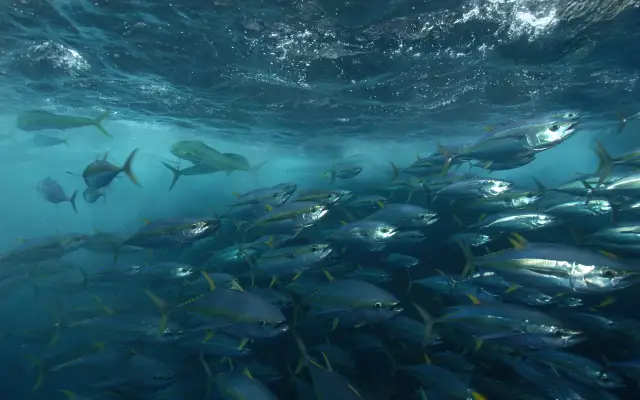
Pacific fisheries ministers and officials will face key decisions on how to control bigeye tuna fishing in the Western and Central Pacific, including longline catch limits, fish aggregating device (FAD) closures and which fisheries should be covered by a new management procedure.
The decisions will be considered at the 23rd Regular Session of the Western and Central Pacific Fisheries Commission (WCPFC23) in Port Vila from 30 November to 5 December, as members work towards a management framework designed to keep bigeye tuna stocks around an agreed target level.
A paper outlining the current approach to bigeye management procedure design identifies four major decisions for the Commission: the target reference point, the geographical scope of the rules, conditions for negotiating fishing limits and possible restrictions on changes to fishing opportunities between management periods.
The proposed management procedure uses two harvest control rules (HCRs) to regulate fishing opportunities.
One rule would determine catch limits for longline fisheries, while the other would set the number of months purse seine vessels can fish using FADs.
The approach follows discussions at WCPFC22 and two Bigeye Management Workshops (BMW01 and BMW02).
The first major decision concerns the target reference point (TRP), measured against average spawning biomass depletion between 2012 and 2015.
Members will consider two options: a lower target set at 0.94 times the 2012–2015 spawning biomass level, and an upper target set at 1.06 times that level.
The second decision concerns which longline fisheries will be covered by the management procedure.
Three geographical scenarios have been identified for assessment: all longline fisheries operating in the Western and Central Pacific Ocean (WCPO); all fisheries excluding Small Island Developing States (SIDS) and territories; or all fisheries excluding SIDS and territories as well as Hawaii.
The choice of geographical coverage and target reference point will determine the combinations of longline catches and FAD closure periods available under the proposed management rules.
The paper explains that different combinations of longline catch levels and FAD open periods can achieve the same long-term bigeye stock depletion.
For example, one combination could allow a longline catch of 50,000 tonnes and nine months of FAD fishing in exclusive economic zones, while another could allow a 20,000-tonne longline catch and 12 months of FAD fishing.
Both combinations could achieve the same lower target reference point.
These combinations would form different pairs of harvest control rules, allowing members to negotiate the balance between purse seine and longline fishing opportunities.
Under the proposed system, the management procedure would estimate the condition of the bigeye stock each time it is run.
The Commission would then negotiate the appropriate combination of longline catch limits and FAD open periods for the following three-year management period.
Members must also decide when those negotiations can take place, including whether they should only occur when stock estimates fall within a specified range, outside that range, or at any time.
The negotiations could seek equivalent changes in fishing opportunities for both fisheries compared with recent fishing levels, or focus on a specific catch limit or FAD open period proposed by either sector.
A further issue is whether to introduce additional restrictions, known as meta-rules, to limit how much fishing opportunities can change between management periods or constrain the trade-off between purse seine and longline fisheries.
The paper notes that these meta-rules have not been evaluated in the current management procedure analyses.
It also raises the question of whether such restrictions are necessary, given that allocation and implementation arrangements will involve further negotiations among Commission members.
The final output of the selected harvest control rules would be implemented through a Conservation and Management Measure (CMM).
However, allocation and implementation arrangements remain unresolved, with some Commission members stressing the need to maintain consistency with existing management systems and the Tropical Tuna Measure.
The decisions at WCPFC23 will determine the design and operation of the proposed bigeye tuna management procedure and the fishing opportunities available to longline and purse seine fleets in future management periods.