


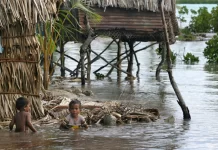


Facing some of the world’s highest exposure to disasters related to the changing climate, high costs of delivering services, and a need to continuously build institutional capacity, Pacific Island countries require development solutions tailored to their unique circumstances.
This reality is central to the Asian Development Bank’s (ADB) new Pacific Approach, 2026-2030 which will guide its collaboration with the Cook Islands, Kiribati, the Marshall Islands, the Federated States of Micronesia, Naoero, Niue, Palau, Samoa, Solomon Islands, Tonga, Tuvalu, and Vanuatu.
Emma Veve, Director General of ADB’s Pacific Department, explains:
Q. Let’s start at the beginning. What exactly is the Pacific approach and what is it designed to do?
The Pacific Approach is our strategy for 12 Pacific island countries (PIC-12). It explains how we will work and what we will do. It is quite different from your usual country partnership strategy because it is multi-country, but also because of the focus on how we will work, which is vitally important in the Pacific because of the unique characteristics of these countries.
The headline news is that ADB is very much open for business in the Pacific, and that’s business with government and also business with the private sector. We want to work closely with the people of the Pacific to build their skill sets, to help them drive their own future development.
Q. What are the specific challenges this strategy seeks to address?
The strategy certainly seeks to build resilience within the region to external shocks, including the shocks from disasters caused by natural hazards. It looks to respond to the very small markets in the Pacific, and how these can be built and strengthened. It also looks to help build capacity in the Pacific region—to improve human development and the ability to deliver public services, and to overcome the challenge of weak infrastructure and the difficulty maintaining and sustaining that infrastructure.
Q. We’re also seeing global uncertainty growing. To what extent has this strategy been shaped by events beyond the Pacific’s borders?
The Pacific is hugely impacted by external events. They’re small, open economies, so they feel it when things happen in other countries. They really feel it through impacts on growth and inflation. These global events are really showing how the impacts of external shocks ramp up in these small Pacific countries.