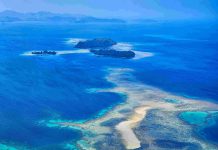

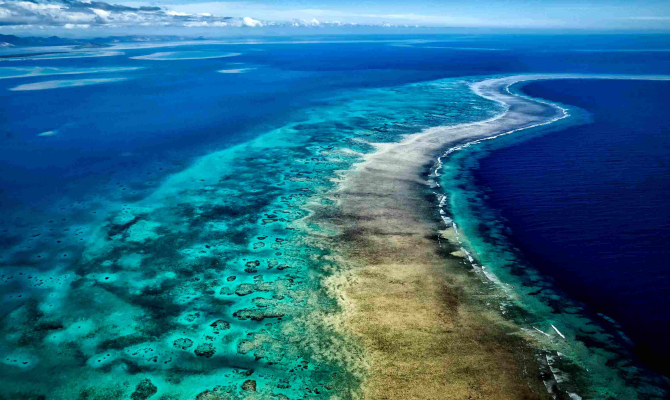
For our Pacific Islands, also known as Large Ocean Island States, the forecast ahead for our coral reefs is grim. Coral reefs around the world are in decline and the time in which they have to recover before the next bleaching event, is getting shorter.
Healthy coral reefs absorb around 97 percent of incoming wave energy, helping to dissipate waves before they come on shore. For Solomon Islands, with more than 80 percent of its population living in rural coastal areas, WorldFish has estimated that Solomon Islanders consume around 73 kilos of fish and other aquatic foods per person per year.
Solomon Islands is part of the Coral Triangle, the global centre of marine biodiversity, together with Malaysia, Philippines, Indonesia, Timor Leste and Papua New Guinea.
“Our reefs support around 500 coral species, more than 1,000 fish species, and an extraordinary diversity of other marine life,” said Rosalie Masu of Wildflire Conservation Society Solomon Islands.
“This richness is a blessing, and it comes with a responsibility to sustain it.”
Masu presented during the “From Global Ambition to National Action: Perspectives from Coral Reefs Nations” event at the Ocean Pavilion during the Seventeenth Conference of the Parties to the UN Convention on Biological Diversity now underway in Yerevan, Armenia.
The event brings together over 1996 governments, stakeholders, NGO’s, indigenous groups and the private sector from 19 to 30 October to negotiate a way forward to halt, and reverse, the loss of biodiversity across the planet.
“Reefs support local markets, tourism, and community economies and they are cultural and knowledge systems too. Customary marine tenure, clan histories, sacred sites, and traditional ecological knowledge connect people to particular places. Through tambu areas, harvesting rules, and customary leadership, communities have long exercised stewardship over marine resources,” said Masu.
“Yet these systems face growing pressures from unsustainable fishing, land-use change, sedimentation, pollution, coastal development, and climate change. When reefs decline, the consequences reach directly into households.”
The Status of Coral Reefs of the World 2025 Report launched in August this year paints a daunting challenge ahead when it comes to caring for Pacific reefs.
Four global coral bleaching events have been recorded since 1998, each associated with a 6.5–9.9 percent relative loss of global hard coral cover.
There was a 8.9 percent decline between 2023 and 2024 which was the largest single-year loss on record, with the fourth global bleaching event not yet fully captured. The recovery intervals for these coral reefs are shrinking from approximately 10 years to 5–6 years in many regions, with no return to reference-period cover at any point since 2010.
The projected frequency of global bleaching events suggests global hard coral cover will continue to decline.
The Pacific is home to 25 – 27 percent of the world’s reefs.
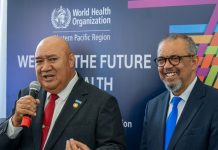
“This makes our Coral reefs the heart of the Blue Pacific. They support our food systems, economies, cultures, and biodiversity, while also protecting our coastal communities,” said Ambassador Amena Yauvoli, Director of Biodiversity Conservation of the Secretariat of the Pacific Regional Environment Programme (SPREP).
Ambassador Yauvoli also presented during the “From Global Ambition to National Action: Perspectives from Coral Reefs Nations” event.
“To address and respond to these challenges, our Members through a shared commitment adopted the 10-year Pacific Coral Reef Action Plan in 2021. It is the Pacific’s own roadmap for coral reefs, developed by the region, for the region.”
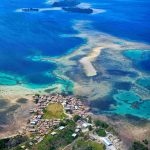
Coastal fishing village Solomon Islands
The Pacific Coral Reef Action Plan focuses on the region’s coral-reef conservation and management around four priorities over the next ten years. Those are conservation of habitats and biodiversity, sustainable fisheries and food security, resilience and adaptation to climate change, and sustainable tourism.
A key feature of the plan is its translation from a document on a shelf, to taking action for nature across the Pacific to protect coral reefs.
Through the EU Pacific BioScapes Programme it is taking ridge-to-reef action across 11 Pacific Island countries, from a regional assessment of coral reef capacity and needs to mangrove and coral restoration.
The AFD Pacific Ocean Initiative is protecting coastal and marine ecosystems across 18 countries and territories, strengthening national and local monitoring, and using eDNA to find and map resilient reefs and how they connect.
A partnership between SPREP, the Government of Australia and the Australian Institute of Marine Science is equipping countries that have requested with ReefCloud monitoring and reporting tools, online monitoring courses, train-the-trainer programs and a scientific writing workshop for the Pacific providing a space for Pacific scientific authors.
The Great Barrier Reef Foundation’s Resilient Reefs Pasifika project is scaling up action and funding through Pacific hubs and a coral reef accelerator, and its Reef Seeding Initiative recently launched in Palau will be looking at large scale restoration of reefs with climate-resilient corals.
The SPREP Executive Board also endorsed the Pacific Year of the Coral Reef, 2028 and 2029 to align with the International Coral Reef Initiative’s fourth International Year of the Reef in 2028.
“Over the next year we will develop a Program of Work with our Members to plan out what they would like to implement and celebrate as part of the Pacific Year of the Reef,” said Ambassador Yauvoli.
“We welcome our partners here today to be part of this 2-year celebration.”
Solomon Islands is nearing completion of its National Plan of Action for Coral Reef Conservation, Management and Restoration, supported through the GEF-7 Coral Reef Rescue Project. This is one aspect of national work underway to protect its coral reefs, of which Masu recommends that communities must remain at the centre of decisions.
National ambition must connect with customary ownership, local knowledge, and community priorities. Communities must be given the opportunities to lead and shape management arrangements and understand how proposed measures will affect their lives,” said Masu as she stressed that the blessing of extraordinary biodiversity comes with shared responsibility.
“Participation must include women, young people, and others whose voices may be less visible. Communication must also work both ways: information should reach communities, and community perspectives should influence national decisions.”
The “From Global Ambition to National Action: Perspectives from Coral Reefs Nations” event was held on 22 October at the Ocean Pavilion during CBD COP17 in Yerevan Armenia.
CBD COP17 is taking place from 19 to 30 October 2026.