

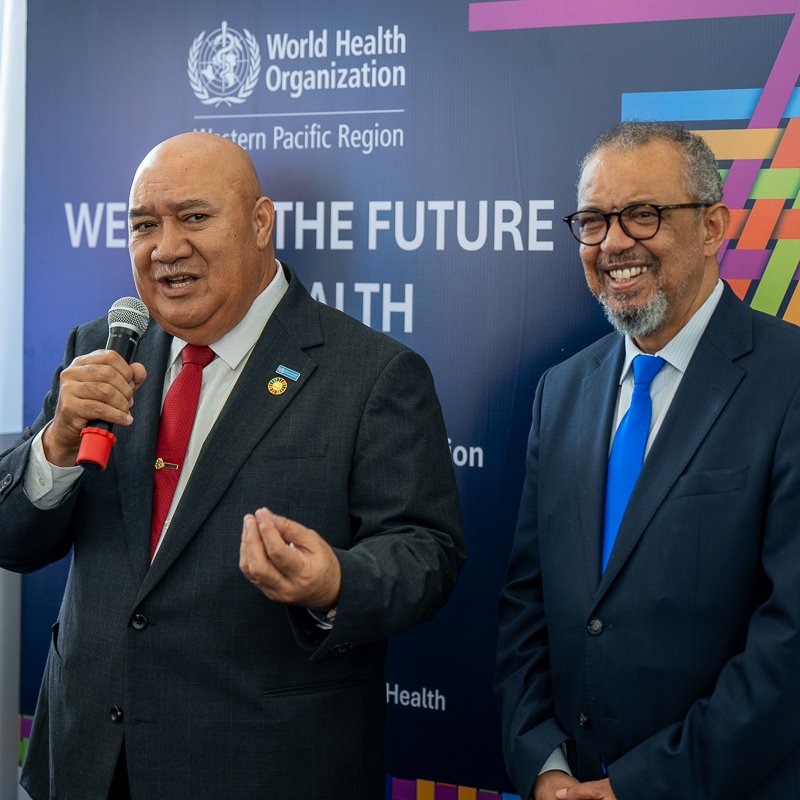
Pacific Island countries are facing growing pressure on their health systems from climate change, workforce shortages and limited funding, with seven Pacific countries yet to include health in their national climate plans, says World Health Organisation (WHO) Western Pacific Regional Director Dr Saia Ma’u Piukala.
Addressing the 77th session of the WHO Regional Committee for the Western Pacific in Manila, Dr Piukala said countries had made progress in health services but continued to face longstanding problems alongside emerging threats.
“Climate change is reshaping how diseases spread, placing additional pressures on our health systems, and displacing communities,” Dr Piukala said.
He said climate-related risks were adding to the burden on health services already dealing with noncommunicable diseases, ageing populations, workforce shortages and competing demands on limited national budgets.
“Seven of them are Pacific island countries which are among the most vulnerable to climate-related risks,” he said, referring to the 10 countries in the Western Pacific Region that have yet to include health in their climate planning.
Dr Piukala said climate resilience had become a central part of WHO’s work, with support underway to help Pacific countries strengthen health facilities and prepare for climate-related emergencies.
Fiji and Kiribati are receiving support through a partnership with the Korea International Cooperation Agency(KOICA) to strengthen climate resilience across their health systems. Similar work is underway in Solomon Islands, Tuvalu and Vanuatu through a WHO and United Nations Development Programme project funded by the Global Environment Facility.
A climate-risk assessment tool, CLEARPLUS, first piloted in Malaysia, is also being used in Fiji’s outer-island clinics.
Dr Piukala said the Green Climate Fund’s (GCF) accreditation of WHO would provide countries with a direct channel to seek climate financing for resilient hospitals and early-warning systems.
“Resilience requires financing,” he said.
The WHO report also highlighted gaps in access to essential health services across the region.
The Western Pacific’s universal health coverage index rose from 63 in 2000 to 81 in 2023, meaning four in five people can access essential health services. However, the index ranged from 32 in Papua New Guinea to 89 in Australia and New Zealand.
Dr Piukala said people in remote, rural and island communities often had less access to health services than those in urban areas.
Fiji, Kiribati, Naoero, Tonga, Tuvalu and Vanuatu are also using WHO platforms to improve health workforce data and planning.
Immunisation remains another major concern. About 1.7 million children in the Western Pacific received no vaccines in 2025, leaving them vulnerable to preventable diseases.
Dr Piukala urged governments to invest in sustainable national vaccination programmes, warning that countries could no longer rely heavily on donor support.
He said the region could become the first WHO region to eliminate measles if countries acted urgently and achieved at least 90 percent vaccination coverage among all children by 2029.
Noncommunicable diseases account for almost 90 percent of deaths across the Western Pacific, while hypertension control rates remain below 10 percent in some Pacific countries and areas.
WHO has set a goal of providing treatment to an additional 100 million people with hypertension across the region by 2030.
Dr Piukala also highlighted progress in health emergency preparedness. The average time taken to notify WHO of a public health event has fallen from 20 days in 2023 to 48 hours, allowing threats to be identified more quickly.
WHO also supported responses to the Pacific’s largest dengue outbreak in decades, affecting Samoa, Tokelau and other Pacific island countries, as well as responses to vaccine-derived polio events in Papua New Guinea, Indonesia and Laos.
Looking ahead, Dr Piukala said digital health and artificial intelligence could improve services, particularly for overstretched health workforces, but countries would need to ensure the technology was used safely and equitably.
In Solomon Islands, health workers are piloting an AI-enabled tool that converts photographs of paper-based forms into digital data.
“The question is no longer whether AI will affect health and health systems,” Dr Piukala said. “It is whether we will manage it responsibly and ensure that its benefits reach everyone.”
He said countries across the Western Pacific needed to strengthen cooperation, close gaps in health services and prepare for future challenges.
“No country has all the answers. Neither does WHO,” Dr Piukala said. “But every one of us has something to contribute, something to teach, and something to learn,” he said.