


New Zealand has scored among the lowest countries globally for integrating public health into its climate plan, while Timor-Leste ranks among the top five performers, according to a new global scorecard assessing countries’ climate commitments.
The 2026 Healthy Nationally Determined Contributions (NDC) Scorecard, released by the Global Climate and Health Alliance, gave New Zealand just two points out of a possible 32, highlighting limited recognition of the links between climate change and human health.
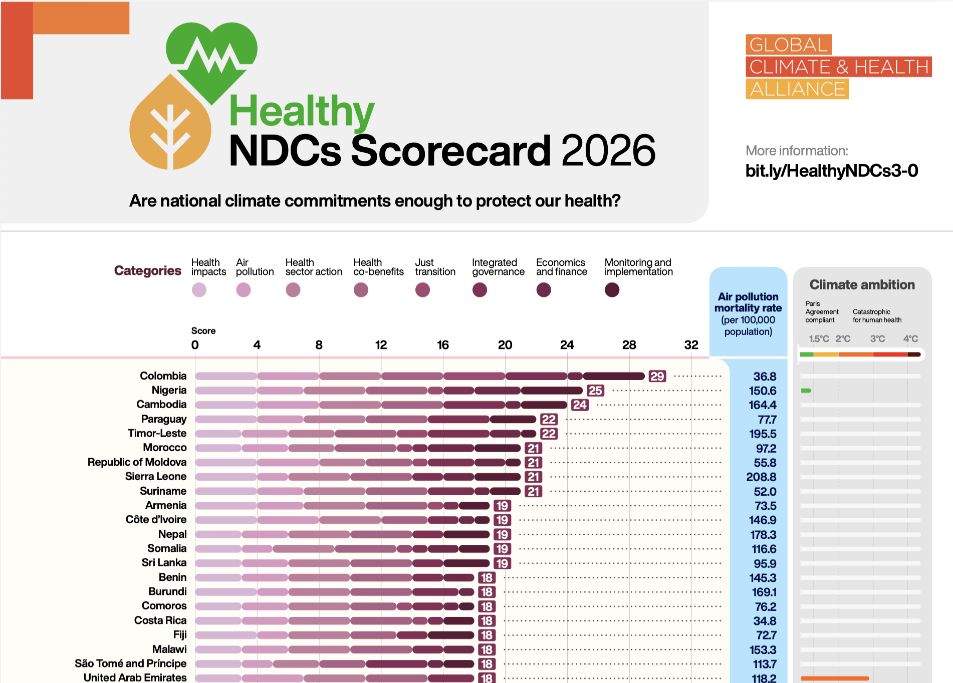
In contrast, Timor-Leste scored 22 points, placing it among the five highest-ranked countries alongside Colombia, Nigeria, Cambodia and Paraguay.
The scorecard assessed the climate plans of 132 countries submitted to the United Nations Framework Convention on Climate Change before 01 August 2026.
Colombia topped the rankings with 29 points, followed by Nigeria with 25 and Cambodia with 24. Paraguay and Timor-Leste each scored 22 points.
The report found that 19 of the 20 highest-scoring countries were low- and middle-income economies, reflecting the extent to which many countries facing climate impacts are incorporating health considerations into their national climate planning.
However, the alliance warned that several major greenhouse gas emitters were failing to match their recognition of health risks with sufficiently ambitious emissions reduction targets.
Japan and India also scored just two points, while South Korea received four, Russia six and Brazil seven. Australia, China and the United Kingdom each scored nine points out of 32.
The European Union scored 12 points, but the report said its climate commitments did not match the level of emissions reductions needed to protect public health.
The scorecard also found that only five countries – Cambodia, Chile, Colombia, Costa Rica and Paraguay had set targets to reduce black carbon, a pollutant that contributes to global warming and causes serious health harm through air pollution.
Dr Nova Tebbe, postdoctoral researcher at the Global Climate and Health Alliance and lead researcher of the study, said governments needed to integrate health considerations more effectively into climate action.
“The human face of climate change has never been more obvious governments must act now to integrate health,” Tebbe said.
The alliance said rapid action to reduce short-lived climate pollutants, including black carbon, methane, hydrofluorocarbons and tropospheric ozone, could slow global heating while delivering immediate health benefits and cost savings.
It stressed that these measures must be accompanied by deeper reductions in carbon dioxide emissions to limit long-term warming.
Dr Jeni Miller, executive director of the alliance, said air quality measures were a vital part of effective climate action.
Integrating health and air quality into climate policies would protect populations, strengthen public support for climate action and maximise economic benefits, she said.
The report also highlighted the need for financing to help countries translate climate commitments into action, particularly in developing economies facing high levels of air pollution and growing climate-related health risks.
It cited Nigeria and Nepal as examples of countries that address air pollution in their climate plans but continue to experience exceptionally high rates of air pollution-related mortality.
The alliance said outdoor air quality received less than one percent of development funding, despite air pollution-related health impacts, lost productivity and reduced life expectancy costing the global economy an estimated five percent of gross domestic product.
Jess Beagley, policy lead at the alliance, said developed countries had a responsibility to provide climate finance to developing nations in line with Article 9.1 of the Paris Agreement.
She said countries with high historical and current emissions also needed to accelerate pollution reductions to limit climate-related harm.
The alliance identified the COP31 climate summit as an opportunity to strengthen international action on climate finance, public health and emissions reduction.
It warned that inadequate funding for adaptation and health protection could place increasing pressure on healthcare systems as climate hazards intensify.
The scorecard is designed to help governments identify gaps in their climate plans and strengthen policies that reduce emissions, improve air quality and protect public health.