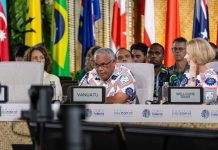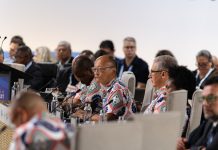
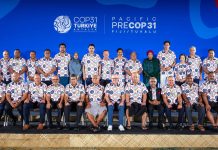
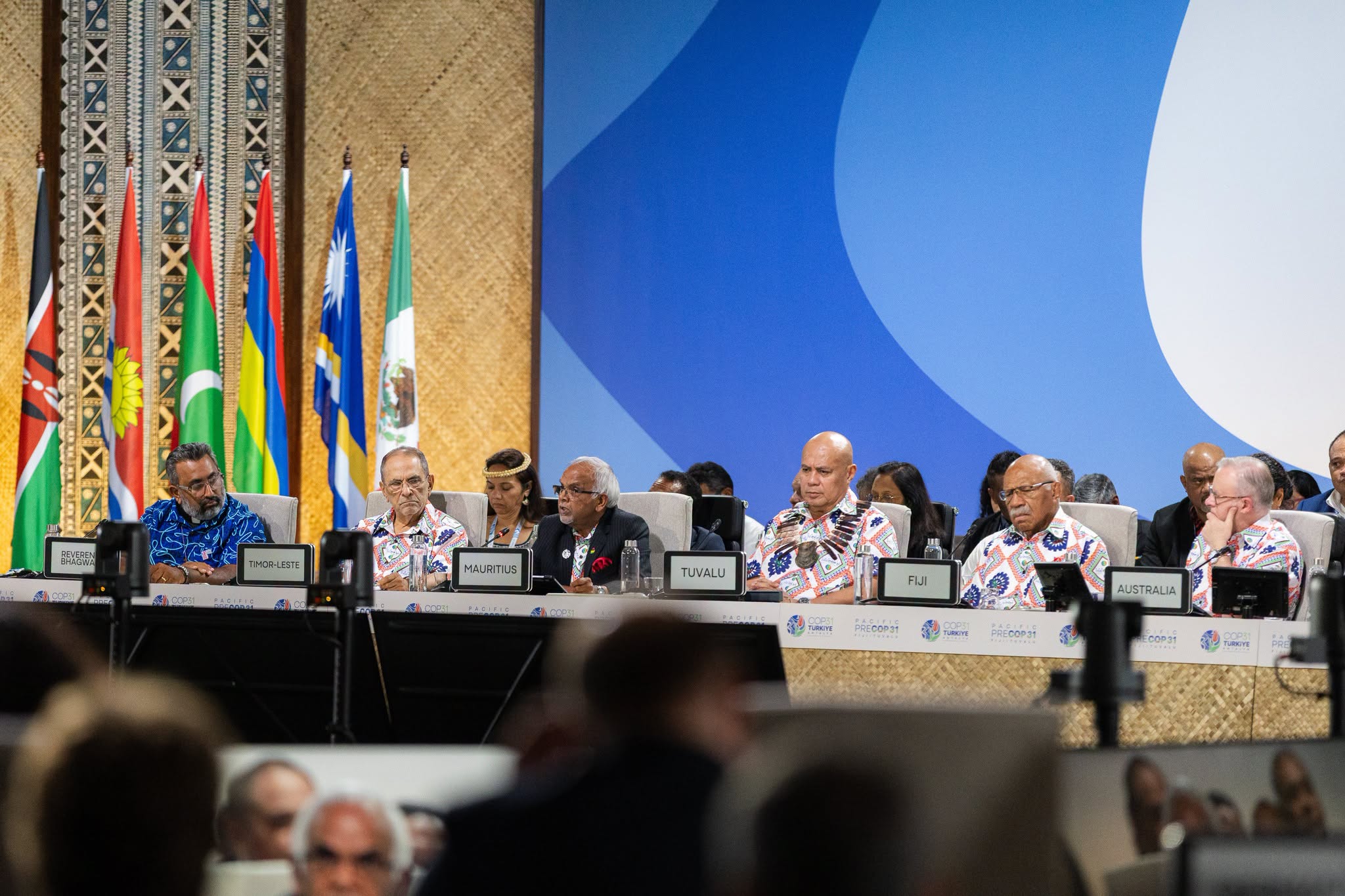
Mauritius has called on Small Island Developing States (SIDS) to strengthen their collective voice and push harder for climate action as emissions continue to rise and the implementation gap widens.
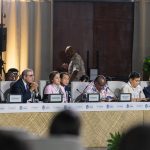
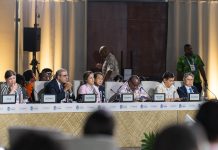
Mauritius President Dharam Gokhool told Pacific PreCOP31 leaders in Denarau that island states could not afford to wait for major emitters to act while their communities face rising seas, extreme weather and growing threats to food security and livelihoods.
“We are still negotiating. Time flies and carbon emissions are increasing more than ever. The implementation gap remains significant,” Gokhool said.
Speaking after spending a day and a half in Tuvalu, Gokhool said Mauritius faced many of the same vulnerabilities as Pacific island countries.
“I see here in the Pacific the same vulnerabilities that plague us back home,” he said.
“Our already limited land surface is being eroded by climate-induced sea level rise. This poses an ever-increasing challenge to our livelihoods, food security and housing.”
Gokhool said the passage of time since the first UN climate conference and the adoption of the Paris Agreement should be measured against the action delivered, not continued negotiations.
He noted that a child born in 1995, when the first COP was held, was now 31, while a child born when the Paris Agreement was adopted would turn 15 this December.
“She has moved from childhood to the threshold of adulthood. She has grown. We are marking time,” he said.
Gokhool said SIDS should use their ocean resources and natural assets as part of the climate response rather than allowing their limited land area to remain a liability.
“We are the custodians of vast seas, ocean states. The size of our land can no longer be our liability.
“We have natural assets, from carbon sinks to our wetlands and mangroves,” he said.
He said the implementation of the Biodiversity Beyond National Jurisdiction (BBNJ) Agreement provided an opportunity for island states to leverage their oceans and strengthen sustainable ocean governance.
Gokhool said the message from SIDS heading to COP31 in Türkiye was clear.
“We believe in multilateralism and the rules-based internationalism,” he said.
He said the Pacific Islands Forum, Alliance of Small Island States and Commonwealth had worked over the past five years to advance a common position to keep the 1.5°C temperature goal within reach.
Gokhool also backed the 2025 advisory opinion of the International Court of Justice on states’ obligations in relation to climate change, following Vanuatu’s initiative.
“Mauritius knows first-hand what it means for a small country to go in front of the world court.
“For international law to prevail, we have taken that road. We respect what the courts decide, and we ask every state to do the same,” he said.
Gokhool said climate action for SIDS was directly linked to economic security, social stability and survival.
“For us, SIDS adaptation is a matter of economic security, social stability, and environmental survival,” he said.
He said Mauritius would take five priorities to COP31: mitigation, adaptation and climate resilience, climate finance, and a just transition.
He also called for loss and damage to be treated as a distinct pillar of the international climate regime rather than being treated simply as another adaptation finance instrument.
“Loss and damage should be a distinct pillar of the climate regime, and not merely another adaptation finance instrument that should be capitalised,” he said.
Gokhool urged major emitters that had yet to submit strengthened NDC 3.0 commitments to do so and called on all parties to accelerate implementation.
He also called for concessional finance tailored to SIDS, particularly financing designed around smaller projects rather than systems developed for large continental economies.
“We do not have the luxury of waiting for others to take action. The opportunity cost is too high,” he said.
Gokhool said the ocean must be placed at the centre of climate action, including through blue NDCs, sustainable ocean governance, resilient blue economies, stronger sea-level science and legal safeguards for island states.
“I, as an islander from the Indian Ocean, echo today from Nadi to Antalya that we keep 1.5 degrees within reach,” he said.
Pacific leaders are concluding their PreCOP31 discussions in Fiji after their programme in Tuvalu and are expected to sign the Taku Pakasoa Declaration ahead of COP31 in Türkiye.