


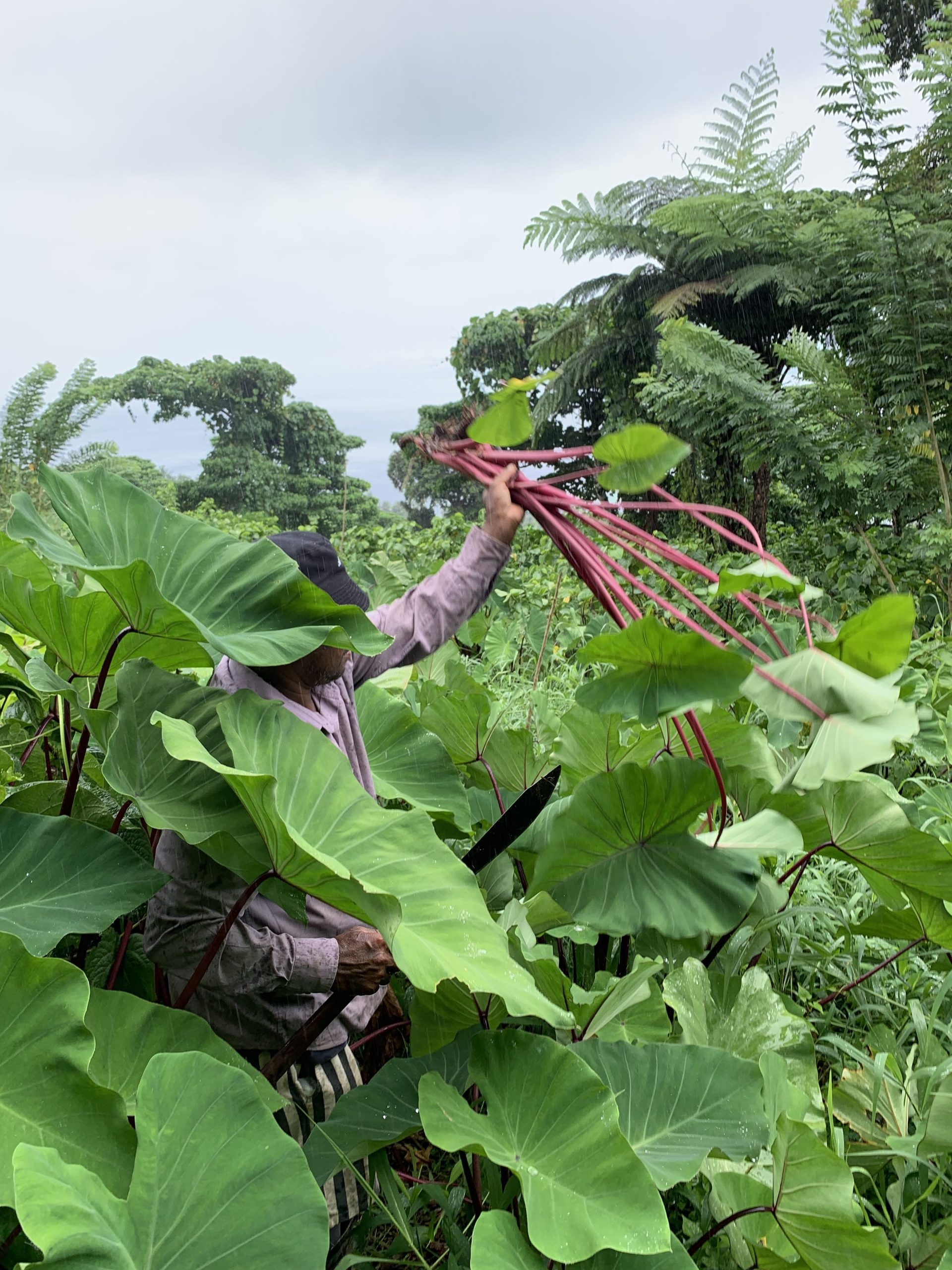
New research into seven Fijian taro varieties has found major differences in how the crop responds to drought, providing potential leads for developing taro that can withstand increasing water stress.
The study found that while drought reduced plant growth across all seven varieties, Matadrala and Tausala ni Samoa suffered the largest losses in total plant biomass, while Tarova Damu and Tarova Vula showed more balanced responses under water-limited conditions.
Taro (Colocasia esculenta) is a major food crop in Fiji and an important source of income for rural communities, making its ability to withstand drought increasingly important as water shortages threaten agricultural production.
Researchers from the Pacific Community (SPC) tested seven locally important varieties under controlled conditions at the Centre for Pacific Crops and Trees (CePaCT) in Fiji.
The varieties tested were Tausala ni Samoa, Tarova Loa, Tarova Vula, Tarova Damu, Bavia, Uro ni Vonu and Matadrala.
The 80-day trial compared plants grown under well-watered conditions with plants exposed to gradually increasing water stress.
Researchers measured total plant biomass, water use efficiency, root-to-shoot ratio and a whole-plant stress index to determine how the varieties responded.
The biggest declines in biomass were recorded in Matadrala, which fell by 45 percent, and Tausala ni Samoa, which declined by 41 percent compared with well-watered plants.
By comparison, Tarova Damu recorded only a 5 percent decline in biomass, indicating greater stability under the conditions tested.
The study also found that some varieties responded to drought by using available water more efficiently.
Tausala ni Samoa, Tarova Loa and Uro ni Vonu all recorded increases in water use efficiency under drought stress. Tarova Loa recorded the highest water use efficiency among the varieties tested.
However, researchers cautioned that higher water use efficiency did not necessarily mean higher growth.
“Increased Water Use Efficiency (WUE) did not always correspond with higher biomass, as conservative water use can limit CO2 assimilation,” the study found.
Root development was another important response.
Most varieties increased their root-to-shoot ratio under drought, suggesting greater allocation of resources to roots to improve water uptake.
Bavia recorded the largest increase, from 1.38 under well-watered conditions to 2.13 under drought stress.
Tarova Damu and Tarova Vula showed relatively stable biomass alongside increased root allocation, indicating what researchers described as a more balanced drought response.
The study found that Tarova Loa and Uro ni Vonu also showed resilience under drought, although each had trade-offs in other traits.
Researchers said the findings demonstrate that there is no single trait that can be used to determine drought tolerance in taro.
“These findings emphasise the importance of multi-trait evaluation when selecting drought-tolerant taro varieties for breeding and cultivation,” the researchers said.
The research comes as drought remains a concern for Fijian agriculture, with the crop requiring relatively high water availability for optimal growth.
The researchers noted that past drought events, including the 1997–98 El Niño, caused severe losses among root-crop farmers in Fiji.
They said identifying naturally resilient varieties could support breeding programmes aimed at developing taro cultivars better suited to water-limited environments.
However, the researchers stressed that further testing is needed before conclusions can be applied directly to farmers’ fields.
They recommended larger trials, biochemical and molecular studies, and multi-location field testing in drought-prone areas to determine whether the varieties maintain their resilience under different environmental conditions.
The study also recommends examining farming practices such as mulching, drip irrigation and soil-moisture management to support taro production during periods of limited rainfall.
The research was supported by SPC through funding from Palladium International, contracted by Australia’s Department of Foreign Affairs and Trade (DFAT).