

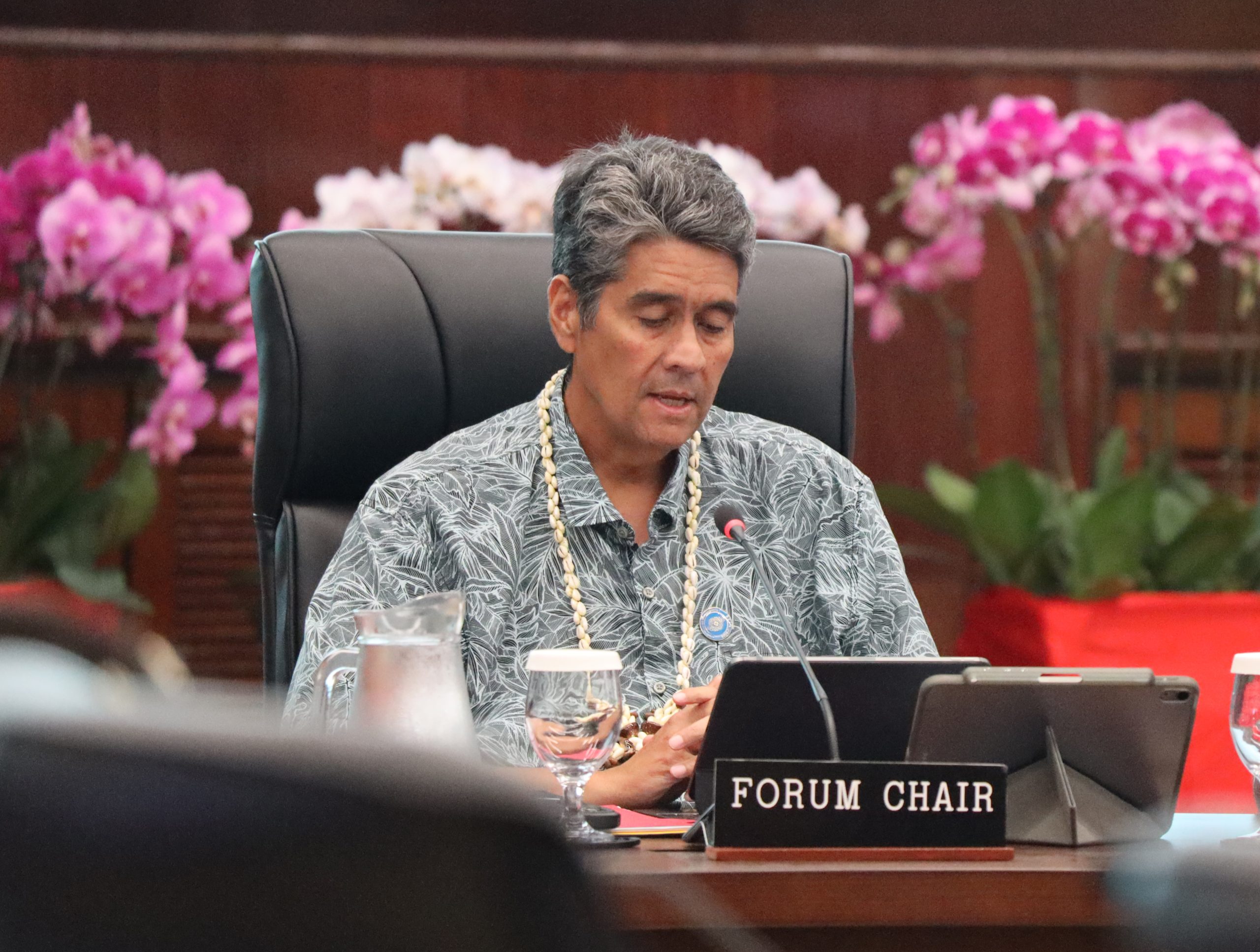
Palau President and Forum Chair Surangel Whipps Jr says Pacific countries must balance ocean conservation with economic development as they confront rising seas, extreme weather and growing pressure on marine resources.
Whipps, who has led Palau since 2021 and was re-elected in 2024, told Earth.Org that Pacific nations needed to invest both in protecting their marine environment and developing industries that allow communities to benefit from ocean resources.
“How do we, as Pacific Island countries, continue to be good stewards?.
“That requires investment in protection, but also requires investment in production,” Whipps said.
Palau has established itself as a strong advocate for marine conservation. It became the first country to ratify the UN High Seas Treaty in 2023, while its National Marine Sanctuary, which took effect in 2020, initially closed 80 percent of the country’s exclusive economic zone to fishing and other extractive activities.
Whipps said Palau’s conservation approach is rooted in the traditional Palauan practice of ‘bul’, in which traditional leaders would restrict access to areas to allow marine resources to recover.
“We often refer to the ocean as our father, and the land is our mother.
“That teaches a very important principle, because if the ocean is your father, it provides, but also you have a responsibility to take care of it. You don’t just take,” Whipps said.
However, Palau is also reviewing how its marine resources are managed, including proposals to reduce the no-fishing area to allow greater access to fisheries.
Whipps said the government’s marine spatial planning process is intended to improve management and assess the impacts of conservation measures on local communities.
He has also argued that Pacific countries should capture more economic value from their fisheries.
“We need to become the OPEC of tuna,” Whipps said, highlighting the need for Pacific countries to move beyond harvesting resources and develop processing and other industries within the region.
“Production is building ports, processing facilities in the Pacific, so that the people in the Pacific benefit from the resources in the Pacific,” he said.
The approach has drawn criticism from some environmental groups and former Palau President Tommy Remengesau Jr, who have raised concerns about reducing the marine sanctuary.
The debate comes as Palau continues to face climate impacts.
Whipps said rising sea levels and increasingly damaging storms were affecting agriculture and communities, including traditional food production.
“Sea level rise is real, storms are real,” he said.
“I always say that for those of us who are the most vulnerable, who have contributed the least, we must not give up. We need to continue to fight.”
Whipps also remains opposed to deep-sea mining, despite differing views among Pacific countries over the industry.
Cook Islands, Nauru, Tonga and Kiribati have supported the sector as a potential source of economic diversification, while Whipps has called for a moratorium.
“We should proceed with caution, because if we do that, we may destroy the ocean, which now is the largest carbon sink,” he said.
Whipps said Pacific countries remained united on the need for stronger climate action, including the transition towards renewable energy.
He said Pacific priorities at COP31 would include greater access to climate finance, development of green industries and accelerating the transition to renewable energy.
Accessing climate finance remains a challenge for small island developing states, with Whipps pointing to lengthy accreditation and application processes.
“Red tape has always been a challenge,” he said.
Whipps also highlighted the role of China in the global transition to renewable energy, despite Palau’s diplomatic relationship with Taiwan and strained relations with Beijing.
He said China’s investments in solar energy and electric vehicles demonstrated the economic potential of the transition.
“It makes economic sense,” Whipps said.
Palau has also promoted conservation through tourism. In 2017, it introduced the Palau Pledge, requiring visitors to commit to protecting the country’s environment.
Whipps said environmental protection ultimately depended on individuals and communities, particularly young people.
“Climate action involves everyone.
“If everybody and every young person makes that commitment themselves, we don’t need governments to change. We make the change. You have the power. Just start acting and doing it,” Whipps said.