
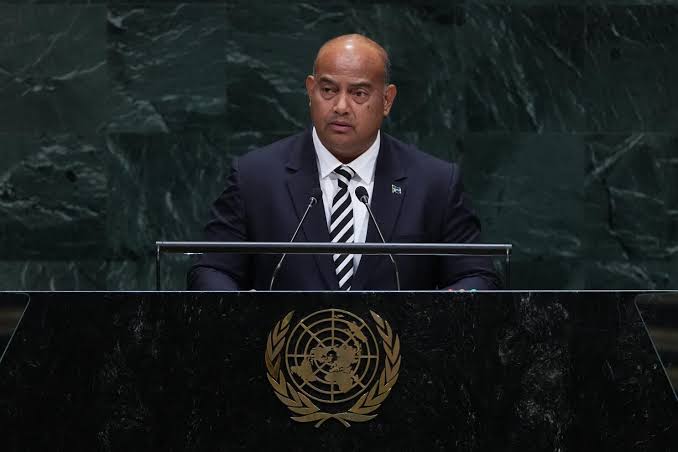
Naoero President David Adeang has told the United Nations that the country is reclaiming its ancestral name, calling on the international community to recognise “Naoero” as an affirmation of its identity, language and history.
Addressing the 81st United Nations General Assembly in New York, Adeang said the name Naoero had always been used by the country’s people and its restoration was about honouring the past rather than erasing it.
“Naoero is the name our people used among themselves.
“Today we restore Naoero. We do not make this choice to erase our past. We make it because we honour it,” Adeang said.
Adeang called on the international community to respect the name as part of Naoero’s identity and place in the international community.
“What I ask of the world costs nothing. Join us in recognising and respecting the identity that is already ours.
“Say our name. Naoero.”,” Adeang told the UNGA.
The name change was one of several issues Adeang raised in an address centred on sovereignty, equal treatment of small states, sustainable development, ocean governance and the vulnerabilities faced by small island nations.
He challenged the UN to deliver on its commitments to small states, saying trust in the multilateral system depended on whether it could respond to the realities of vulnerable countries.
“A multilateral system that cannot deliver for a state like mine does not deliver at all,” Adeang said.
Referring to the UNGA81 theme, “Restoring trust, managing transformation: a United Nations that delivers for all”, Adeang said delivery must apply to countries regardless of their size or geographic distance.
“For my country, that means ensuring no nation, regardless of size or distance, is left behind as the world changes around us,” he said.
Adeang also renewed Naoero’s call for the International Seabed Authority (ISA) to complete regulations governing deep seabed mining.
He said Naoero had spent 15 years fulfilling its obligations as a sponsoring state and had invested resources in exploration and scientific data.
“We were told then that we were rushing. That was five years ago, and today the rules remain unwritten,” he said.
Adeang said Naoero’s position was based on scientific evidence, the United Nations Convention on the Law of the Sea(UNCLOS) and relevant legal opinions.
He warned that continued delays created uncertainty for states that had acted under the existing legal framework.
“A principle declared in 1970 and a bargain struck in 1994, both in this hall, still wait for the rules that would give them effect.
“When a multilateral process cannot deliver, the world does not stand still. Those with the means to act will not wait,” he said.
Adeang called on the International Seabed Authority to complete the regulations.
“Adopt the rules. Let the waiting end,” he said.
On economic development, Adeang said Naoero’s progress should not be measured by income alone, arguing that conventional economic indicators failed to fully capture the structural vulnerabilities of small island states.
He said Naoero had invested in fisheries, seabed resources, new revenue streams, financial regulation, health, education and sport to build a more diversified economy.
But he said geographic isolation and a limited economic base continued to impose significant constraints, including dependence on imported food and limited infrastructure.
“That is why we strongly support the Multidimensional Vulnerability Index, or MVI, and the United Nations efforts to pilot the tool,” Adeang said.
He called for vulnerability assessments to play a greater role in determining access to development finance.
Adeang welcomed moves by institutions including the Asian Development Bank to consider vulnerability alongside income, while urging other institutions, including the World Bank, to adopt a similar approach.
“If the international community is truly serious about restoring trust and managing transformation, it must demonstrate that commitment where it matters most — with those who are most vulnerable,” he said.
Adeang also said Naoero would continue working with international partners while maintaining its sovereignty and right to make its own decisions.
“Naoero will not be made to choose. We will work with every partner who respects our sovereignty and our right to decide our own future.
“That is not neutrality. It is called independence,” he said.
He reaffirmed Naoero’s support for Cuba’s call for an end to the United States embargo and backed reform of the UN Security Council.
Adeang said the Security Council no longer reflected the international system created since 1945 and supported expanding both permanent and non-permanent membership categories.
“The Security Council does not reflect the world as it is. It reflects the world as it was in 1945, when most of the countries in this hall did not yet exist as sovereign states
“A body that speaks for all of us should look like all of us.,” he said.
Adeang said the issues raised in his address were linked by the principle that every people had the right to be treated as an equal and to speak for itself.
“Our name is about sovereignty. How we are measured is about justice. The deep seabed is about opportunity and responsibility. Our partnerships are about standing as equals,” he said.
He challenged the United Nations to match its commitments with action.
“Trust is restored when promises are kept. Transformation is managed when decisions lead to action.
“And we deliver for all only when you deliver for the small.”
“I am challenging you to be as good as your word. Say our name. Let the waiting end. Let vulnerability be measured honestly and treat us as partners,” Adeang said.