

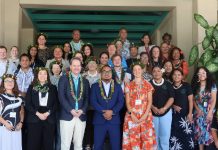

A new Pacific Climate Change Journal envisioned to be a dedicated platform for Pacific climate research, knowledge and solutions to reach policymakers, communities and the international scientific community, has been launched in the Solomon Islands.
The launch was held on the first day of the 5th Pacific Ocean Pacific Climate Change Conference (POPCCC) taking place from 14-18 September in Honiara.
The journal responds to a longstanding challenge across the region: while Pacific Island countries are generating substantial climate change knowledge through research, government programmes, community initiatives and development projects, much of this evidence never reaches peer-reviewed academic literature.
Professor Transform Aqorau, Vice-Chancellor, Solomon Islands National University, who delivered the official declaration to launch the journal said: “If our research is not published, visible and accessible, it risks being overlooked.”
The Pacific Climate Change Journal aims to address this gap by providing a dedicated regional pathway for climate literature generated within the Pacific to be developed, peer-reviewed, published and shared.
The significance of the journal extends beyond creating another academic publication. A central objective is to strengthen the pathway between Pacific-generated evidence and major regional and international climate science processes, including the Intergovernmental Panel on Climate Change (IPCC) and World Meteorological Organisation (WMO) assessments.
Professor Transform emphasised that when Pacific research remains outside peer-reviewed literature, it has fewer opportunities to contribute directly to the evidence used in major international climate assessments. This can mean that knowledge generated within the region is not fully reflected in global discussions about climate risks, impacts, adaptation and resilience.
The journal’s long-term ambition is therefore to become a trusted and credible pathway through which Pacific climate evidence can enter these wider scientific processes.
Easter Chu Shing, Deputy Director General of SPREP, echoed this point.
She added that valuable Pacific research is often held in conference papers, project reports, student theses and institutional records. This can make important evidence difficult to find, cite and use, including by those responsible for national and regional climate policy.
“By integrating our own science and knowledge, we ensure that global evidence bases accurately reflect specific world views, priorities, and contextual realities,” she said.
This is particularly important for the Pacific, where climate change is experienced through distinctive geographical, social, economic and cultural contexts.
Strengthening the availability of peer-reviewed research from the region can help ensure that global climate science reflects those realities, while also providing governments and regional organisations with a stronger evidence base for climate policy and decision-making.
Vensel Margraff, IPCC Regional Coordinator, said: “Greater Pacific engagement strengthens the integration of Pacific science, knowledge, priorities and contextual realities into global science and decision-making.”
The journal’s first edition will include themes aligned with the IPCC assessment process alongside a dedicated focus on the different knowledge systems found across Pacific countries. This gives the journal an opportunity to contribute not only more Pacific data to the global evidence base, but also different ways of understanding climate risk, resilience and adaptation.
The journal will initially be organised around four themes, with an Expression of Interest for papers to follow the launch. Regional write-shops are also planned to support researchers from across the Pacific to develop submissions, with the first edition expected in 2027.
The Journal’s Editorial and management team:
•Dr Morgan Wairiu – Chief Editor; Climate Adaptation and Pacific Resilience
•Associate Professor Awnesh Singh – Editor; Climate Science and Oceanography
•Dr Viliamu Iese – Editor; Impacts, Adaptation and Vulnerability
•Dr Christina Newport – Editor; Climate Mobility and Human Wellbeing
•Dr Kilisimasi Latu – Editor; Water Resources and Hydrology
•Dr Alick Haruhiru – Editor; Meteorology and Tropical Cyclones
•Dr Tumanako Fa’aui – Editor; Infrastructural Systems and Decision Making
•Tagaloa Cooper – Managerial Committee, Advisory; Pacific Climate Change Centre, SPREP
• Professor Timothy Naish – Managerial Committee, Advisory; Victoria University of Wellington
•Fonoti Samani Tupufia – Managerial Committee, Research; National University of Samoa
The Pacific Climate Change Journal can be accessed with the following website: https://pacificclimatechange.com/
The Fifth POPCCC is jointly organised by Solomon Islands National University, the Pacific Climate Change Centre of SPREP, the Solomon Islands Government’s Ministry of Environment, Climate Change, Disaster Management and Meteorology, Te Herenga Waka Victoria University of Wellington and the National University of Samoa, continuing a lineage of Pacific-led gatherings held in Wellington in 2016 and 2018, online in 2020 and in Apia in 2024.
For more information, please contact yvettek@sprep.org