

By Pita Ligaiula in Koror, Palau
Pacific Islands Forum leaders will meet next week against a more challenging regional backdrop, with geopolitics, transnational crime, economic pressures, resilience and regional integration among the key issues demanding collective action.
Forum Deputy Secretary General Esala Nayasi told a regional media training workshop in Palau that the Pacific had faced a particularly demanding year, with the list of issues before leaders longer than usual.
“Geopolitics and the shifting political landscape in the region are one that we cannot turn a blind eye to,” Nayasi said.

He said crises were further intensifying challenges faced by Pacific countries, communities and vulnerable people.
“There are issues that our countries are facing. The crisis has accelerated these challenges even further, not only at the regional level, but the communities and the people who are vulnerable,” he said.
Nayasi said economic issues, political leadership, resilience and transnational crime would feature prominently in discussions at the 55th Pacific Islands Forum Leaders Meeting.
“There are a lot going on in our communities, and transnational crime is key to that. Some of our countries are fighting the battle of drugs, illicit drugs. And also, HIV-related issues,” he said.
He said the scale of the agenda reflected both the challenges facing the region and the importance of regionalism.
“It speaks to where we are as a region. It speaks to priorities that our members identify that are important for the region to push through collectively, rather than as individual countries,” Nayasi said.
Nayasi said the 28 agenda also demonstrated the need for Pacific countries to work together rather than attempt to address regional challenges individually.
“There is an appreciation of, as I’ve said, the value of regionalism. There is acknowledgement that we all need regionalism to work.
“We can’t implement or we can’t do things on our own as individual countries. It is important that there are issues that we need to work together, to deliver together as one collective voice, as one unit,” he said.
He said geopolitics would also shape the environment in which leaders meet, with more development partners expected to be present in Palau compared with last year’s meeting in Honiara.
“You will note that last year partners were not active in Honiara. This year you will see a lot of them around,” Nayasi said.
He said partnership arrangements and how Pacific countries engage with partners would be an important part of the leaders’ discussions.
“The key issues that will be before the leaders also speaks to partnership mechanism and how they would want to engage with partners moving forward. So, partnership is key to that discussion,” he said.
Nayasi also highlighted transnational crime as a growing concern, noting that Forum leaders had acknowledged the issue last year and called for a regional approach.
He said the agenda would cover a wide range of priorities under the Forum’s 2050 Strategy for the Blue Pacific Continent.
“If you look at the different thematic areas of 2050 strategy, you will see in the agenda for our leaders that there is a myriad of issues that will be discussed based on the priorities that they have set,” Nayasi said.
Regional integration will also remain a key issue, following its prominence at last year’s Forum Leaders Meeting in Solomon Islands.
“It was a key thematic area for the meeting in Solomon Islands, which we are now taking through the review of the regional architecture process,” he said.
Nayasi said the regional media has an important role in ensuring Pacific people understood the decisions made by their leaders.
“I believe the important issue for us is communicating what we do, outcomes of the latest meeting here, to our people so that they are able to connect to regional policies and decisions that our leaders make,” he said.
He said the Forum Secretariat valued the role of Pacific journalists in communicating regional priorities and outcomes.
“Like Secretary General has said, we acknowledge the value that you bring to our work.
“We are really appreciative of your being supportive of us. And I know for the last few months you’ve always been there when we call on you with the important issues that we wish to convey to those that we serve, people of the Pacific,” Nayasi said.
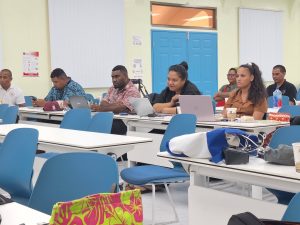
Nayasi said the leaders’ meeting would be an important opportunity for Forum members to address the region’s current challenges collectively.
“It will be a very exciting week for us.
“We are really looking forward to a successful meeting, one that will speak to the key issues that are highlighted and some of the key challenges that our region is currently facing, and one of which is regional integration,” he said..