


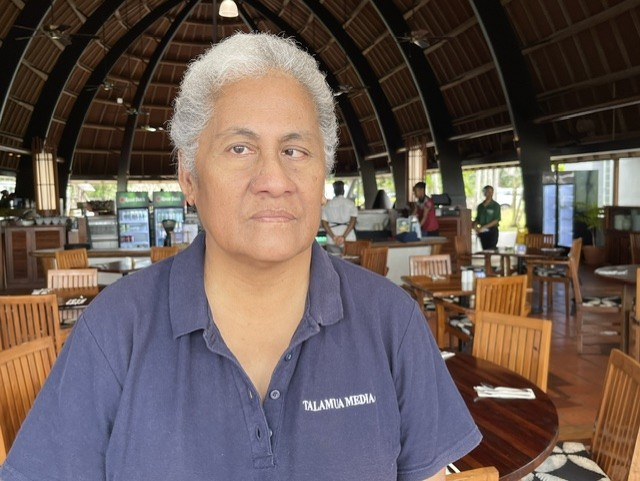
Samoa’s media community is watching closely as senior journalist and JAWS president Lagi Keresoma heads back to court this week on criminal libel charges.
The International Federation of Journalists (IFJ) Asia Pacific is calling for criminal libel defamation charges against one of Samoa’s most senior and respected journalists, Lagi Keresoma to be dropped immediately.
Jane Worthington, the Director of IFJ Asia Pacific, has described the case again Lagi Keresoma as “bogus”.
“Here’s a journalist who was doing her job and reporting in the public interest. The case needs to be dropped.
“It sends a really worrying message that a country like Samoa can use defamation laws to actively silence quality journalism.” Jane Worthington said.
Keresoma is a senior reporter and editor of Talamua Media and president of the Journalists Association of (Western) Samoa (JAWS). She is facing criminal libel (defamation) charges under Section 117A of the Crimes Act 2013. If convicted she could face between three to six months in prison or a fine of about AUD$8,000 (USD$5,700).
Keresoma, a reporter for the past 35 years, is due to appear in court on Wednesday (26 August) in Samoa, with a hearing set for November.
“We are absolutely dismayed that this case has dragged out for as long as it has. This case goes back to May 2025, and you’ve got a senior journalist and leader of IFJ’s affiliate in Samoa, basically with her hands tied behind her back.
“It’s designed to send a really strong message to other journalists, “If you do this, you will get the same” and they’re going to the top, Lagi is one of the most respected journalists in the country. If they can do it to her, what else can they do to anyone else?” Jane Worthington said.
The IFJ met last week with Lagi Keresoma in Port Vila, Vanuatu. With her case still before the court, Keresoma had to apply for permission to travel to join journalists from Vanuatu, the Solomon Islands, and Fiji to cover stories on workers’ rights and labour migration and attend the IFJ Regional Pacific Gender training, ‘Rewriting the Story: Media, Gender and Politics,’ partnership with Media Association blong Vanuatu (MAV) with funding support from DFAT under Union Aid Abroad – APHEDA’s ‘Partnership for Decent Work in the Indo-Pacific’ programme.
In an interview with Australian journalist and IFJ co-trainer, Philippa McDonald, Lagi Keresoma said this was the third defamation case she had faced, but by far the most serious. The first two were under Samoa’s civil law and were both dropped, this current case is under a reinstated Criminal Libel Law Act “and we all know why, this is a threat to journalism, to journalists, and a threat to press freedom,” Keresoma said.
“It was a story of a former cop who actually sought help from the head of state to withdraw charges against him, bribery, forgery charges against him. So that was a story I did, but I think what I did was the headline was actually, I mentioned the head of state in the headline. So, when I was brought in, that was the story. They said I defamed the cop, that it didn’t happen, that they never asked the head of state to intervene or anything.
“It was the assistant police commissioner that called me in. I went in, they informed me, they made a caution statement to me, and then they say, “You are being charged.” I say, “What are the charges?” “Defamation.” But before that, I had met with other senior police officers before, and they asked me to apologise to make it easier for me. That’s the word they use.
“Make it easier for you, apologise, and then we’ll ask the complainant to withdraw,” just like that. I refused.
“A few days later, they asked me in again, and that’s when they arrested me.
“On bail, I had to sign in at the police station every Friday before 12:00 o’clock. And I also had to surrender my passport.
“I asked the lawyer if there could be a variation, remove the signing at the police station, but actually surrender my passport. So that was the deal. So, they took my passport. I didn’t have to sign anymore. If I wanted to travel, I had to apply to the court, and I applied to the court, and I supply two sureties, 500 each. If I don’t return home, the sureties, my friends, will have to pay 500 each. But as soon as I get back home from Vanuatu, I have to surrender my passport again until the court case. So, if I were to travel again next week, I have to go back to court and make another application.”
Keresoma says she’s grateful for the assistance she’s received from international and local organisations and family, but her legal fight is taking a toll.
“I try not to think about it because what really hurts the most is the impact on my family. I put a happy face every day, but deep down, it’s eating me alive.”
Keresoma said she is fourth person to be charged under the Criminal Libel Law, and the other three cases have been dismissed for a lack of evidence.
“It’s a threat to freedom, press freedom, and it’s also a threat to democracy in the country.
“My mission is what I write about can have an impact on somebody, change somebody’s mindset, or change somebody for the better, positive. So that’s what I want to see, the outcome of my, the result of my work with Talamua, that it could change something. If not somebody, something.
“My message to journalists is to be true in what’s you’re calling. If you make a promise, you make a vow to stand for the truth, then don’t bend on it. There will be consequences. Whether you write the truth or not, people will still condemn you. But the truth is the only defence. Be strong in your calling,” Keresoma said.