



Papua New Guinea Prime Minister James Marape’s call for the Pacific to remain “an Ocean of Peace” deserves widespread support.
Few regions have suffered the strategic consequences of great power rivalry more profoundly than the Blue Pacific.
The battlefields of World War Two, decades of nuclear testing and the return of geopolitical competition remind Pacific islanders that the costs of militarisation are often borne by those with least influence over it.
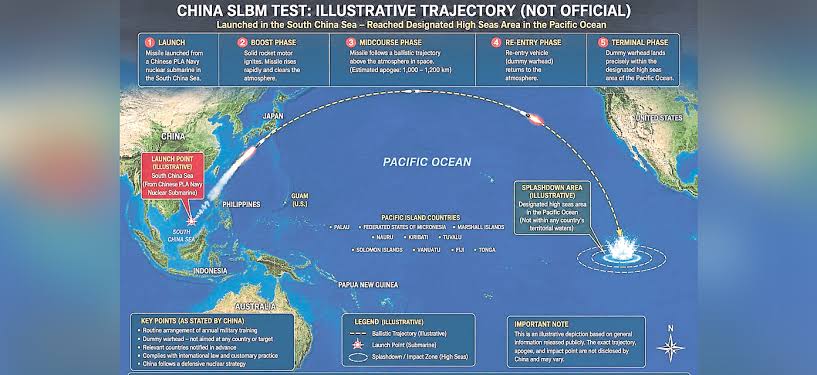
The recent test launch of a Chinese strategic ballistic missile into the Pacific waters has re-ignited debate across the region.
China maintains that the launch formed part of its routine annual military training in compliance with international law and customary international practice, through advance notification to relevant countries, including Papua New Guinea, and was not directed at any specific nation.
However, several Pacific governments expressed discomfort that strategic weapons testing had again occurred in a region, whose leaders have consistently advocated for peace, environmental stewardship and respect for the Blue Pacific Continent.
Beyond one missile launch, the issue is raising a more difficult question: Can the Pacific credibly oppose militarisation if it applies different standards to different powers? Let us reflect on this question carefully.
The United States has for decades conducted missile tests across the Pacific as part of its strategic deterrence and missile defence programmes.
Australia, the US are advancing the Aukus partnership, including the future deployment of conventionally armed, nuclear powered hypersonic submarines.
France maintains military forces across its Pacific overseas territories.
China has expanded its naval reach, strengthening its blue water capability at the same time, strengthening security partnerships with several Pacific Island countries.
Japan, India and other regional actors are also increasing their strategic engagement.
Collectively, these developments illustrate a simply reality that the Pacific has once again become central to global strategic competition.
It seems Pacific leaders are objecting only when China conducts military activities while remaining comparatively silent when similar actions are undertaken by others.
Such silences attracts accusations of inconsistency or double standards – difficult to dismiss therefore.
Equally, if major powers provoke international law to justify their own security activities while criticising those of their competitors, they should expect their actions to be scrutinised under the same legal and diplomatic standards.
Consistency is the foundation of credibility.
This observation is particularly relevant for PNG.
Successive governments have strengthened defence cooperation with Australia, the US and other partners.
Agreement on defence cooperation, maritime domain surveillance, logistics, infrastructure and capacity-building have enhanced PNG’s national capabilities and addressed genuine security challenges such as illegal fishing, transnational crime and disaster response.
While these partnerships are legitimate exercises of sovereign decision-making, they also create perception that PNG is becoming increasingly integrated into the strategic architecture of one side of an emerging geopolitical contest.
When the same government subsequently urges another major power to refrain from military activities in Pacific waters, the inevitably question follows: Is PNG opposing militarisation in principle, or opposing only certain manifestations of militarisation?
China obviously is asking that question.
Broadly, it highlights the strategic ambiguity confronting many Pacific Islands states as well.
The solution does not lie in choosing between Washington and Beijing, nor between traditional partner Canberra and other emerging ones.
Instead, PNG should consider articulating a doctrine of armed neutrality. The time is now.
Such a doctrine would affirm friendship with all nations while aligning militarily with none. It would recognise that national security begins with sovereign capability rather than strategic dependence. Defence cooperation would remain possible, but every agreement would be evaluated against one overriding question, that is – Does it strengthen PNG’s independent capacity to defend itself, or does it increase the risk of becoming entangled in great-power rivalry?
An armed neutrality doctrine would also require PNG to apply one consistent diplomatic standard to every external actor.
If strategic missile tests threaten the vision of an Ocean of Peace, than that principle would apply equally regardless of whether the missiles originate from China, the US, Australia or any other power, either terrestrially-based or from subsea launch platforms.
If foreign military transport infrastructure now raises concerns about regional stability, then those concerns should be expressed consistently, irrespective of the flag flying above such facilities.
If nuclear powered submarines generate anxiety, then the discussion should encompass every such deployment rather than focusing subjectively on one nation.
Such consistency would strengthen, not weaken, PNG’s international standing.
The Blue Pacific is too important to become another arena where global rivalries are merely transferred from one hemisphere to another.
Pacific nations possess the sovereign right to determine their own security futures, free from coercion, dependency or geopolitical pressure from any direction.
As PNG approaches its next chapter of its national journey, it has the opportunity to shape a defence doctrine equal to the realities of the twenty-first century – one that combines credible self-defence, principled diplomacy and genuine strategic independence.
The people of PNG expect this.
An Ocean of Peace cannot be sustained by selective outrage or selective silence.
It can only endure when the same principles are applied to every nation, every alliance and every military power without fear, favour or prejudice.
Only then will PNG speak not merely with diplomatic consistency, but with unambiguous and strategic authority, and moral clarity.