By Nic Maclellan in Noumea
In a poll marked by low voter turnout, New Caledonia’s provincial elections have seen a significant increase of votes for anti-independence parties in the Southern province, who will dominate the Southern assembly.
However support for pro-independence electoral lists in the Northern and Loyalty Islands provinces, will leave the national Congress with a similar balance to the outgoing legislature elected in 2019. The Union Calédonienne (UC) party and other members of the independence movement Front de Libération Nationale Kanak et Socialiste (FLNKS) will be the largest pro-independence parliamentary group, after an electoral setback for the Union Nationale pour l’Indépendance (UNI) group, which broke away from the FLNKS in 2025.
The French High Commission in Noumea will soon announce official results, but with provisional figures tallied at the end of Sunday’s voting, there were several clear outcomes.
There was reduced turnout amongst voters compared to the last elections held seven years ago; a major surge of votes for anti-independence parties in the Southern Province, with the Loyalist and Rassemblement “Fort et Unis” alliance to hold a clear majority in the Southern assembly; the failure of electoral lists that sought a middle way between the two major political blocs supporting or opposing independence; and a setback for the Parti de Libération Kanak (Palika), which failed to win a seat in the South, and lost ground in the other provinces.
Allocating seats
On Sunday 28 June, voters chose 76 members for three provincial assemblies, which have different sizes: 40 seats for the Southern Province, 22 for the North and 14 in the Loyalty Islands.
Each assembly elects its own provincial president and executive, but a proportion of the assembly members also make up the 54-member Congress of New Caledonia in Noumea: 32 (out of 40) members from the Southern assembly, 15 (out of 22) from the Northern assembly and 7 (out of 14) from the Loyalty Islands.
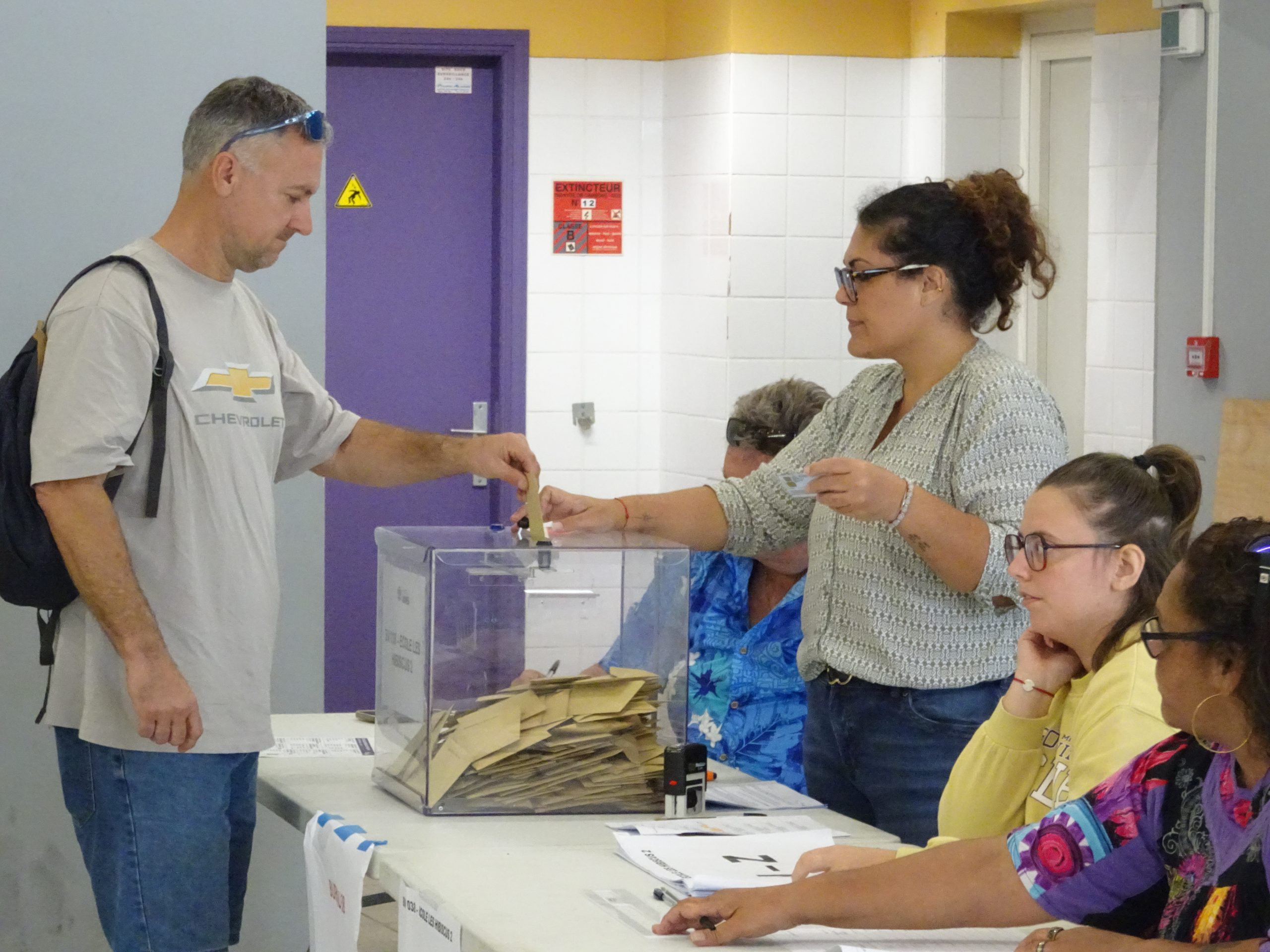
Even though this is the first provincial election in seven years, turnout was low at just 63.71 per cent of registered voters (less that the 66.47 per cent participation rate at the last provincial poll in 2019).
In coming days, political leaders will assess the mix of factors that contributed to one in three voters staying home: the grim economic conditions that have left many New Caledonians focused on day-to-day concerns; a level of voter fatigue, after recent municipal elections in March; the ongoing impasse over sovereignty and relations with France, after the failure of the Bougival process (an attempt to forge a new political statute for New Caledonia); and growing criticism of the political class, especially amongst many young indigenous Kanak and other islanders who have not benefitted from New Caledonia’s social and economic advances since the 1998 Noumea Accord.
Victory for the Right
Sunday’s poll, originally scheduled for May 2024, had been delayed three times by French authorities in the aftermath of the six months of conflict that year, as Kanak protesters clashed with French security forces. Despite an end to overt conflict, the ongoing economic and social impacts of the 2024 crisis have traumatised and fatigued many voters.
With much of the 2024 conflict centred on the capital and surrounding towns like Païta, Dumbea and Mont Dore, many non-Kanak voters in greater Noumea have turned towards the joint ticket of the Loyalist bloc and the anti-independence party Rassemblement les Républicains. With more than 41,000 votes in the South, the united conservative alliance increased their tally by more than 12,000 compared to 2019.
The Loyalists benefitted from division amongst the eleven electoral lists competing for a seat in the Southern provincial assembly. Only three lists reached the threshold of 5 per cent of registered voters (6,374 votes) required to be allocated a seat: the conservative Loyalistes-Rassemblement alliance (winning 28 seats in the assembly and 24 in the Congress); the FLNKS list ‘Kanaky pour Tous’ (with seven assembly seats and six in the Congress); and the islander party Eveil océanien (five assembly seats with four in the Congress).
For the other eight electoral lists in the South, supporters will not be directly represented in the legislature and more than 25,000 votes are not re-allocated.
A number of these lists (Faire pays, Une province pour tous, Nous Reunis) had sought more open dialogue on the future political status of New Caledonia and are sharply critical of the increasingly conservative social policies promoted by the Right-wing alliance in the South. Despite their absence from the Southern assembly, these civil society groups will still provide a critical voice on social policy after the elections, as provincial president Sonia Backès extends a series of policies that already disadvantage poorer Kanak and islander households.
Of these lists, only Eveil océanien (EO) under Milakulo Tukumuli fought through to win seats. Drawing much of its support from the large Wallisian and Futunan community and other islanders, EO increased its representation in the Southern assembly from four (2019) to five (2026) and added another seat in the Congress to the three it held in 2019-26. As in the previous term, the party will continue to play the role of kingmaker in a new Congress balanced between the anti-independence parties (with 24 seats) and pro-independence groups (with 26).
In the 2019 Congress, EO leveraged its small number of seats to win positions on the Congress executive and commissions, as well as a seat in the Government of New Caledonia. Given Tukumuli’s sharp criticism of the Loyalist bloc during this year’s campaign, the possibly of a new “islander majority” between EO and pro-independence parties will depend on negotiations in coming days.
Setback for UNI and CE
The most significant defeat in the South was for the UNI list led by Louis Mapou, who served as President of New Caledonia between 2021-25. After withdrawing from the main independence coalition FLNKS in 2024-25, Palika and the Union progréssiste en Mélanésie (UPM) play a key role in negotiating the draft Bougival Accord (a proposed political statute to replace the 1998 Noumea Agreement). But the rejection of the Bougival Accord by the French National Assembly last April left the two UNI parties isolated, and independence supporters turned away in the South.
In recent months, the collapse of the drawn out Bougival process has caused extensive debate within the UNI parliamentary group. The crisis has also divided grassroots activists, with dissident members of both Palika and UPM opposing the Accord. A telling blow to UNI’s campaign in the north was the absence of the key Bougival negotiators Jean-Pierre Djaïwe and Victor Tutugoro from their electoral list, with other longstanding Palika activists also deciding not to contest the poll.
Another significant outcome was the failure of the Calédonie ensemble (CE) party to win any seats at provincial or national level, as it backed Walles Kotra’s ‘Une province pour tous’ list. Nearly twenty years ago, under Philippe Gomès, the anti-independence party held the presidency of New Caledonia and the Southern Province, as well as three of four seats in the French parliament in Paris. Those days are long gone, and for the first time in decades CE will not participate directly in local governance or talks on New Caledonia’s political status.
Change in the north
With provisional results for the Northern Province yet to be officially confirmed, just three of five lists will win seats: UC-FLNKS (ten assembly seats and six in the Congress); UNI (nine assembly seats and six in Congress); and the anti-independence list Aggisons dans le nord (three assembly seats).
In a significant shift, the UC-FLNKS list under Mayor of Houailou Pascal Sawa has a narrow majority over UNI, challenging the long-standing Palika dominance of the province. Lacking a clear majority, UC-FLNKS will need to negotiate a deal if it hopes to take the presidency for the first time (veteran Kanak politician and Palika leader Paul Neaoutyine has served as provincial president since 1999)
In the Loyalty Islands, where more than 90 per cent of the population are indigenous Kanak, six of seven lists supported diverse independence parties.
Three of those lists will win seats: UC-FLNKS led by Mickaël Forrest (six assembly seats and three in the Congress); Nation Autochtone under Omayra Naisseline (six assembly seats and three in the Congress); and Palika Iles led by Wali Wahetra (two in the assembly and one in the Congress).
After Naisseline’s list won votes across the province beyond its traditional base on Nengone (Maré), Nation Autochtone may ally with Union Calédonienne in the Loyalty Islands assembly and national Congress (noting that Forrest and Naisseline are brother and sister).
The new Congress of New Caledonia will gather on 10 July to choose a new speaker and executive. A week later, a new 11-member government will be chosen, based on the proportion of support in the legislature. Before then, the competing parties will assess the outcome of Sunday’s poll, as they then negotiate the make-up of the new leadership in both provinces and national Congress.
In the July edition of Islands Business magazine, there will be a full analysis of the election and the implications for future talks on New Caledonia’s political status. Subscribe today!