


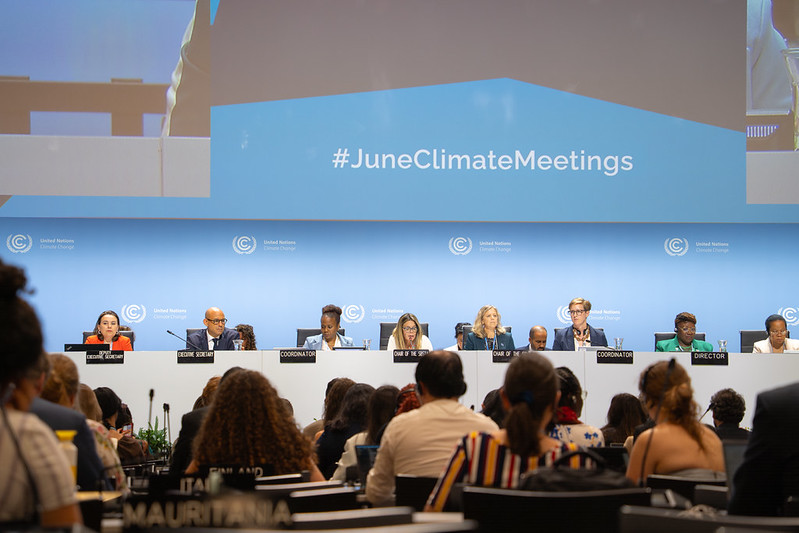
United Nations climate chief Simon Stiell has warned countries against reopening previously agreed climate commitments and delaying action, as the UN June Climate Meetings concluded with major differences still unresolved ahead of COP31.
In his closing statement to delegates at the end of the two-week negotiations, the Executive Secretary of the United Nations Framework Convention on Climate Change (UNFCCC) said progress had been made in several areas but acknowledged that critical gaps remain, particularly on adaptation and mitigation.
“Sometimes history is progressed in moments. Through heavy choices, big decisions or pure chance. And sometimes it is made in rooms like these. Gradually, carefully, out of the spotlight,” he said.
Stiell said the meetings demonstrated the slow but essential work of multilateral climate negotiations.
“We have seen that process in action over these ten days. Yes, there remain significant divides, and significant work for the intersessional period ahead. But we have seen a seriousness in tackling key issues, and a determination to find solutions,” he said.
The UN climate chief said negotiators had made meaningful advances in several key areas, particularly on the just transition agenda.
“In key areas we’ve taken real strides forward – showing climate cooperation at work, and this process doing its job.
On just transition, you took important steps towards turning the promise of the just transition mechanism into a reality, and to set up the review of the just transition work programme,” Stiell said.
He noted that while the outcomes may appear modest within the context of the UN climate process, they carry broader significance for communities and workers worldwide.
“While these might feel like modest steps for our process, they are big strides in the right directions for communities and working people everywhere.”
Stiell also highlighted progress under Action for Climate Empowerment (ACE), which focuses on public participation, education, and engagement in climate action.
“On Action for Climate Empowerment, we laid crucial groundwork for accelerating a just transition, and deepening participation and engagement across societies,” he said.
He said negotiators also achieved substantive progress across several other thematic areas, but expressed disappointment over the lack of stronger outcomes on adaptation and mitigation.
“There were also substantive steps taken across other crucial thematic areas.
On adaptation and mitigation, Parties voiced the need to deepen and accelerate action, but very disappointingly, we did not deliver on that here in Bonn,” Stiell said.
The remarks come as governments face mounting pressure to accelerate implementation of commitments agreed under the Paris Agreement and previous UN climate conferences.
Stiell welcomed announcements made by the COP31 Presidency, which is being jointly hosted by Australia and Türkiye.
“And we’ve heard the COP31 Presidency announce targets for electrification, city resilience and efficiency, and waste under the Action Agenda.”
He stressed that both formal negotiations and the COP31 Action Agenda would be critical to achieving progress.
“Minister Kurum, Minister Bowen and I are in lock-step: the negotiations and the Action Agenda are both vital, separate but parallel and complimentary tracks. COP31 must deliver real strides forward in both,” he said.
Despite areas of progress, Stiell warned that geopolitical tensions had increasingly influenced negotiations.
“In some areas, we have seen some side-stepping and stalling. We’ve seen geopolitical tensions washing through these halls.”
He reiterated that countries must honour commitments already agreed under the UN climate framework and the Paris Agreement.
“As I said when these meetings began, we must all deliver on existing obligations and plans under the Convention and Paris Agreement. And we simply cannot afford to re-open previous decisions, to renegotiate existing targets, or to backslide,” Stiell said.
The UNFCCC chief delivered one of his strongest warnings against attempts to weaken or selectively interpret existing agreements.
“Let me now go further, and say:All Parties must be comfortable and confident in restating our existing global commitments – without cherry-picking those that suit tactically in the moment.”
He highlighted specifically to commitments made during the first Global Stocktake and key financial and adaptation targets already agreed by governments.
“Commitments made in the first global stocktake; commitments that respond to the science and the 1.5 degrees limit; on Loss and Damage; on 300 billion; on 1.3 trillion; on tripling adaptation finance; and more.
These are the baselines,” he said.
Stiell also criticised what he described as a recurring tendency among negotiating groups to condition their own actions on commitments from others.
“But in some negotiating rooms, we’ve heard a familiar tendency towards you-first-ism: Groups refusing to deliver commitments or allow the process to move forward unless others go first.
This is a recipe for gridlock when we need all negotiating tracks to be moving in the fast lane,” he stressed.
He said countries must move beyond political deadlock if they are to make progress ahead of upcoming international meetings and future climate negotiations.
“So that we make real progress towards implementation in Antalya and Addis Ababa. And arrive at the second global stocktake at COP33 much closer to delivering on the pledges made at the first.” said Stiell.
Stiell said leadership from upcoming COP hosts and partner countries would be critical.
“The leadership of Türkiye and Australia will be vital. So will the ongoing support of Azerbaijan, Brazil and Ethiopia.”
He also highlighted the importance of upcoming pre-COP meetings in the Pacific.
“Pre-COP in Fiji and Tuvalu is a key moment on the road to Antalya.”
However, he cautioned against delaying efforts to bridge differences until those meetings take place.
“But we cannot wait until then to step up efforts to find common ground on the tough issues.” he said.
The Executive Secretary called on governments to elevate discussions to ministerial level in the coming months.
“So I urge you to bring in your Ministers as soon as possible, in the weeks and months ahead. Particularly on the thorniest issues,.” he said.
Stiell also addressed efforts to improve the efficiency of the UN climate process, saying the secretariat is examining ways to strengthen the system while preserving its party-driven nature.
“The secretariat has been listening carefully and taking steps to find efficiencies, so we can keep delivering on all our growing mandates.”
He revealed that an independent group of experts had been tasked with exploring possible reforms.
“I also asked a group of experts to consider ways that our process could be optimised or evolve – recognising all that it has achieved, and its Party-owned nature and foundations. This week, they shared some of their independent ideas. A summary will be made available in the weeks ahead.”
The UNFCCC Secretariat will now seek further input from governments and stakeholders.
“The secretariat is very much in listening mode, and very clear on our mandates.
We particularly want to hear from you – the Parties – and other stakeholders, and we’ll provide information soon on a process and timelines to do that,” he said
Looking ahead to COP31 and future negotiations, he urged countries to maintain momentum despite exhaustion following the intensive negotiations.
“We must press forward,” he said.
Stiell also warned against viewing climate diplomacy as a contest between winners and losers.
“I know many folks will take a breath after these ten longs days and watch some World Cup football.
But let’s please not get the idea of winners and losers in our heads. To protect 8 billion people from this climate crisis, it’s cooperation not fierce competition that we need,” he said.
The Bonn talks are widely viewed as a critical stepping stone toward COP31, where governments will face increasing pressure to demonstrate that commitments made under the Paris Agreement are being translated into action amid rising climate impacts and growing global uncertainty.