
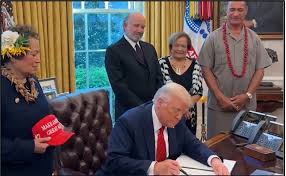
U.S President Donald Trump has signed a proclamation reopening nearly half a million square miles of protected waters in the Pacific to commercial fishing, a move the White House says is aimed at boosting domestic seafood production, creating jobs and reducing reliance on imported seafood.
According to a White House fact sheet, the proclamation restores commercial fishing access to the Mau and Ho‘omalu Zones of the Papahānaumokuākea Marine National Monument, the Islands Unit of the Mariana Trench Marine National Monument, and the Rose Atoll Marine National Monument.
The White House said the move advances President Trump’s America First Fishing Policy and is designed to increase opportunities for the U.S fishing industry.
“The proclamation restores commercial fishing access to the Mau and Ho‘omalu Zones of the Papahānaumokuākea Marine National Monument, the Islands Unit of the Mariana Trench Marine National Monument, and the Rose Atoll Marine National Monument.”
The administration said existing restrictions on commercial fishing had unnecessarily limited economic opportunities for American fishermen and coastal communities.
“Onerous restrictions unnecessarily prohibited commercial fishing within areas of the Papahānaumokuākea Marine National Monument, the Mariana Trench Marine National Monument, and the Rose Atoll Marine National Monument, removing job opportunities for American workers.”
The White House argued that fishing bans were not required for the management of the monuments because many fish species move across large ocean areas and are already covered by existing fisheries laws.
“Prohibiting commercial fishing is not necessary for the proper care and management of these Monuments, as many fish species are highly migratory, not unique to the area, and are already protected through existing laws, such as the Magnuson-Stevens Fishery Conservation and Management Act.”
The administration also said fishing restrictions had reduced domestic seafood supplies and increased dependence on imports.
“Prohibiting commercial fishing in this area also artificially restricts domestic fish supply, which makes the United States reliant on foreign sources for our food supply and increases the cost of seafood for everyday Americans.”
According to the White House, the proclamation will create opportunities for fishing families, seafood processors and maritime industries while maintaining environmental protections.
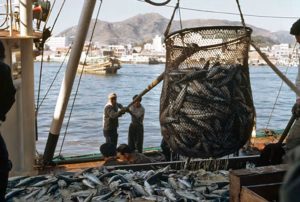
“The proclamation opens economic and job opportunities for U.S fishing families, coastal communities, seafood processors, and related maritime industries, ensuring unfettered access to the coastal waters of the U.S while maintaining rigorous environmental protections.”
The administration said commercial fishing supports thousands of jobs across multiple sectors of the economy.
“Commercial fishing supports thousands of American jobs across the harvesting, processing, transportation, shipbuilding, equipment manufacturing, distribution, sales, and service industries.”
The White House also said the measure would strengthen domestic seafood supply chains.
“The proclamation strengthens the domestic seafood supply chain and reduces U.S dependence on imported seafood.”
The action is the latest in a series of measures taken by the Trump administration to expand commercial fishing access and reduce regulations on the industry.
The White House noted that in April 2025 President Trump signed an Executive Order aimed at restoring seafood competitiveness through deregulation, increasing domestic seafood production and exports, and establishing the America First Seafood Strategy.
The administration also pointed to an April 2025 proclamation reopening commercial fishing access in the Pacific Remote Islands Marine National Monument and a February 2026 proclamation reopening commercial fishing access in the Northeast Canyons and Seamounts Marine National Monument in the Atlantic Ocean.
According to the White House, federal fisheries regulators have used the Magnuson-Stevens Act and executive action to reduce restrictions and increase fishing opportunities.
“Through the strategic use of the Magnuson-Stevens Act and executive action, NOAA has successfully deregulated fishing operations, reversed decades-old closures, and maximised harvest quotas.”
The administration said fisheries openings and higher catch limits had been implemented using available scientific data.
“NOAA expedited the openings of fisheries and increased catch limits based on the best available science, delivering financial returns to coastal communities.”
The White House also said efforts to reduce regulations remain ongoing.
“NOAA continues to aggressively slash red tape and replace outdated, micromanaged restrictions with adaptive, flexible standards – maximizing profitability for the domestic fleet and keeping fisheries open.”
According to the administration, the combined measures have generated substantial economic benefits.
“These actions have unlocked billions of dollars in economic value and secured vital domestic supply chains,” he said.