
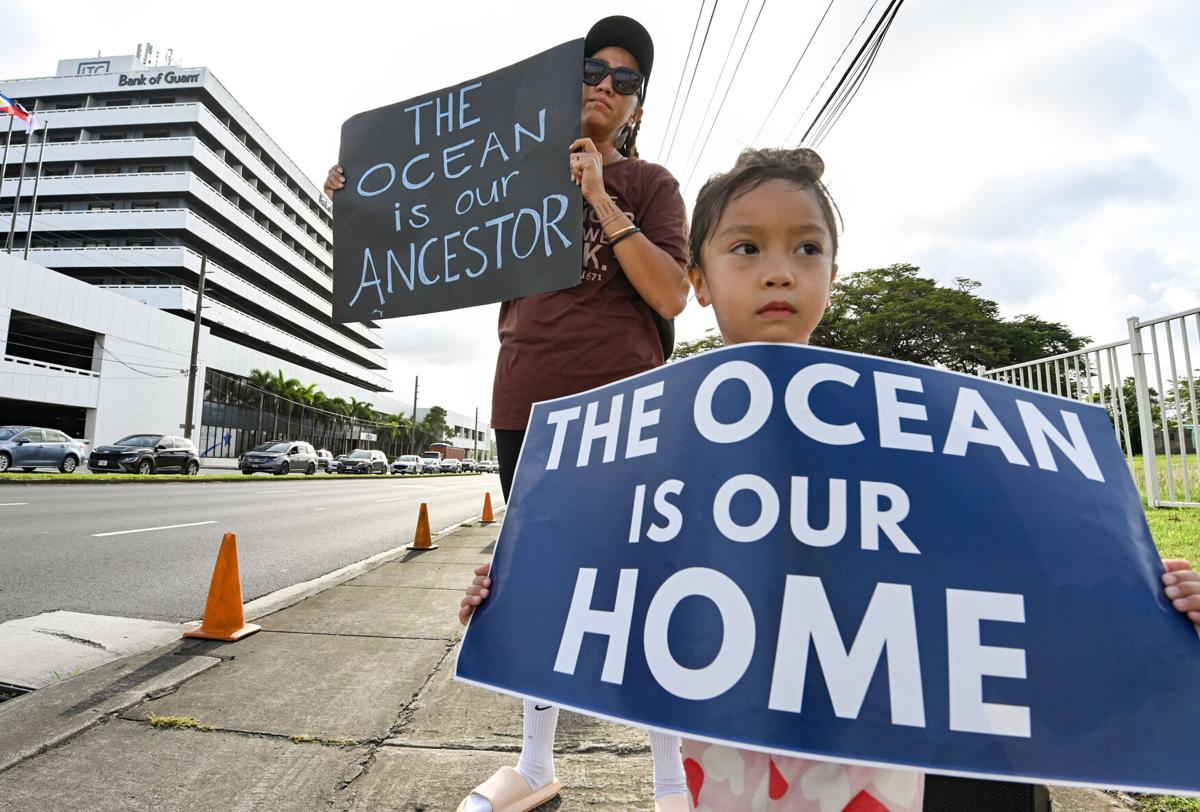
Guam Governor Lou Leon Guerrero signed a bill into law banning deep-sea mining from Guam and its nearshore waters under threat of fines of up to US$50,000 per day and barring the use of the island’s port without “full consultation” of the community.
Senator Therese Terlaje’s recently passed Bill 253-38, for the ban, is now enacted as Public Law 38-129.
The ban does not bar mining from the 69.1 million acres of seafloor around the Marianas claimed by the federal government and eyed for possible critical mineral extraction.
But it does mean that any deep-sea mining operation in the Marianas will have to run without the use of the Port Authority of Guam, unless the local government agrees.
Guam’s port is the largest in the western Pacific by far, bigger than any port for over 1,000 miles in any direction.
“Our island’s connection to the ocean is inseparable from who we are as a people,” Leon Guerrero said in a Wednesday night statement. “This law sends a clear message that Guam will not support activities that threaten the health of our waters, our reefs, and the natural resources that sustain our community.”
The ban
Guam’s territorial waters, which the new ban covers, only extend 3 nautical miles offshore of the island.
But Terlaje has said that the ban is meant to deter the use of the island as a staging area for mining operations.
Fines of between US$10,000 and US$50,000 per day will be levied against any person who violates the ban on mining in Guam’s waters.
Permitting of any facility or infrastructure for mining in Guam waters is likewise banned, under threat of fine.
Mining in the 69.1 million acres of seafloor further offshore of Guam and the Mariana Islands, claimed by the U.S government, faces a different restriction.
No vessel engaged in mining of those waters will be allowed to use Guam’s “ports, harbors, anchorages, and territorial waters as staging, supply, or logistics bases” unless they get approval from GovGuam and federal authorities.
That approval must come “following full consultation with the Department of Agriculture and affected communities,” the new law states.
Port Authority of Guam may deny entry or departure for any vessel upon notice that the vessel is engaged in unauthorized mining activity, it states.
Adelup in a statement Wednesday night said that scientists and environmental advocates around the world have raised concerns that seabed mining could cause irreversible damage to fragile marine ecosystems.
Those ecosystems remain largely unexplored since plans to eventually sell mineral rights leases in the Pacific were first announced by the Trump Administration, the release stated.
Discussion about the risks of deep-sea mining extended well beyond the Marianas, the release stated.
President Donald Trump in an April 2025 executive order called for the “unleashing” of the U.S’ offshore critical minerals, spurring the current federal push for seafloor mining.
Minerals like nickel and cobalt are needed for electronics and military technologies. Their global supply is largely dominated by U.S competitor China.
Over 60,000 comments were submitted to the Bureau of Ocean Energy Management opposing the push for potential commercial mining leases on the Marianas seafloor in recent months.
A few companies did support the effort, according to reports from BOEM.
After reviewing the comments, BOEM nearly doubled the size of the seafloor area slated for possible mineral leases. It moved the areas even closer to the Marianas, just 46 miles offshore Guam and 57 miles offshore Saipan.