


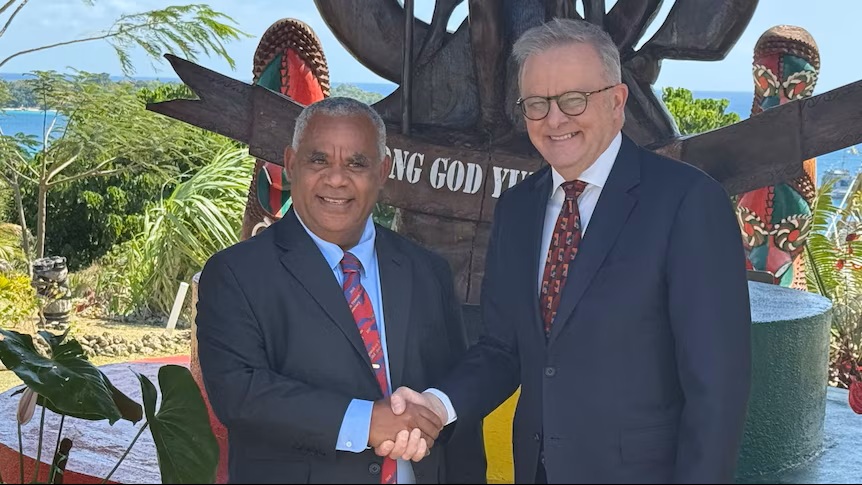
Vanuatu’s cabinet has given the green light to a new version of the landmark Nakamal Agreement with Australia, with the two nations looking increasingly likely to strike a compromise deal after months of sometimes difficult negotiations.
The ABC has been told that Vanuatu’s Council of Ministers signed off on an updated version of the pact last Thursday, with the agreement now just needing final approval from the Albanese government.
Prime Minister Jotham Napat pulled out from signing the major strategic agreement in September, saying some ministers in his governing coalition were worried it would undermine the Pacific nation’s sovereignty.
It comes against the backdrop of a fierce diplomatic arm wrestle between Australia and China, which is pursuing its own pact with Vanuatu called the Namele Agreement.
The exact wording of the new Nakamal Agreement between Australia and Vanuatu is not yet clear.
The ABC has been told the new agreement does not include the same limitations aimed at curbing Chinese investment in critical infrastructure and other sensitive sectors in Vanuatu.
But a source in the Vanuatu government said it still enshrined Australia’s position as the country’s main security partner, without stopping Vanuatu from engaging with other partners, including China.
They also said Napat could travel to Australia to sign the agreement within weeks if it got a final tick off from the Australian government.
A spokesman for Vanuatu’s government did not respond to questions about the Nakamal Agreement.
A spokesperson for the Department of Foreign Affairs and Trade also would not be drawn, saying “decisions of Vanuatu’s cabinet are a matter for the Vanuatu government”.
“Australia continues to work with Vanuatu to finalise the Nakamal Agreement,” the spokesperson said.
If the two countries do manage to sign the pact, it will end long and sometimes torturous negotiations between Canberra and Port Vila over multiple security and strategic agreements.
Foreign Affairs Minister Penny Wong struck a short-lived security deal with then-prime minister Ishmael Kalsakau only months after Labor took office in 2022, but that agreement quickly foundered, with multiple ministers in Vanuatu complaining their prime minister had pushed ahead without consulting them.
Australian officials were also frustrated when Napat declined to sign the Nakamal pact last year, not long after six ministers from both countries conducted an elaborate signing ceremony on the summit of Mount Yasur, a spiritually charged location on the island of Tanna.
There was yet another flare-up last month, with Napat responding angrily when an Australian official raised concerns in the local press about the Namele Agreement, suggesting Canberra was worried Vanuatu and China were on the brink of signing a security pact.
“Our foreign policy is guided by our national interests, not by external speculation or pressure,” he said at the time.
The exact nature of the Namele agreement with China is not yet clear.
Napat has repeatedly referred to it as an economic agreement, although Climate Change Minister Ralph Regenvanu recently called it a “strategic partnership agreement” which is comparable to Nakamal.
“In our effort to maintain our long-held non-aligned position, it sort of makes it feel balanced if the two people who are competing in the Pacific, if we enter into agreements with both of them,” Regenvanu said.
Under the Nakamal pact signed on Mount Yasur, Australia was originally due to invest about half a billion dollars in Vanuatu over a decade to help the country with its key development and security priorities.
While Australia has never publicly pointed the finger at Beijing, it has repeatedly signalled that it sees China as a strategic adversary in Port Vila.
When Pacific Minister Pat Conroy was asked last week if China was trying to sink the Nakamal Agreement, he reiterated that Australia was in a “permanent contest” in the Pacific.
“Many countries, including China, are seeking to assert influence in the region,” Conroy said.
“We’re working very hard to ensure that we’re the partner of choice for the region, but other countries outside our region obviously have a strong desire to be involved.
“Our view is that’s most appropriately expressed in development relationships with the region.
“But for security, which should be driven and provided by Pacific nations,” he said.