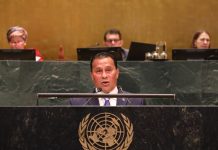


UN Climate Change Executive Secretary Simon Stiell has warned that rising fossil fuel costs and global instability are putting pressure on economies, calling for urgent acceleration of climate action.
“These are perilous times.”
“But this latest war has further locked-in much higher fossil fuel costs for months and likely years to come, delivering a gut-punch to every nation and billions of households,” Stiell said at the opening of the Petersberg Climate Dialogue on Tuesday in Berlin, Germany.
Stiell warned of broader economic risks from global conflicts and their economic fallout.
“Fossil-fuel driven stagflation is now stalking economies – driving up prices, driving down growth, pushing budgets deeper into quagmires of debt, and stripping away governments’ policy options and autonomy.”
He said climate cooperation is central to tackling both economic and environmental threats.
“Climate cooperation is key to fending off the twin-reapers of global heating and fossil fuel cost chaos.”
Stiell stressed the benefits of transitioning away from fossil fuels and made it clear that urgency is increasing.
“Clean energy offers security and affordability – returning sovereignty to nations and their peoples.”
“The need to accelerate action has never been clearer.”
Stiell said negotiations remain important but must now deliver real-world outcomes.
“Negotiations are one – and they remain critical. Now, in this era of implementation – we must turn them into projects on the ground.”
Referring to progress under the Paris Agreement, Stiell said: “They’ve delivered landmark commitments, including at the first global stocktake at COP28.”
He stressed the need for measurable progress ahead of future reviews.
“So that by the second global stocktake at COP33, we are on track to meet the commitments made at the first.”
Stiell called for stronger focus on implementation through the Action Agenda.
“Elevating the Action Agenda to share centre-stage with negotiations is vital to picking up the pace.”
He highlighted its impact, stating it has been “mobilizing trillions of dollars within the real economy” and driving the clean energy shift, adding: “most notably, the clean energy transition is now irreversible.”
“Now, we need to unleash the full power of the Action Agenda the world over – equally, in both the global North and global South.”
Stiell also called for increased investment in developing countries and stronger cooperation between governments, adding: “Far more finance flowing into developing countries.”
He highlighted priority areas for action, including energy systems, methane reduction and food systems.
“Methane is an ultra-potent greenhouse gas. Slashing emissions by 2030 will have a huge impact on putting the brakes on global heating.”
He stressed the importance of resilience measures.
“Early warning systems save lives on a huge scale. Action on food and agriculture has the potential to cut a third of global emissions.”
He highlighted ongoing leadership in shaping the climate agenda, noting efforts linked to upcoming COP processes.
“As every nation at COP30 declared unanimously: Paris is working, and together we will make it go further and faster.”
“This work is key to doing so. So let’s get on with the job,” he said.