
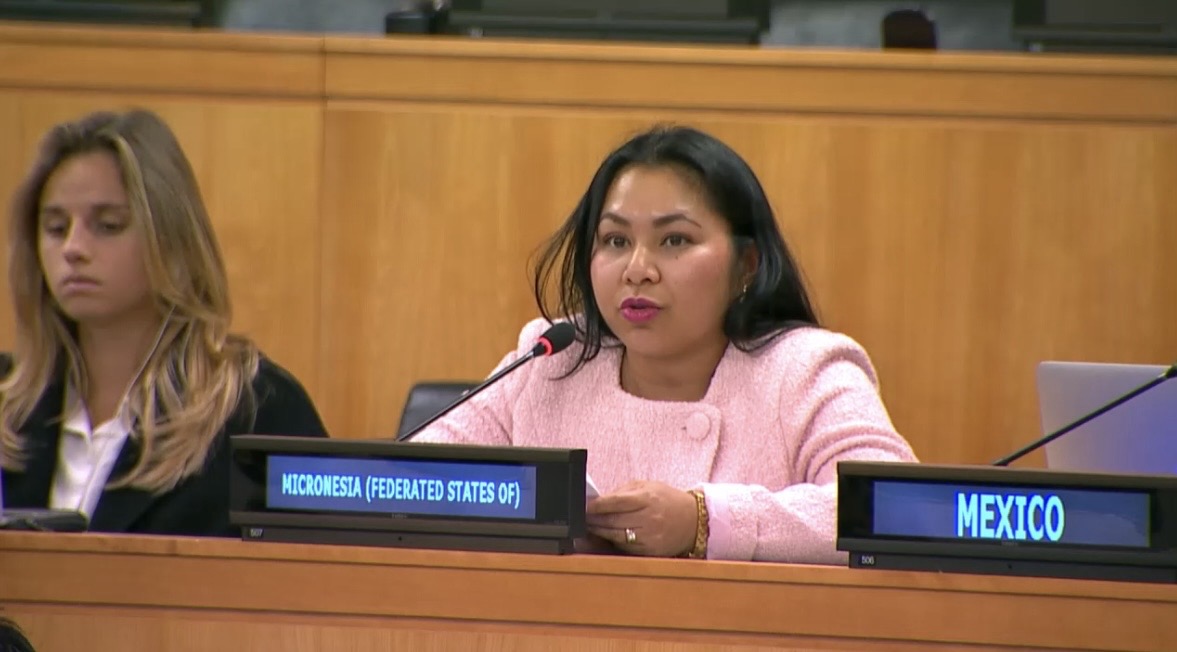
The Federated States of Micronesia (FSM) has called for urgent reform of the United Nations Security Council, warning the current structure “no longer adequately represents the broader membership” and must change to reflect global realities.
“For eighty years since the founding of the United Nations, the arrangement from a bygone era may have been necessary at that time, but it no longer adequately represents the broader membership of the United Nations today.”
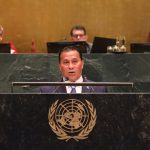
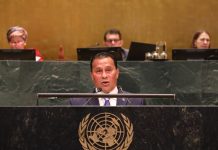
“The world has changed significantly, and this evolution should be reflected in our representation,” said Universe Lawrence, FSM deputy UN Permanent representative at the 80th session of the UN General Assembly (UNGA) informal meeting on Security Council reform.
Aligning with the L.69 Group, Micronesia backed ongoing negotiations and welcomed Africa’s proposal, saying it “strongly supports the ongoing discussions on Security Council reform and warmly welcomes the African Union (AU) Committee of Ten’s submission of the African Model.”
Lawrence warned that current decision-making structures risk sidelining most countries and stressed the urgency of reform.
“It is important that the voices of the majority are not overshadowed by the decisions of a few, and that the needs and perspectives of all members are taken into consideration.”
“It is therefore essential that we continue our efforts to reform the Security Council so that it better reflects the realities of today’s world and serves the interests of all member states,” she said.
Micronesia reiterated support for expanding the Council in both permanent and non-permanent categories to give developing countries and underrepresented regions a stronger voice.
“As an L.69 member, Micronesia supports the L.69’s blueprint of 27 seats (needing 15 affirmative votes) alongside Africa’s minimum of 26. This harmony ensures meaningful growth, fair representation for the Global South, vital for vast-ocean nations like ours, and a Council equipped to tackle the threats posed by climate change and sea-level rise with credibility.
“As my delegation has said in past statements, reform is not just a choice; it is necessary to make the Council more legitimate and effective,” she said.
The statement also backed Africa’s demand for greater representation, with Micronesia supporting “the Common African Position… for two permanent seats with all the rights and privileges of permanent membership.”
Lawrence linked the reform debate to climate threats facing small island states.
“The Security Council lacks legitimacy when regions suffering its decisions most, whether Africa’s crises or our drowning atolls from sea-level rise hold the least sway.
For Micronesia’s low-lying communities, this gap threatens not just equity, but our physical existence,” she emphasised.
She also pushed for dedicated representation for Small Island Developing States (SIDS).
“Micronesia fully supports giving SIDS a non-permanent seat, whose voices are often not heard in the Security Council.”
Highlighting climate risks, she said such representation is critical in addressing “SIDS’ acute exposure to climate-driven security risks that could submerge our homelands.”
“As a SIDS, Micronesia therefore champions the L.69’s proposal, rooted in CARICOM advocacy, for a rotating non-permanent seat reserved for Small Island Developing States. Far from rivaling Africa’s demands, it fills a critical void: addressing SIDS’ acute exposure to climate-driven security risks that could submerge our homelands” Lawrence said.
Micronesia urged further discussion on integrating this proposal, calling on African negotiators to consider the idea.
Lawrence also called for more structured negotiations.
“I respectfully encourage the IGN to consider documenting each meeting in writing.”
“Maintaining a single, updated text would enhance transparency, clarify positions, and support more focused discussions.”
She said this approach would help ensure reform stays on track, adding it would better equip the UN to respond to emerging global challenges.