
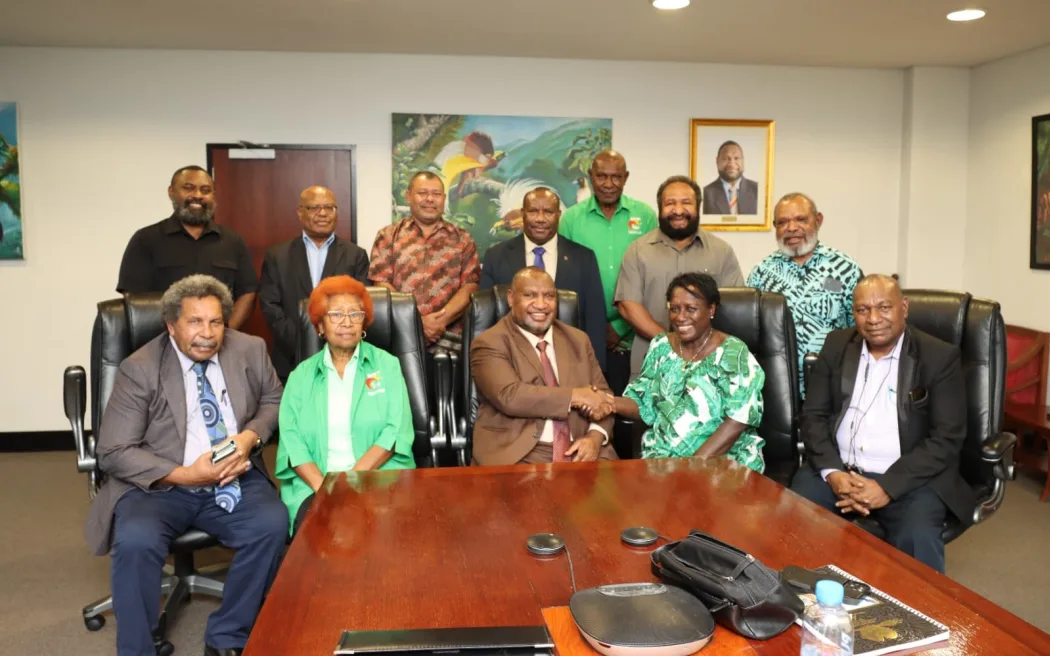
A prominent Bougainvillean MP believes Papua New Guinea’s parliament will back the autonomous region’s drive for independence.
Francesca Semoso, one of four Bougainvillean MPs in the national parliament, made the comment as the deadline looms for the national parliament to vote on the region’s future.
PNG’s parliament was initially expected to decide in June whether to ratify a non-binding 2019 referendum, which saw 97.7 percent of Bougainvilleans back independence.
However, Prime Minister James Marape has since indicated that parliament is unlikely to deliberate on the matter until early September.
But Semoso, an outspoken MP who belongs to Marape’s ruling Pangu Pati, seems convinced that the tide could turn.
“I am confident that at the last-minute people might change their mind and say let’s give it to Bougainville,” Semoso said.
“I mean what kind of people would want to hold onto people that they’ve badly hurt, it’s about money, it’s about mineral wealth.”
Bougainvilleans had already waited too long for a decision, she said.
“This process has taken six years. Now let’s be leaders, have some guts, have some respect for my people of Bougainville. Take the vote to the floor of the parliament, let’s make some decisions,” she said.
Political commentators have claimed in the past that there is little support in the capital Port Moresby to cut Bougainville loose.
Michael Kabuni, a political scientist from PNG, told RNZ Pacific last October that he believed the PNG government was widely opposed to independence.
“It’s not only Marape, but the majority of the PNG MPs also hold the same position. My conversation with a few of them is that if consultation results went to parliament about 10 percent would support independence. That’s how lopsided the PNG parliament is at the moment,” he said previously.
Historically, there was a lack of commitment from PNG over the issue, Kabuni said.
“Because if you go for autonomy, PNG’s history with Bougainville is that when they agreed to autonomy the PNG government never devolved the powers that were agreed under the Bougainville Peace Agreement (BPA),” he said.
Semoso said despite what academics think, there is only one way to find out.
“The only thing that we can do is to take that vote to the floor of parliament, let the members make a decision, a choice.
“How the hell are we supposed to know whether the parliamentarians support it or not. We want to know where we stand, and the most important thing is this – we want that vote ratified.”
Whichever way it goes, Semoso added, both sides needed to prepare for the outcome. She said if the referendum is not ratified, Bougainville would call for a unilateral declaration of Independence.
“The only reason why we should take to the floor of parliament is for the parliament to ratify the independence vote that has been taken by the people of Bougainville. If they don’t ratify it, what is their fall-back plan?”
She stressed that Bougainvilleans will not be demeaned.
“We are not going to be belittled; we took the vote in 2019. Now we’ve been forgotten, there was an army that declared war on us. How the hell do they think we feel?” she said.
Semoso said claims by the national government that the referendum is legally unenforceable are questionable.
“If that was not legally binding why did the government of PNG allow for the referendum vote to take place? They were part and parcel of the referendum vote, so where are they coming from?” she said.
Semoso said her people are watching and waiting and the onus is on the two governments to find a workable way to implement the decision.
Bougainville’s President Ishmael Toroama vowed on his re-election to the top job last September that he would push for independence, whether PNG liked it or not.
The BRA commander told RNZ Pacific at the time that he would achieve political independence for his people, despite his lack of success in the past five and a half years.
Toroama has said that the autonomous region would declare independence no later than 01 September 2027.
In his view, the referendum carries legal weight because it is enshrined in the PNG constitution.
“I see that as a binding referendum, so I really think whilst moving ahead, whether they (the PNG government) like it or not, it’s a step ahead, we can move forward with that,” he said.