

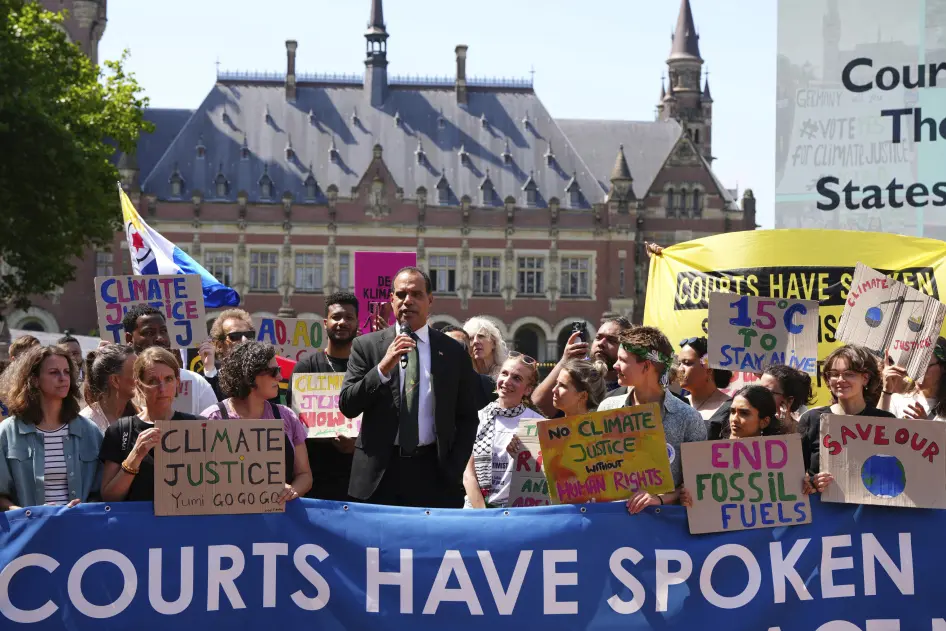
Governments should support a draft United Nations resolution led by Vanuatu that calls for stronger action on climate change following a landmark ruling by the International Court of Justice, according to Human Rights Watch.
The rights group said the world’s highest court has already made clear that governments have legal duties to address climate change.
“The world’s highest court has spoken tackling climate change is not a choice: it’s a legal obligation.”
Human Rights Watch said the responsibility now lies with the United Nations General Assembly and its 193 member states to act.
“Now it’s up to the United Nations General Assembly to speak up and urge its 193 member countries to take action.”
The statement said millions of people worldwide are already suffering the impacts of climate change.
“Millions of people around the world have already lost their homes, livelihoods, and lives, due to climate change. It is vital states take action.”
In July 2025, the International Court of Justice issued a unanimous advisory opinion outlining states’ legal obligations under international law to address climate change.
The court ruled that governments must protect the climate system, prevent cross-border environmental harm, and regulate activities driving greenhouse gas emissions. It also said failure to act on climate change can violate human rights including the rights to life, health, food, water, housing and culture.
Human Rights Watch said its research has shown that fossil fuel production harms communities around the world, particularly those living near extraction and energy infrastructure.
The group said the court’s advisory opinion confirms that governments already have legal duties to address those harms.
Vanuatu, working with a cross-regional group of countries, has circulated a draft resolution at the United Nations General Assembly aimed at turning the court’s findings into action.
The draft resolution calls on countries to strengthen national climate plans, phase out fossil fuels, and better protect communities displaced by climate change. It also proposes mechanisms to document and track climate-related losses faced by vulnerable communities.
The statement said the General Assembly has previously translated advisory opinions from the International Court of Justice into resolutions urging governments to act.
However, the United States, backed by some oil-producing states in the Gulf, has called on Vanuatu to withdraw the resolution.
But the Pacific island country, which faces threats from rising sea levels, has refused.
Human Rights Watch said Vanuatu and its partners have worked to address concerns raised by different countries, including from the European Union which has argued for a narrower interpretation of the court’s advisory opinion.
Human Rights Watch and partner organisations are now urging governments to support the resolution.
“It’s imperative they resist efforts to water down its core elements, especially those protecting human rights, international law, and advancing international cooperation on climate change, said Human Rights Watch.