


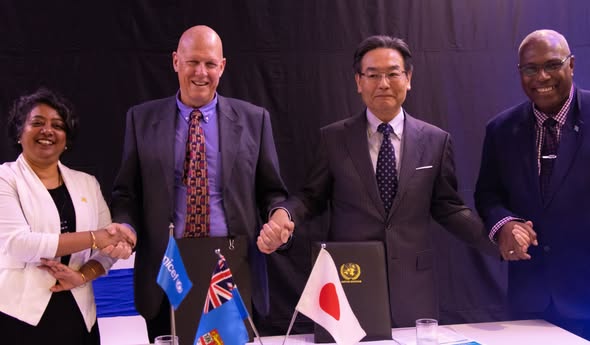
The Government of Japan and UNICEF signed a new partnership to protect Fiji’s children, including adolescents*, from the escalating drug crisis.
The initiative will equip them with essential knowledge, skills, and support to make informed, healthy choices to stay safe from drugs.
With USD$5.48 million in funding from the Government of Japan, the four-year project will reach more than 150,000 children, including 10,000 at risk adolescents. It will also support 300 children and adolescents in conflict with the law, as well as thousands of teachers, service providers, community members, parents, and caregivers.
“Japan has long enjoyed a close and enduring partnership with Fiji, a valued friend in the Pacific region. This cooperation reflects our strong support for the Government of Fiji’s dedicated efforts to address drug-related challenges and to protect its children and youth,” said the Ambassador of Japan to Fiji, Hiroshi Tajima.
“We are pleased to work together with UNICEF to help build a society where no one is left behind.”
Fiji has seen a worrying increase in drug trafficking and use in recent years, with more children being exposed to harmful environments at younger ages. According to Fiji Police, more than 4.2 tons of methamphetamine were confiscated in early 2024.
The Fiji Police Force also recorded 2,446 cases of illicit drug activity between May 2024 and May 2025, including 50 cases involving children. Drug use in schools has also been rising, with the Substance Abuse Advisory Council reporting a rising number of cases, from 2,400 in 2021 to 3,143 in 2025.
In focus group discussions, students and teachers said drug use had become visible across many schools, with some children turning to drugs to cope with difficult home situations. Communities have also called for more support, especially in high‑risk areas where young people are struggling with the combined challenges of drugs, poor mental health, and family violence.
“Every day, more children and adolescents in Fiji are being pulled into a crisis they did not create. We are deeply grateful for this support from the Government of Japan, which comes at a moment when it is desperately needed and will make a real difference,” said UNICEF Pacific’s Representative, Hamish Young.
“We also thank the Government of Fiji for its leadership and commitment to protecting its young people. Together, we can ensure that when children ask for help, whether in a school, a clinic, or a police station, there is someone there to take their hand.”
Through this new project, parents will gain practical skills in positive parenting, better communication, and creating safe, supportive home environments. At the same time, adolescents will receive guidance, mentorship, and opportunities that help build their confidence and resilience. The project will also strengthen the capacity of teachers, healthcare workers, police, and social workers to prevent drug use, identify early warning signs, as well as support young people who are already affected.
In addition, the initiative will upgrade safe, child and adolescent‑friendly spaces where they can seek support when needed. This includes safe rooms in hospitals, child‑sensitive interview rooms in police stations, and dedicated counselling areas in schools.
The programme will be delivered in partnership with the Government of Fiji, including the Ministry of Justice, Ministry of Women, Children and Social Protection, Ministry of Health and Medical Services, Ministry of Education, Ministry of Youth and Sports, and the Ministry of Home Affairs and Immigration. The Fiji Police Force, civil society organisations, faith-based organisations, community leaders, and other development partners will also be closely involved in the project.
The Embassy of Japan and UNICEF will work closely with the Government of Fiji to ensure that the young generation, especially those most at risk, have greater access to care, protection and opportunities that support their wellbeing as well as future potential.
*The United Nations defines adolescents as human beings in the second decade of life, ages 10-19.