
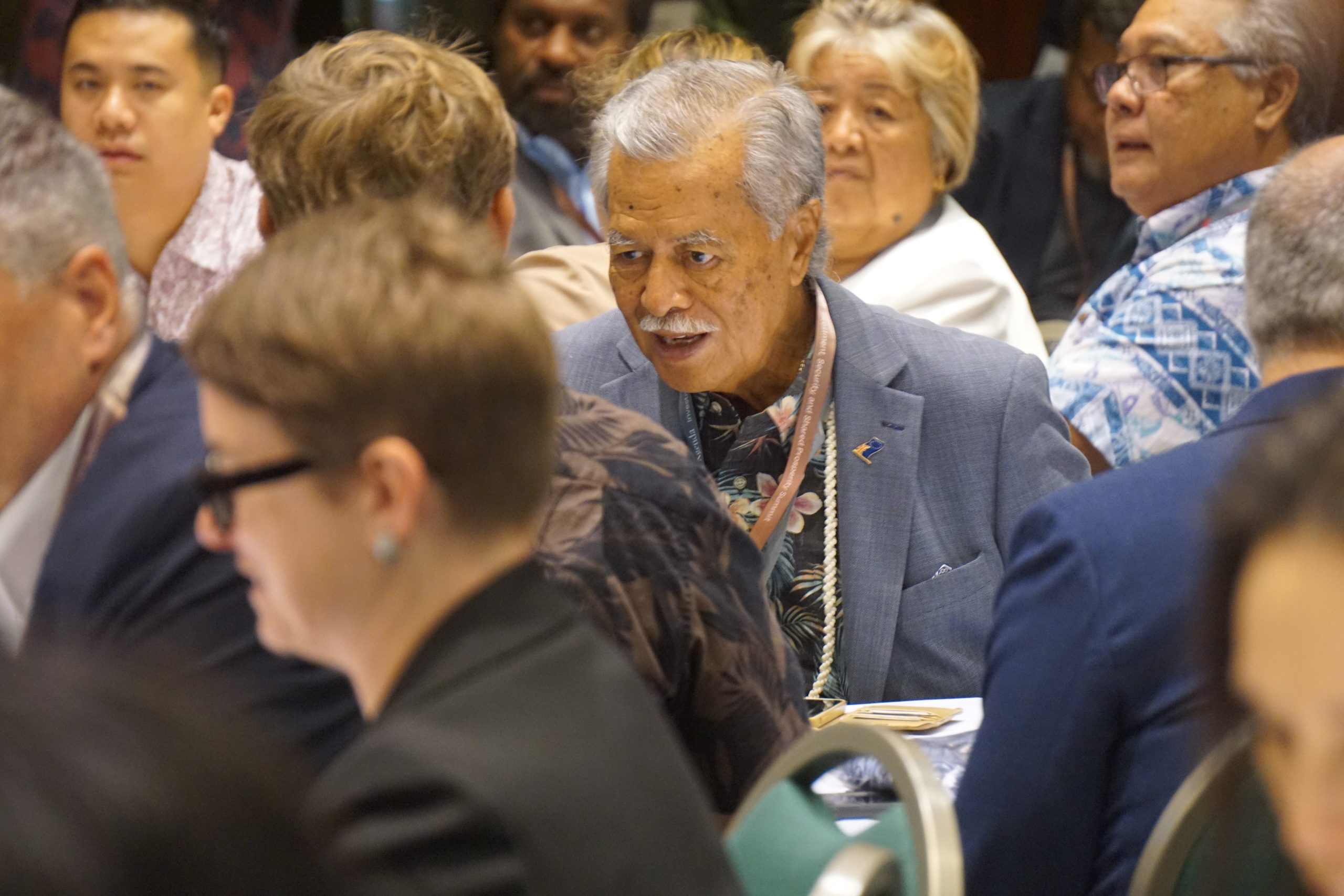
Seabed mining is no longer a distant ambition for the Cook Islands as at last week’s Pacific Agenda: Investment, Security and Shared Prosperity summit in Hawaii, it was pushed into the geopolitical spotlight with Cook Islands leaders declaring global leadership, clearing diplomatic roadblocks and indicating that movement, not moratorium, is the direction ahead.
The two-day summit was held behind closed doors with Pacific media including Cook Islands News present at the event.
Prime Minister Mark Brown left Hawaii for another ministerial commitment in Australia before the summit completed while three government officials stayed behind.
Former prime minister Henry Puna, now interim director of the Pacific Islands Development Program at the East West Centre in Hawaii, said the Cook Islands at the summit is already ahead of the pack.
“The Cook Islands is leading in this space,” Puna said. “Not just in the Pacific I believe in the world.”
According to Puna, deals have been made although he did not specify what the deals are, between Cook Islands and the U.S.
Puna said the country’s seabed minerals sector has already moved beyond theory. Exploration licences are in place, companies are operating “under strict rules” and environmental sustainability is built into the system from the start.
“The rules are very clear,” he said. “Companies operating now are in the exploration phase and they are doing a fantastic job.”
But the summit was also about removing barriers particularly those sitting in Washington.
Puna confirmed that Cook Islands exploration companies have faced unresolved issues with United States bureaucracy, describing them as sensitive but significant.
He said the Prime Minister’s presence at the summit, alongside senior US officials, had opened doors that had previously been closed.
He pointed to a positive bilateral meeting with senior figures from the United States Department of State, including Deputy Secretary Landau, as a turning point.
“The bottlenecks these companies have experienced with Washington will now be resolved,” Puna said. “The way is clear for things to move forward.”
The three companies granted five-year licenses for seabed mineral exploration in the Cook Islands, as of 2022 are Cook Islands Cobalt (CIC) Limited, Moana Minerals Limited and CIIC Seabed Resources Limited (sometimes referred to as Cobalt Seabed Resources or CSR).
Puna clarified that the issue lay between explorers and US bureaucracy, not Cook Islands policy.
Central to the Cook Islands’ argument, he said, is its ocean governance law, Marae Moana.
“We are the only country with a legal framework for the management of our entire ocean,” Puna said. “That framework addresses all environmental concerns.”
As regional and international scrutiny around seabed mining intensifies, Cook Islands officials used the summit to emphasise a science-led, precautionary approach.
That message was reinforced by Beverly Stacey-Ataera, Commissioner of the Cook Islands Seabed Minerals Authority.
“Seabed minerals for us are an opportunity that we’re exploring,” Stacey-Ataera said. “But we are grounded in scientific research. We must complete our environmental impact studies first.”
Stacey-Ataera said one of the key outcomes of the summit was gaining support, particularly from American investors to fund the research still required to fully understand environmental impacts.
“There’s an awful lot yet to be done.”
She also said discussions with Pacific neighbours were critical, with many seeking to better understand how the Cook Islands has built its regulatory framework.
“Our precautionary, science-led approach is world-leading,” Stacey-Ataera said, adding that several Pacific nations had expressed interest in learning from the Cook Islands’ experience.
Cook Islands Investment Corporation chief executive Allan Jensen said the closed-door sessions went beyond speeches and into practical collaboration.
“I think one of the key themes is the various nations sharing their various projects that have initiated priorities and how we can, in terms of collaborating more regionally, better,” Jensen said.
Speaking about the summit, Jensen added overall, “it’s been really good in terms of the degree of sharing from the speakers and various participants”.
“Good cross-section representation between the public sector and the private sector and throughout the region.”
Chief of Staff at the Office of the Prime Minister, Karopaerangi Ngatoko, described the summit as a shift from talk to action.
“I think this is a very unique approach that the U.S have taken to this dialogue, to this convening,” Ngatoko said.
“I think moving from dialogue to action is really important and having private sector here really, I think, signals an intention to move to action and something that I think is quite unique. And possibly something that others should think about too,” Ngatoko said.