


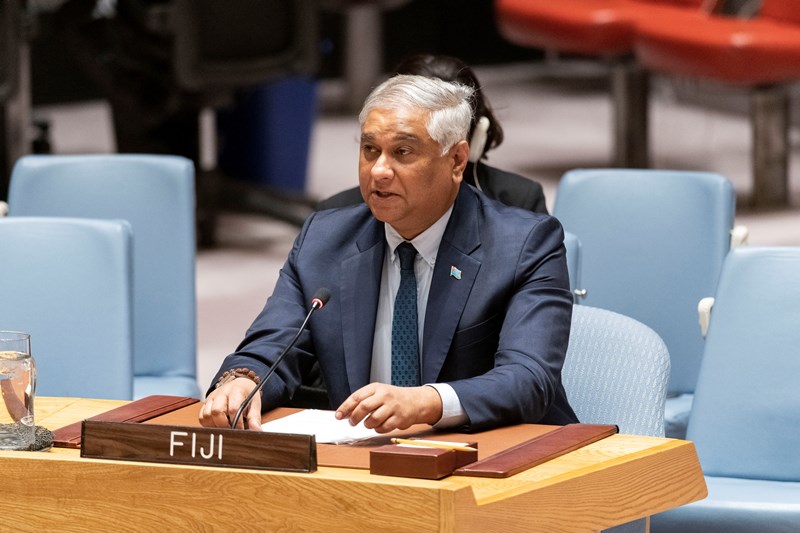
Fiji’s former UN Ambassador and Climate Lead at Abt Global, Dr Satyendra Prasad, says the Pacific is living through “a breathtakingly extraordinary period” of human rights threats driven by climate change, telling a Human Rights Day lecture at Fiji University that the region must prepare for a far more dangerous future.
Speaking on “Protecting Human Rights in a Climate-Changed Pacific,” Dr Prasad said his remarks focused on “the narrower field of human rights in the context of climate change in the Pacific,” delivered at a time when the world is witnessing “extraordinary retreat from human rights protection.”
He said, “every human right, every breach of human right and every advance in the protection of human rights should matter equally to us,” adding that Pacific rights do not enjoy privilege over the rights of people suffering elsewhere.
“We will find greater support for our human rights when we extend our support to those whose rights are violated elsewhere.”
Dr Prasad said global human rights protections remain strong in international law, but the “paralysis” in practice reflects deep geopolitical fractures. He said the rare global consensus that built the post-war rights system “is dead.”
He noted that while the UN Charter and Universal Declaration of Human Rights date back to the 1940s, it was not until 2008 that the UN explicitly recognised climate change as “a real and substantial threat to the full enjoyment of human rights.”
He said the Pacific’s experience is shaped by “our lived realities today.” The region’s right to life, health, food and water are already under pressure.
“It is estimated that over 1200 death annually are now attributed to heat stress,” he said. More than 1,000 deaths each year are linked to climate-related illnesses.
Sea water intrusion, prolonged droughts and contamination of water systems are undermining the right to water. Rising ocean temperatures and collapsed reef systems are harming the right to food.
He warned that indigenous rights are being eroded as communities across Melanesia move because of climate impacts, often without the accompanying social or cultural protections linked to land. For Tuvalu, he said, “a not too dis-similar future awaits… as their small and culturally compact communities get thinly dispersed across larger countries such as New Zealand, Australia and Fiji.”
Dr Prasad said climate change is undermining the right to education across the Pacific. Flooded river crossings stop children from reaching school, with learning days lost increasing.
He said many I-Taukei communities live in the most flood-prone areas. Schools are also struggling with extreme heat.
“The safe classroom temperatures for children are 24-26 Degree Celsius at the upper end,” he said. “In many schools, classroom temperatures are well above 30 Celsius for days on end.”
He said schools are rebuilt “exactly the same way as they were done 4-5 decades ago,” and that gender disparities persist. He cited an example where boys’ hostels were rebuilt a year after cyclones, but girls’ hostels took another year, resulting in “a whole generation of girls… simply dropped out of school.”
He said access to health care is a core right, but the climate crisis is amplifying risks. Mental health impacts after disasters are severe, especially for children.
“When winds pick up ever so slightly, many children in schools get frightened – scared – quietly reliving their traumas,” he said.
He said schools are “complicit” when they cannot provide the counselling needed. Increasing outbreaks of dengue, influenza and leptospirosis are also harming communities.
Dr Prasad said food insecurity is a core human rights concern. He described visiting classrooms where “nearly a 3rd” of students had no lunch and highlighted stunting rates reaching 10 percent in Fiji.
He said climate change is directly linked. “There is a near collapse of oceanic foods across so many Pacific’s coastal communities,” he said, with Highlands communities in PNG facing crop losses due to delayed rain and drought.
He said food insecurity, gender violence and conflict are “a growing part of the Blue Pacific’s climate story.”
Dr Prasad said climate change threatens cultural and political rights, especially for atoll nations. Tuvalu may be uninhabitable within “4-6 decades.”
“It is indeed possible that its whole populations in time may come to be dispersed,” he said, warning that language and identity may be lost.
He said a similar future could confront I-Taukei coastal communities as they are displaced within Fiji and abroad.
While emphasising the fight for the 1.5°C target, Dr Prasad warned that the planet is “on course for a 2.8 Degree or perhaps even a post 3.0 World.”
“The consequences… are unimaginable,” he said. Most infrastructure in the Pacific is not built for the equivalent of Category 6 or 7 cyclones. Hundreds of schools and health centres will need relocation even under 1.5°C.
“The silliest thing we can do as a region and as a people is to not prepare for a 3.0 World,” he said.
He praised Pacific students who took the world to the International Court of Justice and won.
“We owe such an extraordinary gratitude to Fiji’s Vishal Prasad, Cynthia Houniuhi, Solomon Yeo… and that small group of university students at USP.”
Dr Prasad outlined priorities for protecting rights in a climate-changed region:
*Individuals must understand how climate affects their rights.
*Pacific laws must be updated for climate realities, including labour protections for workers in extreme heat.
*Employers need to meet obligations for safer workplaces in a hotter world.
*National human rights agencies and courts must build capability.
*The region must “push the boundaries of international law” over the next decade.
With the Pacific to host a pre-COP31 gathering, he said the region has an opportunity to “bring a consolidated understanding of how fundamental human rights are being harmed by runaway climate change.”
“We need to tell our stories with clarity and with impact,” he said. “Protecting human rights in a climate changed world… means that all instrument available in the Pacific’s state armoury now need to be deployed.”
He thanked Fiji University for marking Human Rights Day in a way that forces a deeper conversation about the Pacific’s future.