
By Pita Ligaiula in Manila, Philippines
The Parties to the Nauru Agreement (PNA) says its technical expertise continues to drive some of the most important proposals before the Western and Central Pacific Fisheries
Commission (WCPFC22), including the long-delayed South Pacific albacore Management Procedure now sitting at the top of the agenda in Manila.
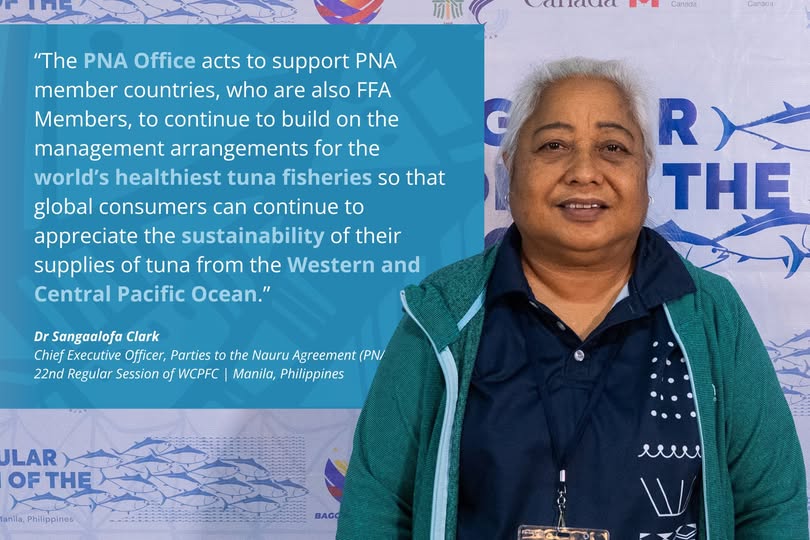
PNA Chief Executive Officer Dr Sangaalofa Clark said that the group’s work remains central to shaping regional fisheries governance and ensuring Pacific states maintain control of the world’s largest and healthiest tuna fishery.
“The PNA Office acts to support PNA member countries, who are also FFA Members, to continue to build on the management arrangements for the world’s healthiest tuna fisheries so that global consumers can continue to appreciate the sustainability of their supplies of tuna from the Western and Central Pacific Ocean,” Dr Clark said at the WCPC22 in Manila.
She said PNA will continue providing technical backing across conservation, monitoring and management work that has underpinned major FFA bloc proposals this week and strengthened Pacific positions at the Commission.
PNA members form one of the most influential groupings within the Forum Fisheries Agency (FFA), often acting as the core management bloc that shapes collective FFA positions and drives regional consensus.
Founded in 1982, the Nauru Agreement has grown into the most powerful sub-regional fisheries alliance in the world, managing the largest sustainable purse-seine tuna fishery through innovations that have reset global standards.
These include the Vessel Day Scheme (VDS), a strong observer programme, advanced monitoring systems and strict controls on Fish Aggregating Devices and high-seas fishing.
The PNA membership includes the Federated States of Micronesia, Kiribati, the Marshall Islands, Nauru, Palau,Papua New Guinea, Solomon Islands, Tokelau and Tuvalu.
As WCPFC22 negotiations intensify, PNA’s technical guidance is again proving decisive in pushing forward Pacific-led conservation and management measures, particularly on albacore — an outcome that Pacific nations say cannot be delayed any further.