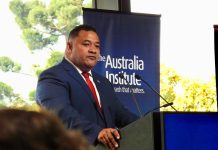
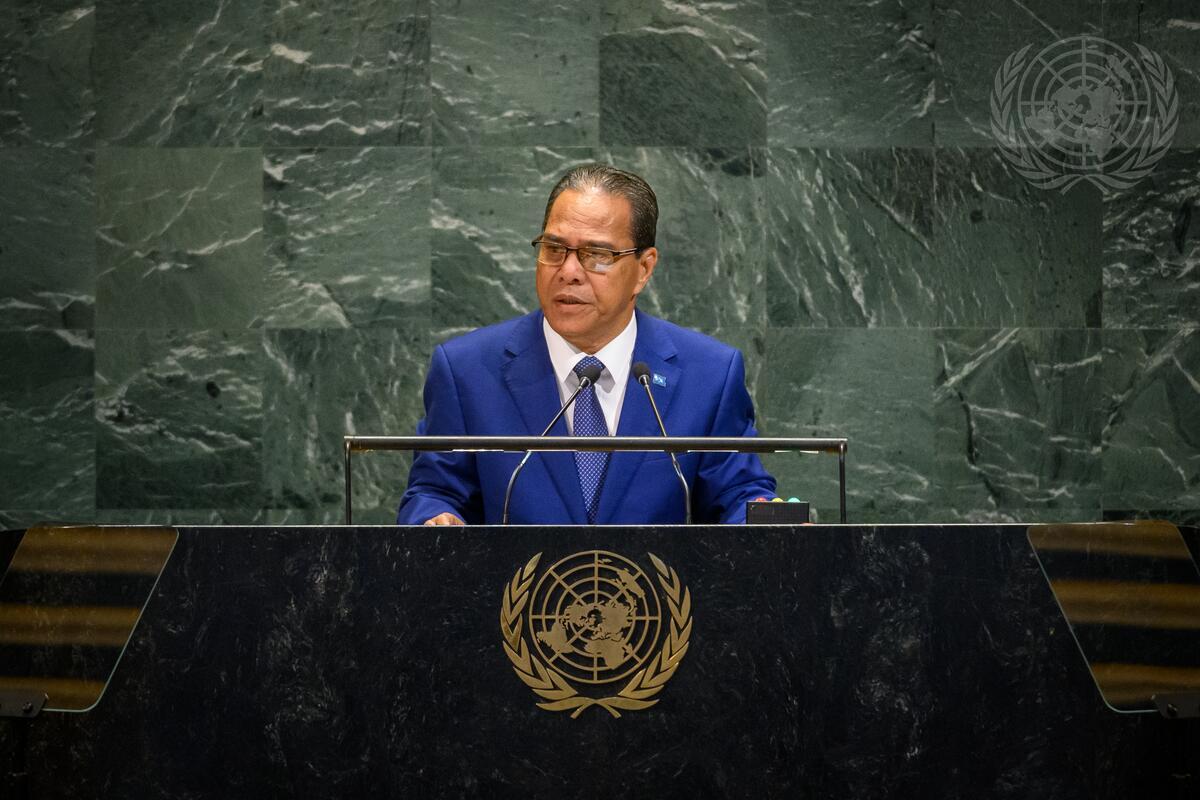
Federated States of Micronesia (FSM) President Wesley W. Simina used his address at the 80th United Nations General Assembly last week to demand urgent climate action, stronger protections for oceans, and meaningful reform of the UN Security Council, warning that small island nations cannot continue to bear the brunt of global inaction.
“The climate crisis is not up for debate; the only question now is whether we as leaders will act with the urgency it demands,” Simina told world leaders.
He welcomed the International Court of Justice’s (ICJ) recent advisory opinion on climate change, stressing that it confirmed climate action is not only a “moral imperative, but also a legal one.”
“It affirms that all states, particularly those who are Parties to the UNFCCC and Paris Agreement, must do their fair share to limit warming to 1.5 degrees celsius and that major emitters carry the primary duty to act and keep 1.5 alive,” Simina said.
“It also underscores the obligation of developed countries to support the adaptation efforts of countries like mine who live with the impacts of climate change everyday.”
Simina urged the General Assembly to endorse the ICJ’s opinion.
“At the core of this climate crisis lies the pursuit of justice – justice for the most vulnerable, justice for future generations and justice for our shared planet.”
He also echoed the Pacific Islands Forum’s recent call to prioritise methane reduction.
“Cutting methane now could prevent 0.3 degrees celsius of warming by the 2040s, slowing ocean heating and buying us time for long-term decarbonization. This is the only scalable near-term solution that can protect vulnerable nations and peoples today.”
Looking ahead to COP30, Simina said it will be the first test of the ICJ opinion.
“After three decades of COPs, and now with the clearest pronouncements by the ICJ, let’s get to work.”
Turning to ocean issues, Simina said Micronesia remains committed to a “full lifecycle approach” in global negotiations on plastics pollution.
“This pollution—including climate warming greenhouse gases and thousands of other toxic chemicals—severely impacts our health, our environment and our economies. Despite the failure of the INC to produce a plastics treaty in Geneva, we are not giving up. The plastic pollution crisis is far too dire to ignore.”
He welcomed the upcoming entry into force of the High Seas Treaty (BBNJ Agreement) and reaffirmed Micronesia’s precautionary stance on deep-sea mining.
“We emphasise the necessity of consolidating comprehensive knowledge, data, and scientific understanding of the marine environment and the impacts of deep seabed mining before any exploitation takes place.”
Simina said coastal states, Indigenous peoples, and Pacific communities must be fully consulted before any seabed exploitation.
He urged the International Seabed Authority (ISA) to finalise its regulations before allowing mining to begin.
“Additionally, it is crucial that all stakeholders, including adjacent coastal states, Indigenous Peoples, and local communities in the Pacific, are consulted and their perspectives considered before any exploitation occurs.
“In Micronesia, we have taken steps in preparation for exploration and possible exploitation in a responsible manner. We urge the ISA to finalise without further delay all relevant regulations, standards, and guidelines for its Mining Code prior to any exploitation – as failure to do so risks countries turning to alternative measures,” said Simina.
On finance, Simina pressed for the adoption of the Multidimensional Vulnerability Index (MVI) to ensure small islands receive fairer access to international support.
“It recognises our economic, environmental, and social fragilities. The MVI provides a fairer framework for allocating resources. Development partners must base their aid decisions on it.”
The FSM leader said health challenges remain significant, citing non-communicable diseases and mental health concerns.
“We are investing in primary healthcare clinics, the development of our health workforce, and the use of telehealth to extend essential services to our most vulnerable and hard-to-reach populations.”
On peace and security, Simina reaffirmed the Pacific’s shared commitment under the Ocean of Peace Declaration.
“Today, as conflicts continue to unfold across the world, we hold hope that they may be resolved through leadership rooted in peace. In our own region, while we uphold peace and unity as guiding values, we find ourselves navigating the geopolitical and geostrategic competition among major powers.
“As Leaders of the Pacific Islands Forum, we recently adopted the Ocean of Peace Declaration at the 54th Annual Meeting in Honiara. In doing so, no single Member State can face the growing threats to peace and security alone. We must act together—as one Pacific family,” said Simina.
He also highlighted FSM’s support for responsible regulation of artificial intelligence, co-sponsoring the UN’s first AI resolution.
Domestically, Simina revealed that FSM had just declared a national state of emergency over an oil leak from a World War II shipwreck in Chuuk Lagoon.
“This ship, together with more than 60 other wartime wrecks, has rested in our waters for nearly 80 years. But now these remnants of conflict pose new dangers as toxic oil seeps into our ocean, threatening our fisheries, coastal communities, and livelihoods. The scale of this crisis far exceeds Micronesia’s capacity to address alone.”
He appealed for international assistance to address the threat.
“As we mark the 80th anniversary of the war’s end, we appeal to the international community to work with us in transforming this legacy of war into an opportunity for cooperation.”
Simina called for urgent reform of the UN Security Council to reflect 21st century realities.
“The exclusive nature of its permanent membership creates inequities and hampers effective responses to global crises. We must restructure the Council to include underrepresented voices, including Japan, India, Germany, Brazil and the African continent.”
Simina also reminded the Assembly of the founding principles of the UN.
“Eighty years ago, the United Nations was founded on a simple but enduring truth: every nation—big or small—has a voice, a vote, and a role to play in shaping the world we share.”
“Big or small, every nation has the duty to protect our planet from harm. Big or small, every nation has the responsibility to defend justice and human dignity. Big or small – we always have been, and always will be, ‘Better Together, he said.