
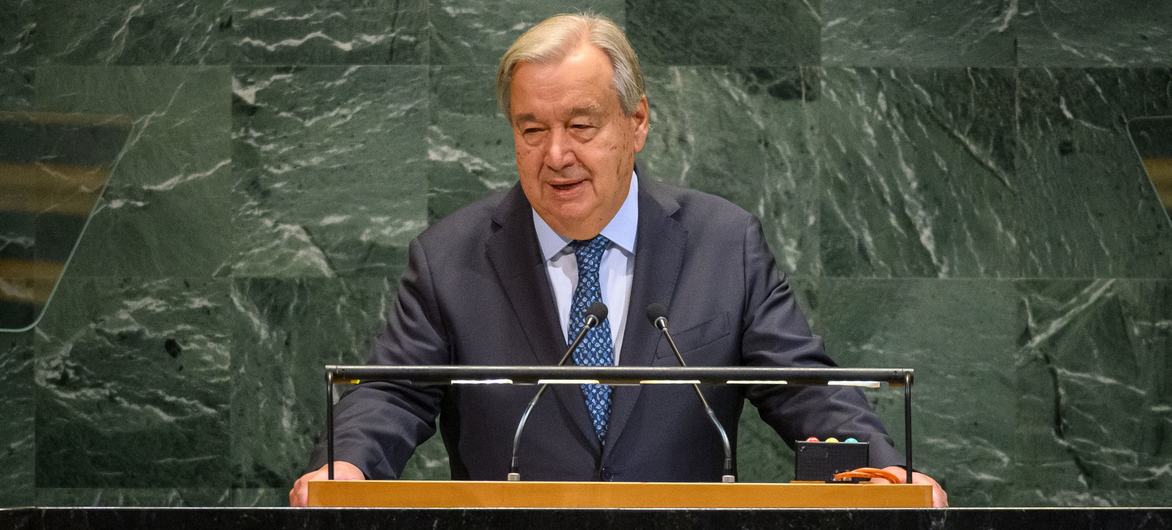
UN Secretary-General António Guterres has warned world leaders that the climate crisis is accelerating and urged governments to act with urgency.
“We must choose climate justice.”
“The climate crisis is accelerating. So are the solutions. The clean energy future is no longer a distant promise. It’s here. No government, industry, or special interest can stop it. But some are trying – hurting economies, locking in higher prices, and squandering a historic opportunity,” Guterres said in his address to the General Assembly.
He said fossil fuels were “a losing bet,” pointing out that almost all new power capacity last year came from renewables.
“Renewables are the cheapest and fastest source of new power. They create jobs, drive growth, shield economies from volatile oil and gas markets, connect the unconnected, and can free us from the tyranny of fossil fuels. But not at today’s pace,” he said.
The Secretary-General warned that clean energy investment remains uneven and that subsidies still heavily favour fossil fuels.
“Public subsidies – taken from taxpayer money – still flow to fossil fuels over clean energy by a factor of nine to one,” he said.
He stressed that those least responsible for the crisis were suffering the most.
“Science says limiting global temperature rise to 1.5 degrees by the end of this century is still possible. But the window is closing,” Guterres said.
He called on the G20 to lead on stronger national climate plans, adding that all countries must accelerate action ahead of COP30 in Belem, Brazil.
“By accelerating action in energy, forests, methane and industrial decarbonisation. By defining a credible roadmap to mobilise US$1.3 trillion annually in climate finance by 2035 for developing countries. By supporting just transitions. By doubling finance for adaptation to at least US$40 billion this year and rapidly deploying proven tools to unlock billions more in concessional finance. And by capitalising the Loss and Damage Fund with significant contributions,” he said.
Guterres urged governments, financial institutions, philanthropies, civil society and the private sector to work together.
“We have the solutions and tools. But we must choose climate justice and climate action,” he said.