


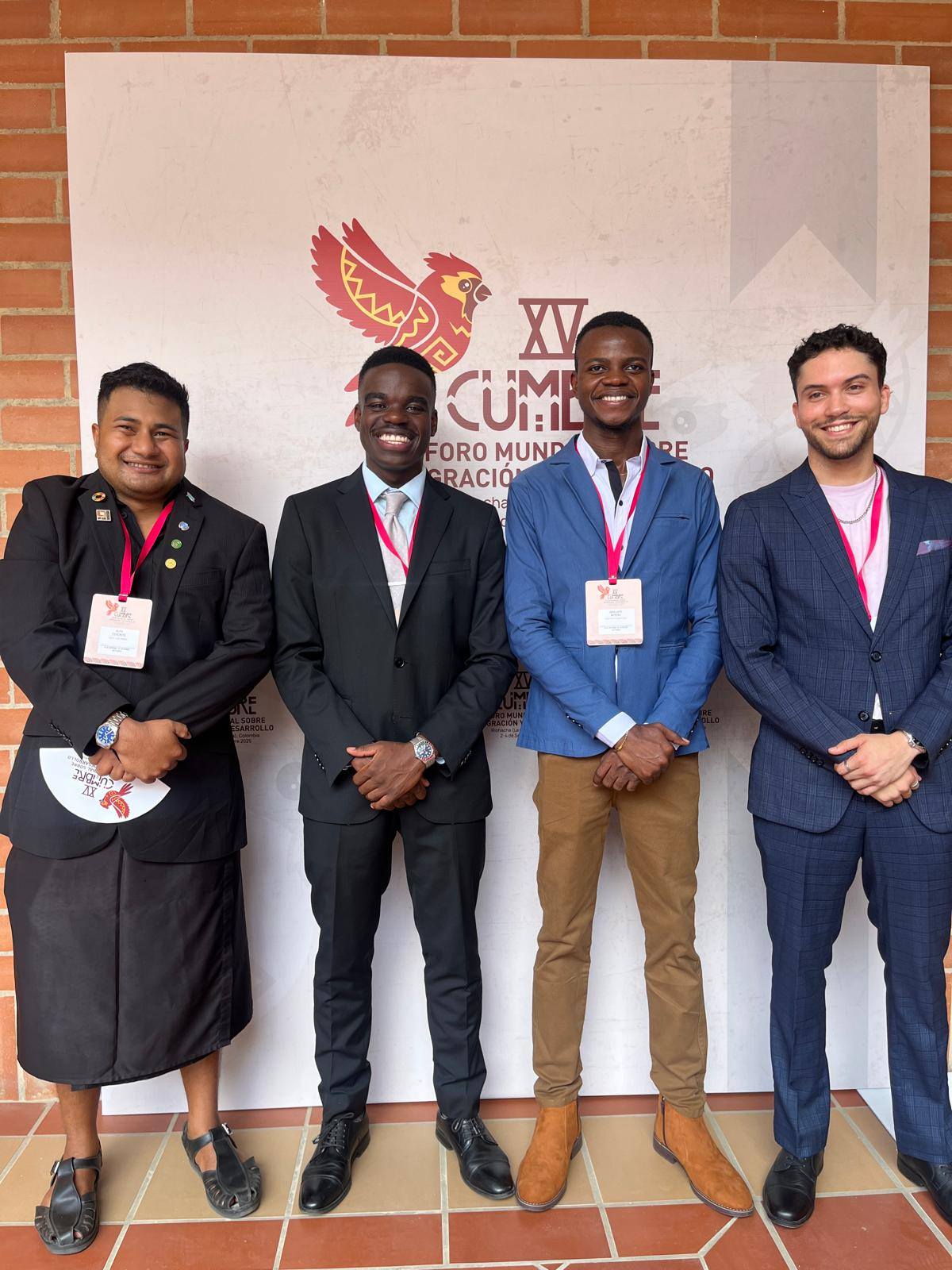
At the XV Global Forum for Migration and Development (GFMD) in Riohacha, Colombia, Pacific youth leaders delivered their strongest warning yet: the future of Pacific youth is under existential threat if decisive action is not taken immediately. Echoing the La Guajira Declaration, the Pacific delegation stressed that the region can no longer afford to lose its brightest generation to overseas labour markets while local economies stagnate and wages fail to reflect the true cost of living.
Speaking on behalf of the Pacific Youth Platform, Kuta Joseph Fonorito, a proud Rotuman and Banaban youth and community practitioner, declared: “The Pacific cannot continue to be a training ground for Australia, New Zealand, and the United States to poach our young people. Our governments must strengthen job security, raise the minimum wage, and stop holding back emerging generations. We need opportunities at home, not just pathways abroad.”
The crisis is undeniable. Between 2020 and 2025, youth unemployment across the Pacific averaged 23 percent, one of the highest rates globally. In Fiji, the figure remained at 18–20 percent, while Solomon Islands and Kiribati exceeded 30 percent. Meanwhile, youth unemployment in the United States is around 8 percent, with many states paying USD $15 or more per hour, compared to USD $23 in Australia and USD $16–20 in New Zealand. By contrast, Pacific youths at home scrape by on wages as low as USD $2.20 per hour.
This disparity has fueled a mass exodus. In just five years, over 45,000 Pacific workers have left for Australia and New Zealand under temporary labour schemes. While these programmes provide immediate income, they are devastating long-term development, creating a brain drain that undermines industries, empties villages, and fractures families.
But across the region, Pacific youth practitioners are going the extra mile to reverse this crisis. Broderick Mervyn, a renowned Pacific youth and community leader, has been at the forefront of professionalising youth work and championing policies that align with national development agendas. Josaia Tokoni, a proud iTaukei voice, has consistently advocated for indigenous rights and called out structural inequalities that perpetuate youth unemployment and drive migration. Rae Baenteiti, a Banaban leader, has highlighted the plight of displaced island communities, ensuring that the Pacific diaspora remains connected and heard on the global stage. Together with Fonorito, these practitioners represent a new generation of leaders who refuse to be silenced by tokenism.
For too long, youth representation has been treated as a box-ticking exercise—a seat at the table without the power to influence decisions. The Pacific youth leaders made clear in Riohacha that tokenism must end. Youth are not symbolic participants but drivers of real change, and their voices must shape policies on wages, employment, and migration.
The La Guajira Declaration insists that migration must be about rights, justice, and opportunity. For Pacific youth, this means ensuring that the right to migrate does not become the obligation to migrate. They must have the dignity of decent work and prosperity at home.
The Pacific delegation therefore demanded urgent action. Minimum wages must be raised to reflect the soaring cost of living. Sustainable jobs must be created in renewable energy, technology, agriculture, and cultural industries. Education-to-employment pathways must be guaranteed so graduates can serve their nations rather than leave them.
Fonorito underscored the urgency of this moment: “Our youths are not commodities to be exported. They are the backbone of our nations. If governments continue to deprive young people of fair wages and opportunities, the Pacific will face an even deeper crisis—social, economic, and cultural.”
The message was unflinching. The Pacific is facing a crisis of unemployment, tokenism, and mass migration, and leaders must either wake up to the reality or move aside to allow the leaders of today—the youth—to take charge, to be heard, and to implement the changes that are urgently needed.
As Fonorito concluded: “When I return home to Fiji, I will continue this affirmative action. The time has come. The Pacific can no longer wait—our youth deserve better, and they deserve it now.”
The message is no longer a plea but a demand. The Pacific stands at a crossroads: either invest in its youth and secure its future or watch that future vanish on one-way tickets abroad.