


By Pita Ligaiula in Honiara, Solomon Islands
The Pacific is closing in on finalising its maritime boundaries and securing permanent ocean entitlements, with regional leaders warned that delays carry real risks for sovereignty, fisheries, and food security.
Speaking at a side event in Honiara on finalising maritime boundaries and advancing 100 percent ocean management, Pacific Community (SPC) Director-General Stuart Minchin said the region is already setting the global benchmark.
“For more than two decades, SPC has been the technical custodian of the Pacific Maritime Boundaries Project, coordinating the settlement of maritime boundaries and Extended Continental Shelf submission,” Minchin said.
“Today, eight Pacific countries have adopted national ocean policies, and 75 percent of our shared maritime boundaries have been concluded through signed treaties – well above the global average of 60 percent.
The Pacific is leading the world in ocean diplomacy,” he said.
This year has seen major milestones. Tuvalu finalised its boundary treaty, strengthening fisheries management and community livelihoods. The Cook Islands secured a positive recommendation on its Manihiki Plateau submission, 16 years in the making. And three new Extended Continental Shelf (ECS) submissions were advanced to the UN in July.
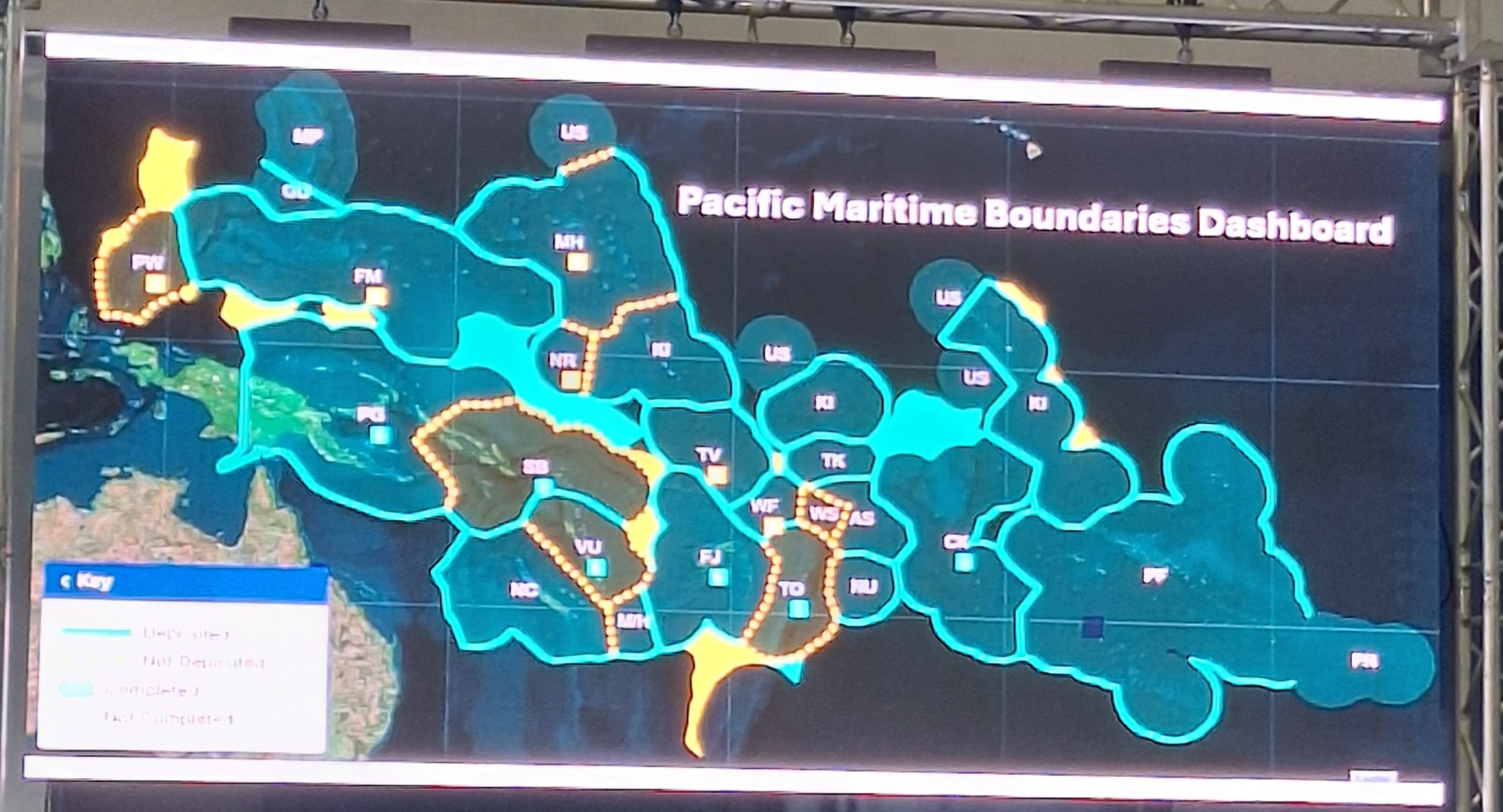
The launch of the Pacific Maritime Boundaries Dashboard was also announced Tuesday, a tool Minchin described as a “regionally owned authoritative tool that tracks maritime boundaries, ECS submissions, and National Ocean Policies. This ensures transparency, accountability, and a shared reference point for governments, negotiators, and partners.”
He stressed that boundaries are not symbolic lines but the “foundation for sustainable fisheries management, secure access to deepsea minerals and advancing 100 percent ocean management of the Blue Pacific Continent. Boundaries provide certainty for investors, underpin conservation zones, and secure sovereign rights. They are not abstract legal lines on a map – they are anchors for development, climate resilience, and food security.”
Minchin cautioned that unfinished boundaries undermine security and weaken Pacific resilience to climate change.
“Please allow me to remind you that delays carry risks. Outstanding boundaries leave gaps that undermine security, erode resource management, and reduce resilience to climate change,” he said.
He welcomed new financing under Unlocking Blue Pacific Prosperity (UBPP), supported by the Bezos Earth Fund, the Great Barrier Reef Foundation, Australia, and others, to help Pacific countries complete boundary work and strengthen ocean management.
“The recent ICJ opinion confirmed what Pacific Leaders declared in 2021: sea level rise does not strip states of their maritime rights or status,” Minchin said. “This strengthens our case but also reminds us of our obligations under the Law of the Sea Convention. Completing the remaining boundaries is not only a legal duty but also a climate action, effectively locking in our entitlements permanently and protecting our people’s rights and livelihoods.”
Minchin urged partners to maintain momentum and invest in the final stages.
“The Pacific has shown that collective action works. We are close to the finish line. Let us maintain the momentum, complete the remaining boundaries and ECS submissions, and support more countries to implement their National Ocean Policies.
SPC stands ready to continue providing the science, technical expertise, and people-centred facilitation that underpin this work – but it will require continued and increased investment. With the right support, the Blue Pacific Continent can show the world how regional solidarity delivers not only words, but enduring results for our people,” said Minchin.