

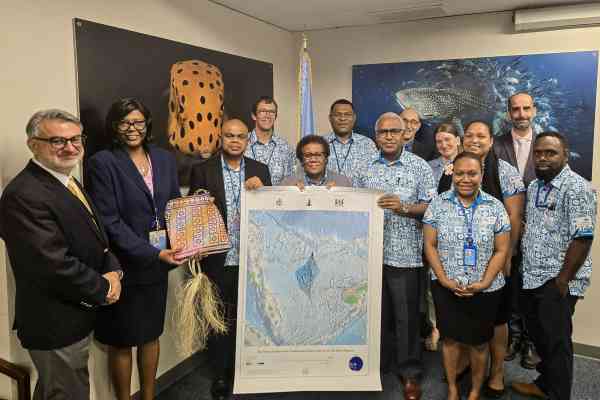
Fiji, Solomon Islands, and Vanuatu have today taken a major step to secure 453,400 square kilometres of shared ocean heritage.
The countries submitted three Extended Continental Shelf (ECS) submissions to the United Nations Commission on the Limits of the Continental Shelf (CLCS).
The submissions cover the North Fiji Basin (Fiji, Solomon Islands, and Vanuatu), the Melanesian Borderland Plateau (Fiji and Solomon Islands), and a national claim for the extended continental shelf (Fiji) of the Lau-Colville and Tonga-Kermadec Ridges.
International recognition is sought for seabed areas beyond 200 nautical miles under Article 76 of the UN Convention on the Law of the Sea (UNCLOS). They are crucial to securing Pacific sovereignty, protecting ocean resources for sustainable development, safeguarding entitlements against sea-level rise and ensuring clear jurisdiction for managing ocean spaces.
Establishing ownership of extended continental shelves and their resources is vital for the wellbeing and political stability of Pacific Island States. Until these “gaps in the world map” are closed, coastal States cannot fully protect their interests or effectively manage their ocean resources.
The Pacific Community (SPC), with support from a consortium of partners, has been instrumental in assisting countries with these submissions, which will ensure ownership of the extended continental shelf areas to unlock marine resources for economic growth, strengthen sovereignty, create jobs, and help safeguard the ocean for future generations.
“This is important for Pacific Island countries because it enables them to benefit from natural resources vital for marine conservation, climate resilience, and sustainable development,” said SPC’s Maritime Boundaries Advisor Malakai Vakautawale.
“These submissions align with global efforts to secure climate-resilient maritime boundaries that protect sovereignty and preserve entitlements against sea-level rise. They also support SDG 14, Biodiversity Beyond National Jurisdictions, and the vision of a thriving Blue Pacific Continent,” said Vakautawale.
Fiji’s Permanent Secretary for Foreign Affairs Dr Raijeli Taga, said the submission was about ensuring that ocean wealth supports national development and environmental protection. “This achievement is about safeguarding the future of our people. By securing these rights, we can ensure that the wealth beneath our ocean contributes to national development while protecting our marine environment.”
Solomon Islands Permanent Secretary for Foreign Affairs, Collin Beck, highlighted the importance of national sovereignty and community benefit. “This submission strengthens our sovereignty and our ability to manage ocean resources in a way that benefits every Solomon Islander, today and in the future.”
Vanuatu’s Head of Maritime and Ocean Affairs, Toney Tevi, reflected on what the joint effort means for Pacific solidarity. “Our ocean is the very foundation of our livelihoods, sustaining our communities and cultures. This collaborative effort exemplifies the powerful outcomes that can arise from Pacific unity. Together, we are committed to safeguarding the marine environments that nourish us and future generations.
The ECS submissions were made possible with support from the Pacific Community (SPC) Maritime Boundaries Programme, a multi-year initiative funded by the United Kingdom Government, in collaboration with regional and international partners, and technical consultancy provided by GeoLimits Consulting.
During the submissions, the Governments of Fiji, Solomon Islands, and Vanuatu expressed their deep appreciation to the United Kingdom Government for its generous financial support, which enabled this multi-country effort to succeed.
The submissions demonstrate Pacific leadership in global ocean governance and contribute to shared regional goals, including the 100 percent ocean-managed Pacific vision and Sustainable Development Goal 14.
The Pacific Community Pacific Maritime Boundaries Programme helps Pacific Island countries define, secure, and manage their maritime zones in line with international law. Through technical, legal, and diplomatic support, the program strengthens sovereignty, ocean governance, and sustainable development across the region. It operates as a regional partnership with national governments and international agencies, with funding support from partners including the United Kingdom Government.