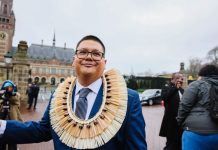
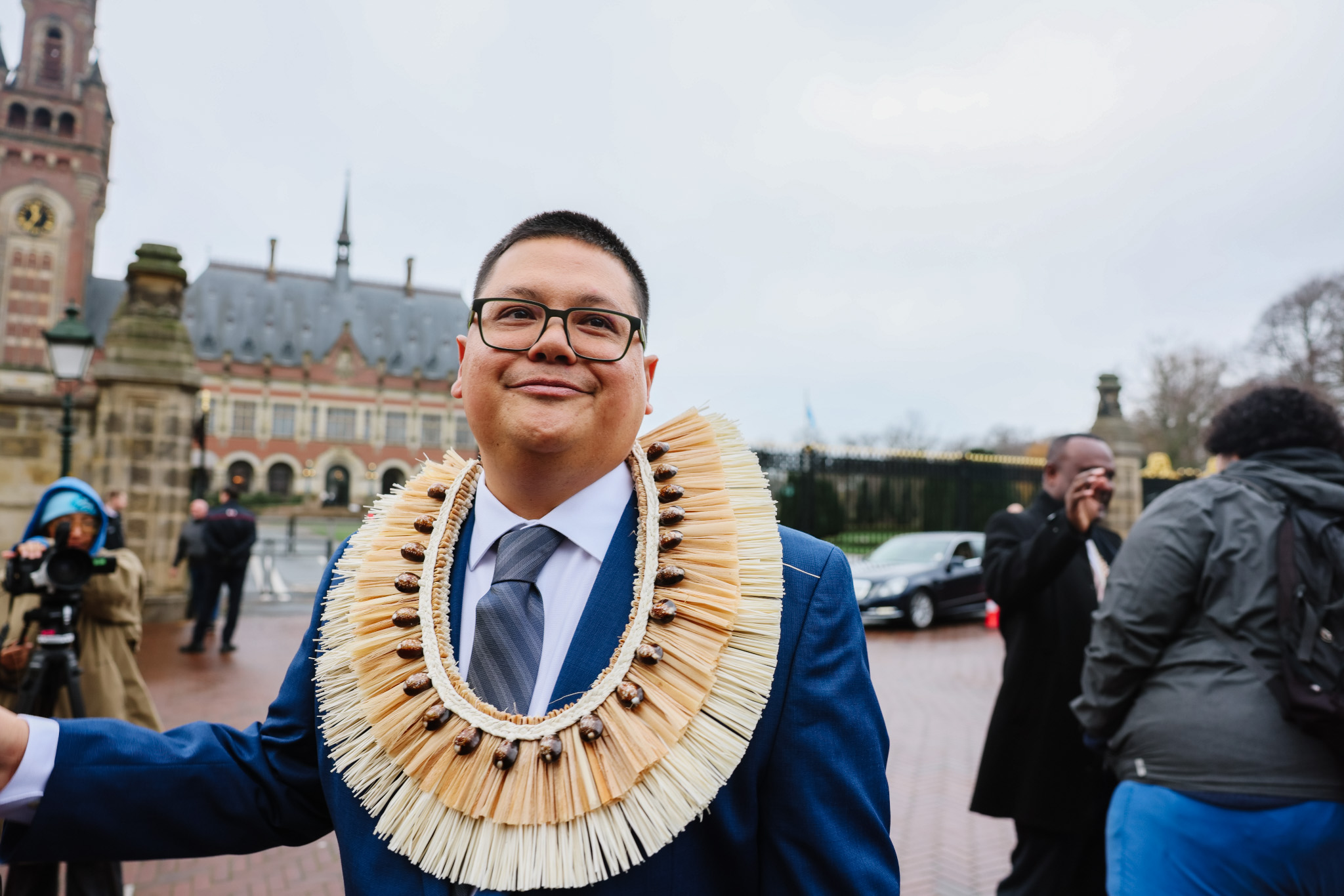
Climate change is destroying more than homes and livelihoods across the Pacific — it is eroding Indigenous cultures, disrupting ancient traditions and severing communities’ ties to their ancestral lands and oceans, says human rights lawyer Julian Aguon.
Aguon, an Indigenous Chamorro lawyer from Guam and founder of Blue Ocean Law, says the cultural and spiritual damage caused by climate change must be recognised as a human rights violation.
He was part of the legal team that represented Vanuatu in the campaign that led to the International Court of Justice (ICJ) issuing its landmark advisory opinion last year on states’ obligations to address climate change.
“Climate change is unraveling the very terms by which people know themselves and keep covenant with the natural world.
“In the ICJ case, we brought that to the court’s attention because these are rights violations of the highest order — violations of the right to life, the right to culture, the right to self-determination,” Aguon said.
Aguon said testimony gathered from communities across Vanuatu, Fiji and other Pacific island countries showed that climate change cannot be understood only through environmental or economic measurements.
“There’s no way to translate the urgency and gravity of the climate crisis other than via firsthand accounts of loss and damage, so we wanted to foreground vulnerable communities’ experiences.
“The harms aren’t just environmental,” Aguon said in an interview with Yale Environment 360.
In Yakel village in Vanuatu, Aguon said climate impacts on the yam crop have disrupted ceremonies that have been central to the community for generations.
“Some of the ceremonies haven’t been performed in years because there hasn’t been a successful yam harvest,” he said.
One of those ceremonies involves an elaborate four-day dance used to choose the village’s high chief.
“And they’re unable to perform this dance because of the yam’s absence,” Aguon said.
He said the loss of traditional practices was causing significant stress and threatening the transmission of cultural knowledge to future generations.
“These are cultures that have grown out of a particular piece of soil, they’re tied to their place and the life in it.
“So we’re talking about a massive rupture to culture and to cosmologies,” Aguon said.
Aguon also highlighted communities already being forced to relocate because of rising seas.
“In Veraibari, in Papua New Guinea, people have already moved four times due to sea level rise,” he said.
The community, located between a river and the sea, is now facing another climate-induced relocation.
“It’s one thing to talk about rising seas in terms of the numbers, but it’s something else entirely to hear what it means when you have to move four times, and you’re in the midst of a fifth and final climate-induced relocation,” he said.
Aguon said the relocation is particularly devastating because the community does not view the area simply as a place where people settled.
“According to their cultural teachings, it is one of the birthplaces of humankind.
“To be forced to keep moving and retreating from your ancestral homeland … the stakes could not be higher,” Aguon said.
Aguon said the ICJ advisory opinion has changed the legal landscape for climate action despite being technically non-binding.
“While it’s technically nonbinding in and of itself, the opinion is an authoritative statement of what the law really is,” he said.
The court considered states’ obligations not only under climate agreements such as the Paris Agreement and the UN Framework Convention on Climate Change, but also under international environmental law, human rights law and the Law of the Sea.
Aguon said the court’s finding that breaches of those obligations can constitute an “internationally wrongful act” gives communities and governments new legal tools.
“That dispels the ambiguity that has frustrated global progress,” he said.
“And most importantly, it said breaching those obligations is an ‘internationally wrongful act.’ That gives countries and communities new tools, and it has changed the legal terrain for this fight.”
He expects the opinion to influence a growing number of climate cases against governments and major corporations.
“Now we are seeing new waves of climate litigation that seek to really hold the powerful to account, be it a state or a corporation.
“And it’s going to be something that travels,” Aguon said.
Aguon said Indigenous leadership must be central to climate justice because Indigenous communities have approaches to the environment that challenge the idea that nature can simply be treated as a commodity.
“Indigenous peoples have a different imagination, and they have a lot to say about restoring the right relationship between people and planet,” he said.
“Indigenous peoples the world over share an absolute insistence on anti-commodification, the idea that not everything can be bought and sold.”
He said Indigenous communities understand human wellbeing as inseparable from the health of the natural world.
“We understand that our health and the health of the planet are inseparable, that humans are inseparable from the more-than-human world, and the health of one is the health of all,” Aguon said.
The same approach, he said, is increasingly shaping legal challenges over deep-sea mining in Micronesia.
Aguon said his firm is challenging efforts to expedite deep-sea mining in waters off American Samoa, the Commonwealth of the Northern Mariana Islands and Guam.
He said Indigenous communities have cultural and spiritual connections to ocean areas that could be affected by mining.
“Some of the sacred sites that way-finders have talked about forever in their chants include areas where the U.S government wants to allow deep-sea mining,” he said.
Aguon said those claims go beyond whether an agency has complied with environmental legislation.
“We’re saying something much deeper, that certain cultures depend on the health and integrity of the ocean, of the deep-sea environment, and to authorise deep-sea mining in these spaces violates several of their human rights, including the right to culture,” he said.
“What we were talking about earlier happening on land is also happening at sea.”
He said the challenge for modern legal systems is to recognise Indigenous knowledge and worldviews that predate the political structures imposed on the Pacific.
“How do you fit the worldviews and the traditional knowledge systems of ancient civilisations into categories that reflect only the last 200 years?.
“It’s almost an impossible task, but that’s what we need to do to get to where we need to go,” Aguon said.