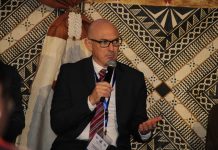


Pacific Economic ministers are looking beyond short-term responses to rising fuel prices and living costs, with Marshall Islands Finance Minister David Paul saying leaders are determined to find long-term solutions to the region’s dependence on imported fossil fuels.
Responding to a question on what concrete measures are being taken to lower food, fuel and shipping costs for ordinary families, Paul said the fuel crisis is affecting countries across the Pacific and requires a regional response.
Paul said Pacific countries have responded differently to the crisis, but all share a common challenge.
“I think the common denominator in all of this is because, number one, most of our energy sources in our economy depend so much on importation of that energy source,” he said.
The Forum Economic Ministers Meeting (FEMM) Chair said Pacific countries have often reacted to crises rather than preparing for them.
“Every time there is a crisis, we tend to react,” he said.
Paul highlighted the 2008 energy crisis, the COVID-19 pandemic and the current fuel shock as examples.
“When that crisis subsided, then everybody pretty much relaxed. Then the next crisis hit, which is the COVID. And then everybody mobilised so much resources to try to solve the problem. When the COVID was done with, we kind of back to business as usual. And then now this crisis.,” he explained.
He said ministers now recognise that future shocks could be even more severe.
“I think this time around, which all the ministers realise, that the next crisis is going to be twice or three times more severe than this one. So, you can see that there is a resolve among the members to really get to the bottom of it, come up with a concrete way forward to be able to make sure that when the next time comes around, we’re ready for it,” he said.
Using the Marshall Islands as an example, Paul said the government chose not to continue subsidising state-owned services but instead allowed operators to pass on costs while providing direct support to households.
“What the government did is rather than continue to subsidise the services, which is the electricity services, shipping and the air service, we thought that we allow them to pass through, meaning pass on the cost so that they themselves can continue to operate within the context of the market forces.”
“In the meantime, the government turns around and pump liquidity into people’s budget so they get able to absorb that increasing cost,” he said.
Paul said measures included tax relief, higher wages and income support.
“What we’ve done is we’ve cut taxes on the low-income earners. First US$8,320 of your income is tax exempt.”
“Number two, we increase minimum wage. Now, by 01 October, it’s going to be US$5 an hour.”
“Number three, we implemented the UBI or the Universal Basic Income and we top it off so it reached US$200 a week and continue to pump liquidity into families’ budget so they can be able to absorb that increase in cost,” he said.
Paul said those measures were only temporary solutions.
“The government thinks that this is only a bandaid solution. We have to come up with something that is going to wean us away from continuing to depend on that fossil fuel that continues to be our main source of energy,” he said.
He said discussions would continue on finding a permanent solution.
“We will continue to discuss this and come up with a way forward to address this issue once and for all.”
Forum Secretary General, Baron Divavesi Waqa said ministers had spent considerable time discussing the impact of the Middle East conflict on Pacific economies.
Waqa said rising fuel prices were affecting transport costs and livelihoods throughout the region.
“Not just on fuel, the cost of fuel and cost of transportation, livelihoods of our people are affected tremendously.”
The Forum SG said ministers reported that higher costs were making it harder for families to maintain a sustainable standard of living.
“These have continued to erode their ability to maintain a normal and sustainable cost of living,” he said.
Waqa said ministers focused on how Pacific countries could work together to ensure fuel supplies remain stable.
“How do we as a region work together to making sure that the cost of fuel, the supply of fuel is unaffected?”
He noted the Pacific’s heavy dependence on imported fuel. “As you know, the Pacific is one of the most vulnerable users or dependent on fuel that most come from Singapore.”
“So yes, the cost of fuel, because it’s affected, it affects the inflation of the cost of living in all of our island countries,” he said.
Waqa said ministers arrived at the meeting prepared to discuss the issue and exchange experiences and solutions.
“The ministers brought that with them, the concerns and to share experiences and best practices that they can share among each other,” Forum SG Waqa said.