
Papua New Guinea plans to increase its oil and gas production to supply its Pacific island neighbors and alleviate the burden shouldered by the fuel-dependent region due to the global crisis triggered by the war in Iran.
The recent agreement between the U.S and Iran to cease hostilities and reopen the Strait of Hormuz may have paved the way for oil price stabilisation, but island leaders noted that the volatility of global geopolitics underscored the need to enhance regional cooperation in building economic resilience.
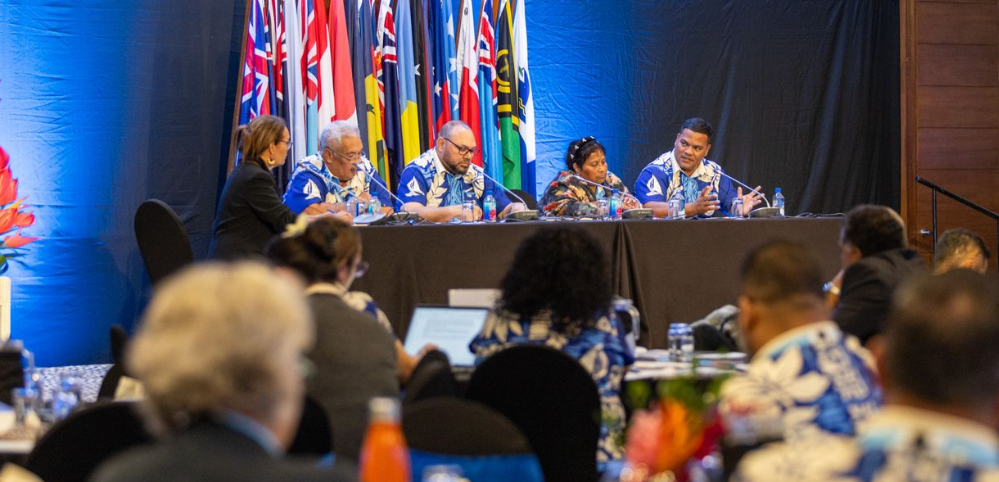
At the 2026 Pacific Peace and Security Dialogue in Suva, regional leaders tackled inflation and the surging cost of living that weighed on Pacific Islanders, resulting from the U.S-Iran war, which broke out in February.
Thomas Opa, PNG’s finance minister, said that, as a small producer of oil and gas, the South Pacific nation is also exploring strategies to assist smaller Pacific Island states, whose economic security is at risk.
“Our prime minister in the recent Pacific Energy and Transport meeting in Port Moresby indicated Papua New Guinea’s intention to build smaller refineries to not only support fuel security in storage tanks and fuel security in our country, but also how we can contribute to our smaller Pacific island countries,” Opa said.
Papua New Guinea’s oil exports, including crude oil and petroleum gas, are a major driver of the South Pacific nation’s economy, with petroleum gas leading in export value.
In 2024, PNG’s top oil-related exports included petroleum gas valued at approximately US $5.36 billion and crude petroleum at US$838 million. Its oil exports are primarily directed to China, Japan, Australia, South Korea and Taiwan.
Pacific island countries are highly vulnerable to disruptions in the oil sector due to their lack of domestic production and limited storage capacity.
According to the Centre for Strategic and International Studies, oil supplies around 80 percent of the Pacific’s total energy, with some countries relying on it for as much as 98 percent.
Most refined fuel in the Pacific comes from Singapore, Korea and Japan.
“Pacific island nations spend roughly 5 percent to 15 percent of GDP on net oil and gas imports, thus increasing oil prices combined with heavy oil dependency exacerbate already fragile economies and have the potential to massively increase national debt distress risk across the Pacific,” CSIS said.
“Papua New Guinea stands as an exception thanks to its role as a net exporter of liquified natural gas, where rising prices are poised to boost government revenue and planned LNG projects can become more attractive,” it added.
But even as an oil producer, PNG was not spared from the impact of the crisis.
“The increase in fuel prices has really affected not only the people on the mainland who will now buy more fuel at the bowser, but it also affects business and if the business is not growing, they cannot make a profit, they cannot employ people,” Opa said. “So, it has broader implications for the well-being of people. This is a concern that affects Papua New Guinea.”
PNG has instituted a fuel subsidy to alleviate pressure, but Opa said it is a temporary measure that does not offer a long-term, sustainable solution.
Simon Kofe, Tuvalu’s minister for transport and energy, said the global fuel crisis was “a wake-up call” to accelerate the transition to low or zero carbon.
“We do a lot of advocacies on the international stage, but what are we doing on the local level to achieve that transition?” Kofe asked. “It’s no longer just an environmental issue; it’s now become a security issue for us.”
Tingika Elikana, the Cook Islands’ foreign affairs minister, said regional security is tied to economic stability.
He attributed the Cook Islands’ economic growth to tourism and “15 years of unbroken political stability.”
“None of that stability comes from military capacity,” he said, noting the value of extending the definition of security beyond defence capabilities.
“If we take what’s happening around the world with the use of military power and might, then we can’t really stand up to these people. But what we have is economic stability and the need to stabilize for the resilience and further development of our countries,” Elikana added.
Charmaine Scotty, Nauru’s minister for Women’s and Social Development Affairs, suggested leveraging the Pacific islands’ human resources to create new opportunities.
“The Pacific’s greatest resource is not beneath our oceans or on our lands. It is our people: educating them, developing their skills, providing them with leadership, empowering our youth – must remain central to our economic agenda,” she said.