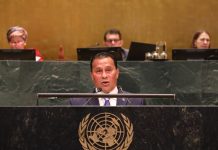
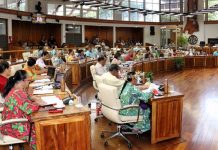
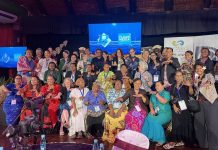
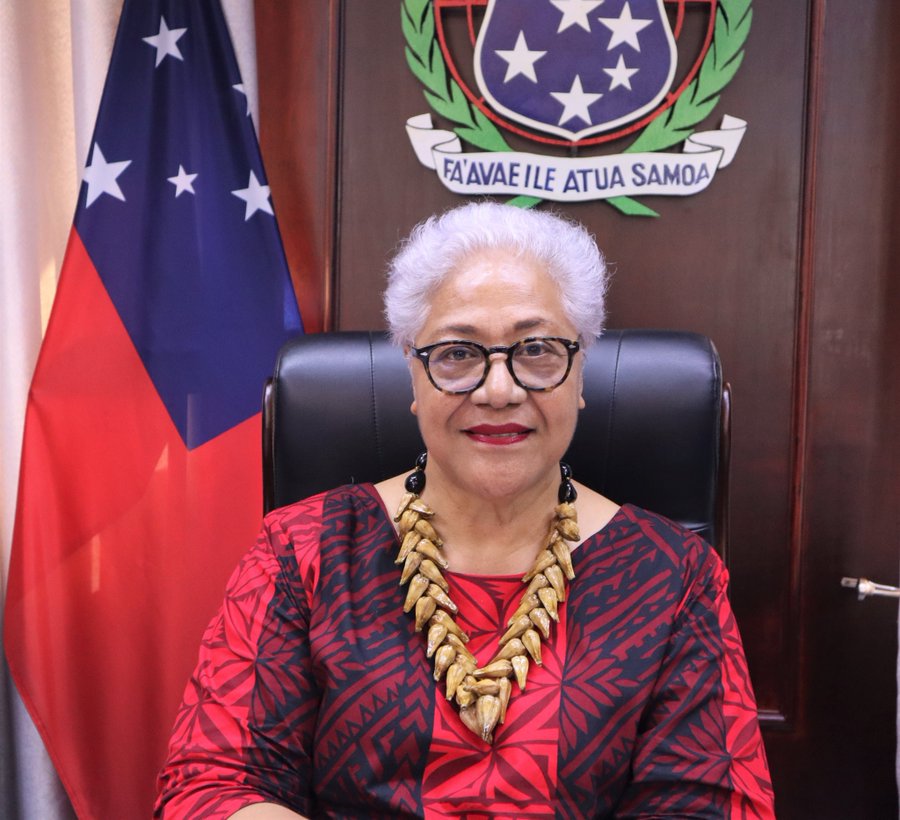
Former Samoa Prime Minister Fiame Naomi Mata’afa has challenged Pacific leaders and institutions to rethink development, warning that the region’s future depends on whether people can build meaningful lives at home.
Addressing the 2026 State of the Pacific conference at Australian National University (ANU), Mata’afa said the core issue is not migration, but whether staying remains a real option.
“When I first became Prime Minister, I was asked a question many leaders are asked: What is your vision? My answer was deliberately simple: “I want a Samoa where people want to stay — and where they have a stake.”
She made it clear that mobility has always been part of Pacific identity, but should not come at the cost of belonging.
“That statement was not a rejection of mobility. Movement and free mobility have always been part of Pacific life.”
“The true measure of nationhood is not whether people can leave, but whether they can imagine a future at home without feeling left behind,” Mataiafa said in her address in Canberra.
Drawing on her own experience, Mata’afa said migration has long been used to strengthen families, not abandon them.
“Before I entered politics, I was myself a product of this movement — a young Samoan who moved to Aotearoa New Zealand for education.”
She said today’s pressures are different, with global forces reshaping Pacific societies.
“But the context in which our nations operate has changed profoundly. Globalisation has compressed distance and time, geopolitics has intensified competition for influence, and digital connectivity has reshaped aspiration,” she said.
Mata’afa warned that development is too often reduced to economic indicators, ignoring the lived reality of families.
“Viability is too often discussed as a technical issue, measured in economic indicators and fiscal ratios. But viability is personal. It is shaped inside families and households, not in ministries.”
She said migration reflects deeper structural gaps, not a failure of Pacific nations.
“Migration is not a failure of nationhood; it is a signal, revealing where systems are unequal and where structural gaps remain.”
The former prime minister called for a rethink of economic models to ensure communities are not left behind.
“How do we build economies that generate meaningful livelihoods locally? How do we strengthen rural and outer-island communities so staying is a choice rather than a compromise?”
She said nation-building in the Pacific is an ongoing balance.
“Nation-building is ongoing — a negotiation between growth and belonging, mobility and rootedness, global opportunity and local responsibility.”
Mata’afa highlighted the importance of the Blue Pacific narrative in shaping regional identity.
“As Pacific scholar and ANU alumnus Epeli Hau’ofa reminded us, our ocean connects us rather than divides us.”
But she warned that small island states face real constraints that must be acknowledged.
“Pacific states are small. Our populations, economies and institutions are limited, carrying immense responsibility with constrained capacity.”
“Smallness is not our weakness; denying it is.”
She said rising geopolitical competition and climate threats are narrowing policy space.
“Geopolitical competition narrows policy space. Climate change challenges the physical foundations of sovereignty — security, livelihoods, wellbeing and identity.”
In response, Mata’afa called for stronger regional cooperation and strategic partnerships.
“The response cannot be isolation. It must be agency exercised collectively and intelligently — through regional solidarity, strategic partnerships and values-based engagement.”
She also challenged universities to rethink their role in the Pacific.
“Research agendas should be co-designed with Pacific communities, institutions and scholars, grounded in ethical partnership rather than extraction.”
“Education systems must prepare students for global engagement while grounding them in Pacific histories, languages, values and Indigenous knowledge systems.”.
Mata’afa said decolonisation in research must go beyond rhetoric.
“Decolonisation is not a historical exercise; it is a living process that requires shifting power in knowledge production.”
“Pacific peoples must define research priorities, control narratives and benefit directly from academic work,” she emphasised.
She said the future of the Pacific will depend on whether people feel connected to home.
“The future of the Pacific will not be secured by borders, balance sheets or policy frameworks alone, but by whether our people can imagine a meaningful life at home, connected to place, culture and community.”
Mata’afa also emphasised unity and shared responsibility.
“One of my favourite Samoan proverbs — which has guided my leadership in the village, in government and in international settings — is O le mativa fa’afesaga’i.”
“When I say that I want a Samoa where people want to stay — and where they have a stake — I mean a Samoa where people feel there is something precious worth holding on to: their land, their language, their culture, their families and their future.”
“A stake is more than economics; it is belonging — the quiet but powerful commitment to protect what we love and to stand for one another, because our future is not built by those who turn away, but by those who face each other and stay,” said Mata’afa.