



Vanuatu is leading international efforts to secure a United Nations General Assembly (UNGA) resolution that would welcome and operationalise the landmark advisory opinion of the International Court of Justice (ICJ) on climate change, with negotiators aiming for adoption on 22 April.
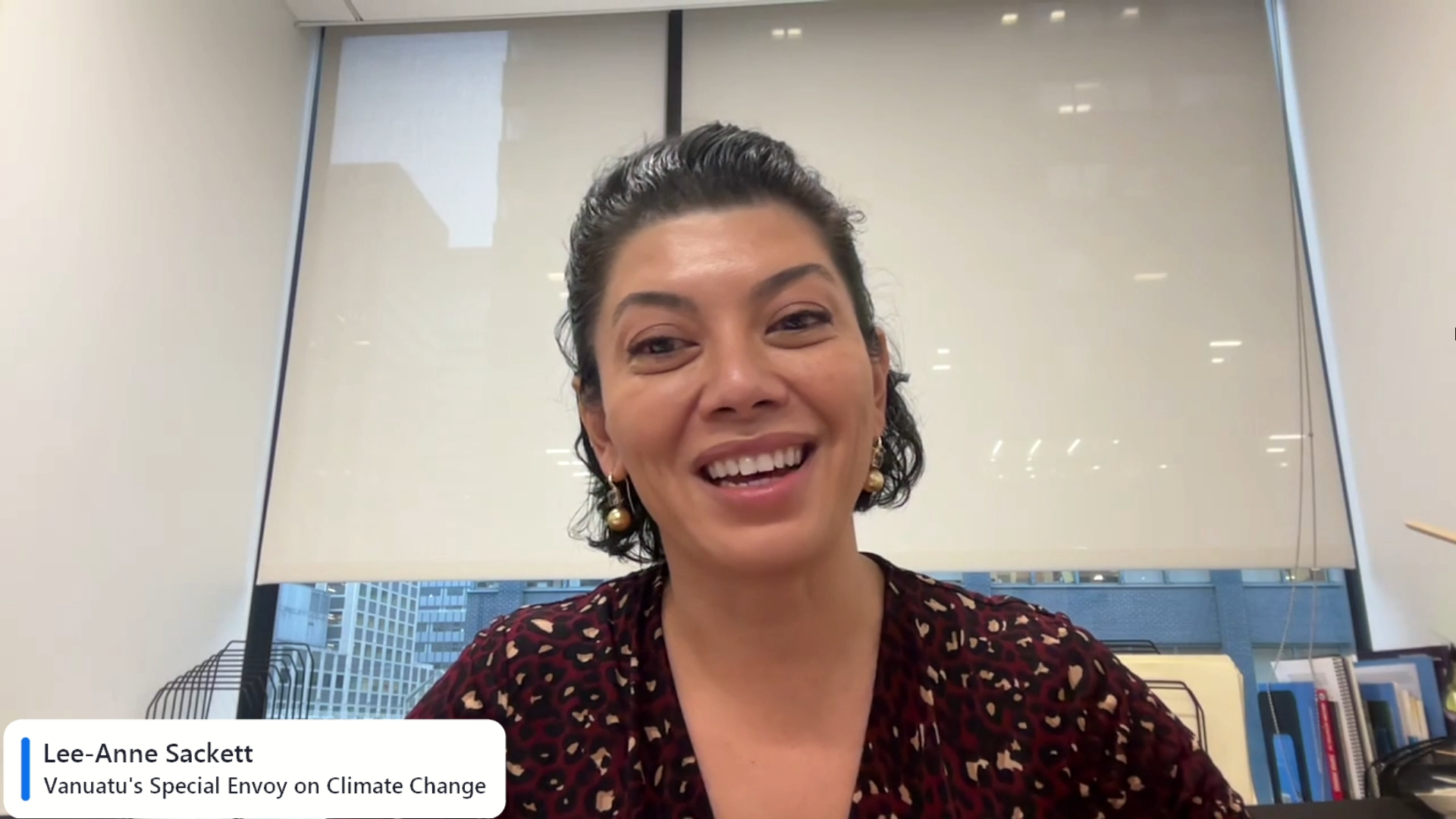
Speaking during a recent webinar, Vanuatu’s Special Envoy for Climate Change, Lee-Anne Sackett, said the resolution comes at a critical moment as climate impacts intensify for vulnerable nations.
“As many of you are aware, Vanuatu and many other small island developing states and other climate-vulnerable states are already living the consequences of climate change,” Sackett said.
“Sea level rise is also a big issue, and loss of land, culture and livelihoods are everyday lived experiences now for most communities. So, it’s really not seen as a future risk for us at this point in time, it’s a present reality.”
The ICJ advisory opinion, delivered in July last year following a request led by Pacific Island nations and youth advocates, clarified states’ legal obligations regarding climate change under international law.
Sackett said the ruling confirmed that climate change is not simply a policy challenge but a matter of justice and legal responsibility.
“Climate change is really not just a matter of policy, it’s a matter of justice, and it’s a matter of international law,” she said.
The court recognised that multiple areas of international law apply to climate obligations, including human rights treaties, the law of the sea and customary international law.
“The court recognised that states’ obligations in relation to climate change are owed to the international community as a whole,” Sackett said.
“It also confirmed that the rules of state responsibility apply, meaning states responsible for internationally wrongful acts will face legal consequences.”
The advisory opinion is now being brought back to the UNGA, which originally requested the ruling, to seek political endorsement and guide its implementation.
According to Sackett, the proposed resolution has three core objectives.
“The first and most fundamental objective, and the one that can’t be compromised on, is a full and unequivocal welcome of the advisory opinion,” she said.
“It’s historic in so many ways… from the consensus resolution adopted by the General Assembly in 2023 requesting the opinion, to the record levels of participation before the court, to the unanimous opinion delivered by the court.”
She said protecting the integrity of the court and the advisory opinion was particularly important at a time when multilateral institutions face growing pressure.
“It’s a critical time to be protecting international law and the rules-based order that we all operate under in international relations,” Sackett said.
The second objective of the resolution is to strengthen climate action by aligning state conduct with the obligations outlined by the court.
“The court has provided clarification of legal obligations not just under the climate treaties, but also under other areas of international law,” she said.
“So, it’s critical that we think about how states can now ensure they are fulfilling those obligations.”
The third objective focuses on advancing climate justice, particularly by addressing climate harm and state responsibility.
Sackett said Vanuatu had initially proposed establishing a register for climate damages alongside a mechanism for climate reparations.
“In the current political context, it’s a really tough fight,” she said.
“But we saw this architecture as a great opportunity for UN membership to explore.”
Negotiators are now considering a process-focused approach that would request the UN Secretary-General to examine options for such mechanisms.
Language relating to fossil fuels is also included in the draft resolution, although negotiations remain sensitive.
“Yes, there’s explicit language on fossil fuel,” Sackett said.
“Initially, we hoped for fossil fuel phase-out, but as you can imagine that is particularly sensitive.”
Alternative wording referring to a transition away from fossil fuels in line with the COP28 UAE Consensus is currently being discussed.
For the resolution to carry significant weight, Sackett said it must secure broad support from UN member states.
“What broad support looks like is not a simple majority of states supporting the resolution,” she said.
“We’ve seen in previous resolutions around advisory opinions about 130 states or even 150 states voting in favour.”
Negotiations are ongoing, with a revised draft expected to be followed by further consultations.
“The new date that we are proposing is the 22nd of April for the adoption of the resolution, which happens to be Earth Day,” Sackett said.
“So, fingers crossed we make it to that.”
Legal experts say the ICJ ruling has already reshaped the international legal landscape around climate responsibility.

Joie Chowdhury, Senior Attorney at the Centre for International Environmental Law, described the advisory opinion as a turning point.
“At a moment when climate devastation is accelerating worldwide and climate-destructive conduct too often escapes accountability, we recognise the ICJ’s climate ruling as historic,” Chowdhury said.
“The opinion provides a sound foundation to move beyond vague promises and voluntary pledges and ground climate ambition in legal obligation.”
She said the court clarified that states have binding duties under multiple sources of international law and confirmed that obligations to protect the climate system are owed to the international community as a whole.
The ICJ also found that failure to take appropriate action on fossil fuels could amount to a breach of international law.
“The failure of a state to take appropriate action to protect the climate system, including through fossil fuel production, fossil fuel consumption, the granting of fossil fuel exploration licences, or the provision of fossil fuel subsidies, may constitute an internationally wrongful act,” Chowdhury said.
The court also recognised that climate change threatens a wide range of human rights.
“It affirmed that climate degradation impairs numerous human rights, including the rights to life, health, food, water, housing and family life,” she said.
Chowdhury said the upcoming UN resolution would be key to translating the court’s legal findings into action.
“General Assembly resolutions responding to advisory opinions do more than simply welcome them, they operationalise them.
“What remains now is the political will to act on the court’s ruling, for the sake of the people today and for the generations yet to come,” she said.