


By Pita Ligaiula in Manila, Philippines
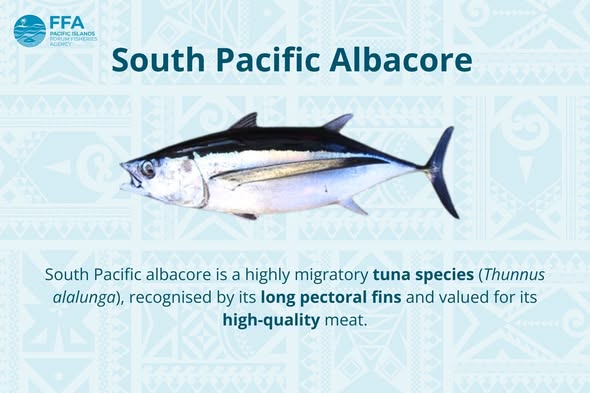
The Western and Central Pacific Fisheries Commission (WCPFC) must adopt a management procedure for South Pacific albacore this week or risk market consequences and weakening the Commission’s credibility, Executive Director Dr Rhea Moss-Christian told reporters in Manila.
Speaking at WCPFC22’s press conference in Manila, Dr Moss-Christian laid out the most significant conservation decision before the Commission — a rule that would cap how much albacore can be caught and begin the process of allocating catch among members.
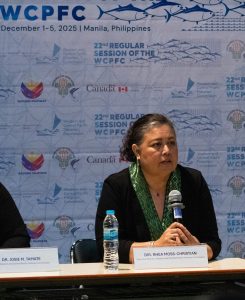 “The management procedure does limit the number of fish that can be taken in very simple terms,” she said.
“For the South Pacific albacore fishery, which is not in any biological trouble in other words, the stock is sustainable but economically, there’s a lot of value that could be added.”
She said members will decide how much albacore can be taken, then turn to how that catch is shared, calling it “the biggest conservation and management measure on the table this week.”
Beyond albacore, Dr Moss-Christian said the Commission is also reviewing limits for bigeye tuna and preparing next year’s work on yellowfin, as well as revisiting the skipjack management procedure.
“Those are the core management measures that are in place and under review,” she said.
Asked how many tonnes might be set under the new rules, she said: “There are many options on the table at the moment, and that will be the subject of negotiations this week.”
Pressed on how critical it is to approve the albacore management procedure this year, Dr Moss-Christian did not hesitate.
“Very critical. Very critical for the work of the Commission, especially with respect to the harvest strategies,” she said.
“South Pacific albacore is the target or the main one that needs to be adopted by this Commission meeting.”
She reminded media that the Commission’s own work plan required completion of the albacore strategy last year.
“It’s taking us this year to hopefully complete that work,” she said, noting bigeye and yellowfin are next.
Dr Moss-Christian also warned of concrete economic risks for Pacific fleets if the deal is delayed again.
“The implication of not adopting the management procedure this year is that the certifications for certain South Pacific albacore fleets might be at risk,” she said.
“It does call into question the Marine Stewardship Council (MSC) certifications that a lot of these fleets have and want to maintain.”
She stressed that while markets may not close, the loss or downgrading of MSC certification would have real commercial impacts.
She added that Pacific Island countries would feel the consequences most.
“A lot of these tuna fleets that target albacore are flagged to Pacific Island countries or in close partnership with Pacific Island countries,” she said.
“In the South Pacific in particular, those countries are heavily dependent on the South Pacific albacore fishery, more so than other fisheries,” she said.
As negotiations intensify, Dr Moss-Christian said the Commission must stay focused on completing the harvest strategy work that members committed to more than a decade ago.
“We’ve done skipjack, Pacific bluefin and North Pacific albacore,” she said.
“South Pacific albacore is the one for this year,” Dr Moss-Christian said.