


By Pita Ligaiula in Manila, Philippines
The Marshall Islands has told the Western and Central Pacific Fisheries Commission (WCPFC22) that its decisions have direct consequences for the country’s security, economy,
and long-term survival, calling for stronger action on SIDS rights, transshipment reform, and South Pacific albacore management.
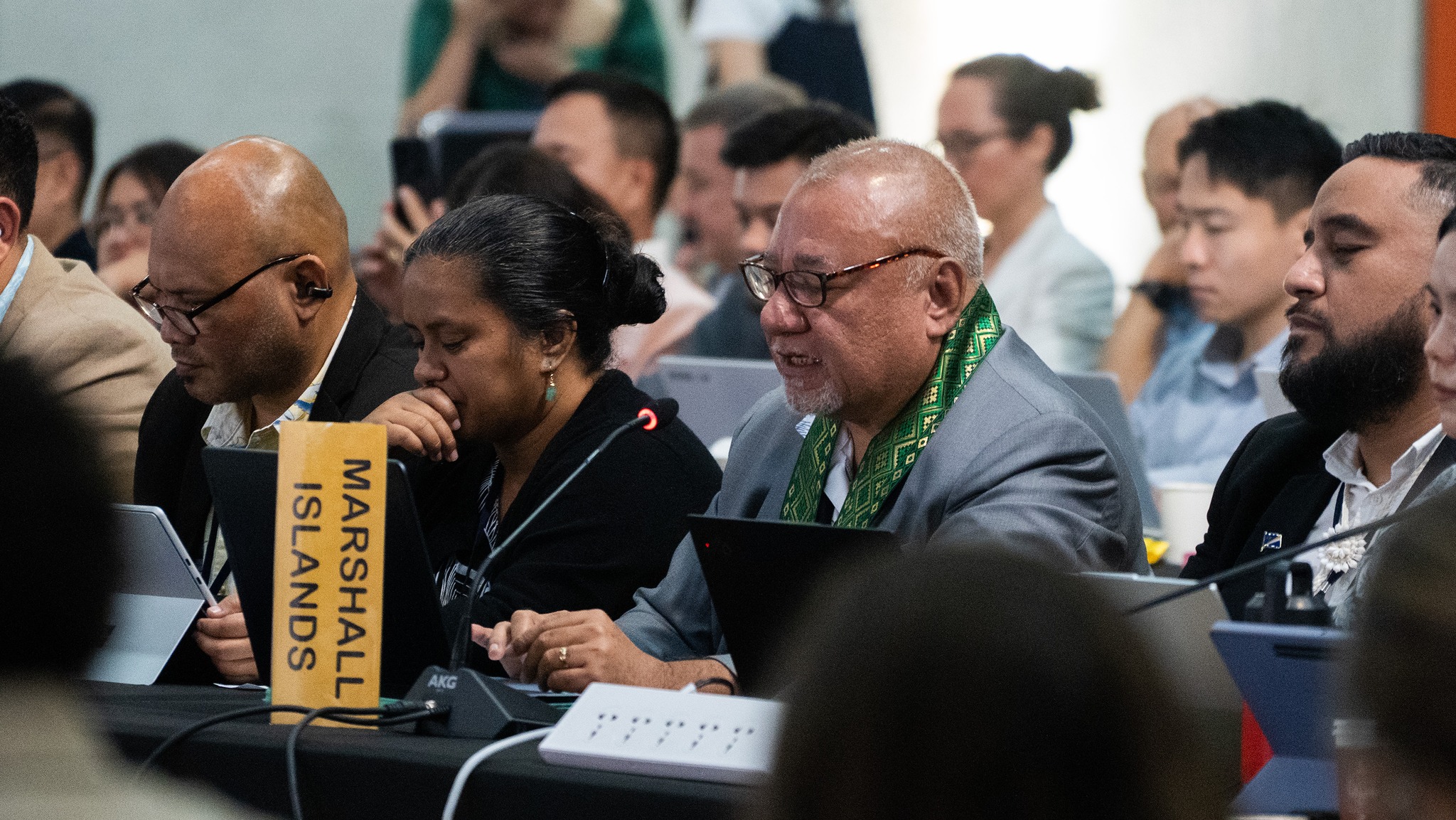
“It is an honour to deliver these remarks on behalf of my Government and the people of the Marshall Islands—people whose daily lives, economic aspirations, food security, and long-term development are inseparable from the health and sustainable governance of our tuna resources,” said Anthony M. Muller, Minister of Natural Resources and Commerce and Chair of the MIMRA Board.
Muller said the Marshall Islands approaches the session “with clarity of purpose and unwavering commitment,” adding that “our identity, prosperity, and security are tied to the ocean that surrounds us.”
He laid out three national priorities and urged Members to “deliver meaningful, future-focused outcomes.”
Muller stressed that Article 30 of the Convention is essential for SIDS participation in regional fisheries.
He said the ongoing assessment of CMM 2013-06 must:
• Reinforce obligations on capacity-building and technology transfer;
• Address the persistent and disproportionate compliance burdens placed on SIDS;and
• Safeguard the sovereign right of SIDS to develop and benefit from their fisheries.
“Article 30 is the platform upon which our engagement in this Commission stands,” he said, urging Members to act with “sincerity” and “fairness.”
Muller said strengthening CMM 2009-06 is a top priority, describing high-seas longline transshipment as “insufficiently monitored, inadequately verified, and highly vulnerable to exploitation.”
To “protect the integrity of this Commission,” he called for:
• A transition toward in-port or designated EEZ transshipment “under full monitoring and verification,” with only limited
high-seas transshipment where independent oversight is assured;
• Stronger and harmonised reporting aligned with FFA and PNA frameworks; and
• Mandatory 100 percent observer or electronic monitoring coverage on all carrier vessels.
“The Commission must rise to meet this progress,” he said.
Muller said South Pacific albacore is a “lifeline” for many Pacific economies, but SIDS longline fleets face “decliningprofitability, rising operational uncertainty, and real threats to their long-term viability.”
He urged the Commission to:
• “Improve management arrangements that support the economic viability and operational stability of SIDS-based
longline fleets;”
• “Advance a precautionary, science-based harvest strategy;” and
• Ensure SIDS’ long-term development needs are “embedded into every layer of the management procedure.”
A robust Management Procedure, he said, should become a benchmark for durable and equitable management.
Muller reminded delegates that for the Marshall Islands, the negotiations are not theoretical.
“These negotiations are not abstract—they are woven into our national security, our economic resilience, our cultural identity, and our very survival as an island nation,” he said.
He urged Members to “elevate the voices and needs of Small Island Developing States” and to “safeguard the resources that define our future.”
“The Marshall Islands stands ready to collaborate in good faith,” Muller said. “Let us ensure that WCPFC22 is remembered for unity, ambition, and decisive” action, he said.