



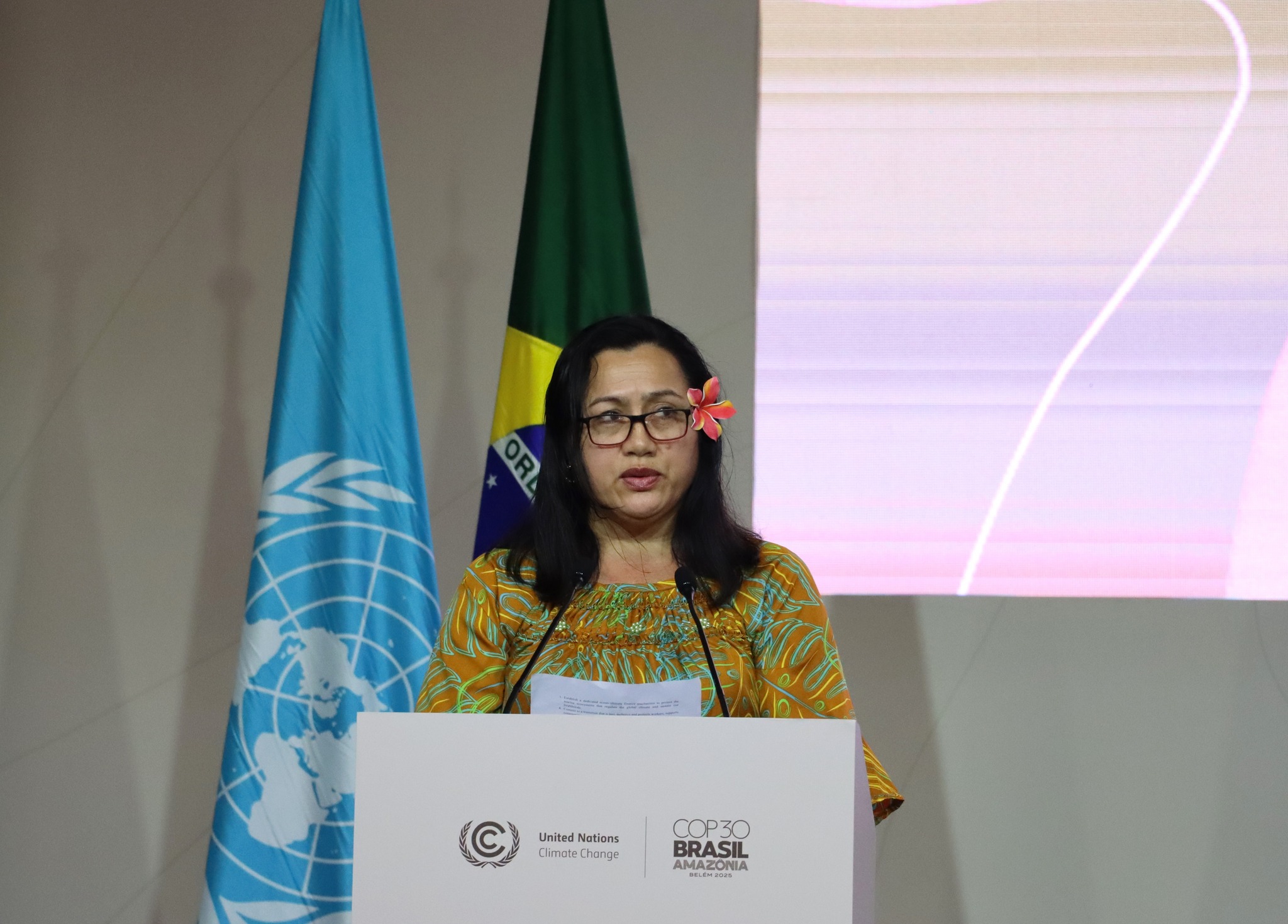
Kiribati has called on world leaders to urgently step up climate action and finance, warning that rising seas pose an existential threat to the Pacific island nation.
Speaking at the High-Level Segment of COP30 in Belém, Deputy Permanent Representative of Kiribati to the United Nations Josephine Moote emphasised the urgency of meeting the goals of the Paris Agreement on its 10th anniversary.
“We mark the 10th anniversary of the Paris Agreement here in Belém. We must show the world that multilateralism is alive and strong and that the 1.5 degree Celsius target remains the unshakable moral and scientific compass of our time,” Moote said, citing the latest IPCC report that highlights the accelerating climate crisis.
Moote highlighted the ongoing challenges of insufficient climate finance, weak enforcement, and political hesitation.
“Transitioning away from fossil fuel and mobilising the new collective quantified goal of at least USD$300 billion per year by 2035 remains unfulfilled. For Kiribati, climate change is not an unfolding story. It is a lived reality,” she said.
The representative described the human toll of climate change on Kiribati, noting how rising seas threaten heritage, livelihoods, and basic human rights, including access to clean drinking water and food.
“Each encroaching wave erodes our heritage, our livelihoods and disrupts our basic human rights,” she said, adding, “But we do not stand as victims. We stand with resolve.”
Moote outlined Kiribati’s development vision, aligned with resilience, sustainability, and justice, and called on COP30 to take bold action in four key areas:
* Keeping 1.5°C alive – critical for the survival of small island nations.
* Scaling up loss and damage funding – ensuring resources are more significant and predictable.
* Establishing a dedicated ocean climate finance mechanism – to protect marine ecosystems that regulate the global climate and support livelihoods.
* Committing to a just transition – protecting workers, supporting communities, and leaving no one behind.
She emphasised the urgent need to reform global climate finance systems, calling for simplified, fast-track access to funds.
“Complex procedures, high transaction costs, and delayed disbursements must be addressed,” Moote said.
She also referenced the recent International Court of Justice advisory opinion, which underscores that all states have an obligation to achieve deep, rapid, and sustained emission reductions, including fulfilling climate finance commitments.
Moote concluded with gratitude to Brazil for its leadership at COP30.
“We place our confidence in your stewardship to deliver a historic hope. One that transforms words into action and ambition into implementation.”
Kiribati’s appeal at COP30 highlights the continued struggle of small island states to secure meaningful climate action and financial support, as rising seas increasingly threaten their existence.