
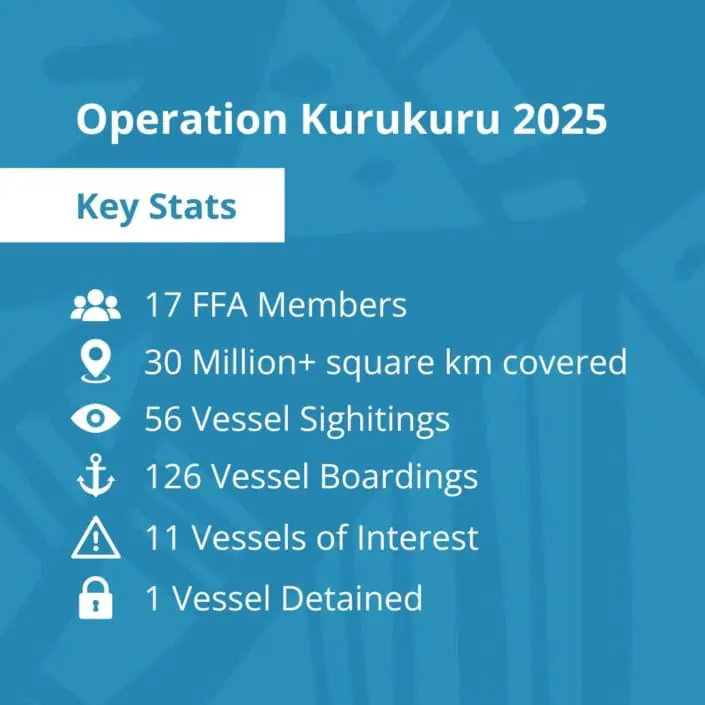
Pacific nations have covered more than 30 million square kilometres of ocean in a regional effort to detect and deter illegal, unreported, and unregulated fishing.
Over a three-week period from 13-31 October, Operation Kurukuru inspected 126 vessels, apprehended one on suspicion of offences, and identified 11 high-risk ships.
The operation involved 17 Forum Fisheries Agency (FFA) members and results were consistent with earlier regional operations this year.
FFA Director-General Noan David Pakop said the operation was an important milestone in delivering on the goals of the Regional Monitoring, Control and Surveillance (MCS) Strategy 2025–2029.
“Operation Kurukuru 2025 is more than just an annual surveillance exercise. It marks the first full-year implementation of our Regional MCS Strategy,” Pakop said.
“It demonstrates how policy commitments are being put into action through coordinated patrols, intelligence sharing and targeted enforcement. Our members are using data and technology more effectively than ever to protect their tuna resources.”
Kurukuru aimed to optimise compliance and strengthen fisheries enforcement across the Pacific.
Participating nations used targeted surveillance, intelligence-led planning, and modern maritime domain awareness platforms. These included Integration of satellite, electromagnetic and optical imagery through technology service providers.
The methods enhanced the detection of vessels operating without tracking signals and strengthened risk targeting.
Pakop said the steady detection rate and follow-up actions show the value of sustained regional coordination.
“These outcomes confirm that our approach to intelligence-driven operations is delivering real results. We are identifying high-risk vessels earlier and directing assets more efficiently, even across vast ocean areas,” he said.
There was a record participation of women in the coordination team, with 11 female secondees joining the FFA Regional Fisheries Surveillance Centre in Honiara.
The operation involved surface and aerial assets from the Cook Islands, Federated States of Micronesia, Fiji, Kiribati, Palau, Papua New Guinea, Samoa, Solomon Islands and Tonga, supported by aircraft from Australia, New Zealand, France and the United States.
It also included high seas coverage under the Western and Central Pacific Fisheries Commission (WCPFC) framework, with surveillance operations conducted by the French Navy, Cook Islands and FFA King Air aircraft.
During the operation, 13 daily intelligence briefs were produced, combining data from regional systems such as the FFA Regional Surveillance Picture, FFA Regional Information Management Facility and Starboard Maritime Intelligence platform to guide national headquarters and surveillance assets.
This ensured patrols were coordinated effectively despite weather disruptions and concurrent national commitments.
“Operation Kurukuru 2025 reinforces that monitoring, control and surveillance continues to be a key component of sound fisheries management in the region,” Pakop said.
“Our shared efforts are essential to keep our tuna resources sustainable and beneficial for all Pacific people,” he said.