

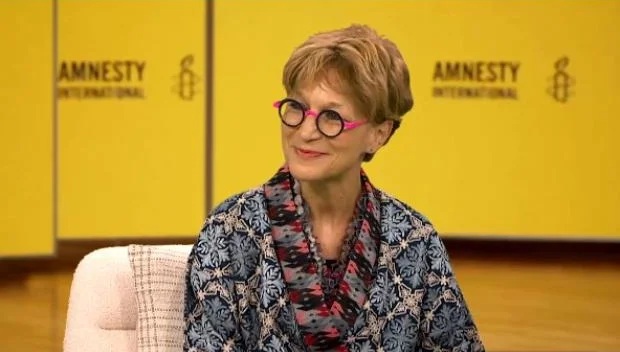
The global head of human rights organisation Amnesty International says New Zealand’s immigration policies are discriminatory and “ruthless” and failing to support the people on the front line of climate change.
Secretary General Doctor Agnès Callamard was in Aotearoa after visiting people displaced by climate change in Tuvalu and Fiji.
Amnesty International has called on the government to provide humanitarian visas to the people of Tuvalu, a small low-level Pacific atoll that is confronting a sea level rise.
Tuvalu’s nine islands are made up of small, thinly populated atolls and reef islands. It is widely considered one of the first countries likely to be significantly impacted by rising sea levels due to climate change and it is already making it more difficult for people to access fresh food.
It is also one of the poorest countries of the world, and according to science, it could disappear by the end of the century, Callamard said.
“Some percentage of its territories could disappear by 2050, and I want to reiterate the people of Tuvalu have had nothing to do with what’s happening to them.”
They want to live with dignity, Callamard said, and that is not happening right now under the scheme that has been devised by New Zealand.
That scheme is discriminatory, particularly against people with disabilities, and people with medical conditions so Amnesty International is calling on the government to provide humanitarian visas to the people of Tuvalu.
“Under the the visa, the migration path, people with disabilities, people with medical conditions and people that are above a certain age, including someone like me, cannot apply to come to New Zealand under that particular visa”.
We’re not talking about lots and lots of people, Callamard said.
“This kind of discrimination is ruthless. It’s taking dignity away from people and it will take so little for New Zealand to just be a little bit more rights-based with the industrialised nation of the world.”
She said it is the responsibility of the industrial industrialised nations to respond to what happened, including New Zealand.
“I think the the government of New Zealand should feel that supporting the people of Tuvalu, the government of Tuvalu, is part of or central to its contribution,” she said.
“New Zealand is part of the international community it is part of the industrialised nations. It has a very important farming sector which is a huge emission emitter and it must play its role.”
Callamard said commitments were made in Paris several years ago around Net Zero Emissions, around responding to climate change, and around supporting the people on the front line of climate change that have had nothing to do with causing climate change.
“By supporting the people of Tuvalu, New Zealand is doing a good thing for the rule-based order. I think New Zealand wants an international rule-based order, which means implementing your commitment, otherwise it will be the rule of the mighty, the rule of the powerful, and for small countries like New Zealand, this is not good news.”
The people of Tuvalu want choice, Callamard said. They don’t want to go, contrary to popular belief.
They want dignity in their life, and if they need to go, then they would like to go with dignity, and it means with their family, including if they have a disabled child.
New Zealand’s current visa settings are splitting these families.
“This kind of discrimination is ruthless,” she said. “When people have to choose between staying or being separated from their children, I think it is pretty ruthless.”
“Australia right now has just agreed a treaty with Tuvalu and an entire family can move and become resident resident of Australia overnight under this agreement. People with disabilities who are part of a family that has been processed and approved will be able to move too.”
She said she met with the Australian High Commissioner in Tuvalu and he explained that it is part of Australia’s commitment to the Paris Agreement.
Signed in 2015, the Paris Agreement laid out the plan to limit global warming below 2C.
“It is part of Australia’s commitment to ensuring that the people of Tuvalu have a choice with dignity. So, what we are asking. New Zealand has an even closer cultural, historical, economic relationship with Tuvalu, so please do the right thing.”
In a previous role, Callamard was the UN Special Rapporteur on extra judicial executions, the deliberate killing of a person without the lawful authority granted by a judicial proceeding, and she led a major investigation into the killing of Washington Post journalist Jamal Khashoggi by Saudi agents.